Article 77 vs Article 81 in Saudi Arabia: How OFWs Can Understand the Difference in Qiwa
Learn the difference between Article 77 and Article 81 in Saudi Arabia, how they work in Qiwa, and what OFWs should know before terminating a contract.
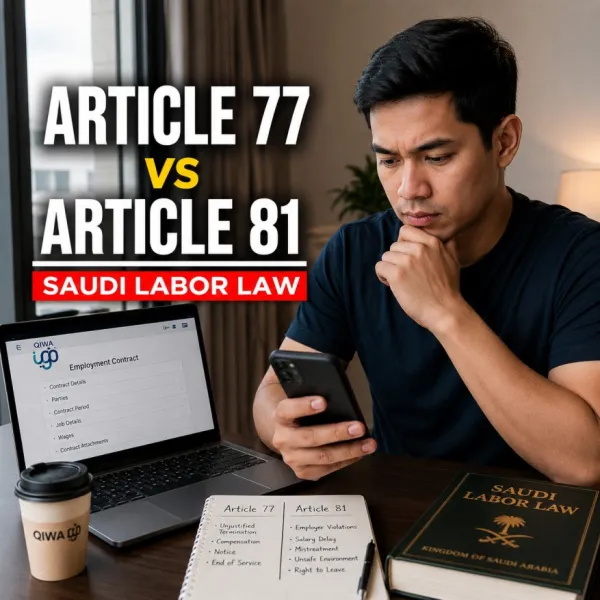
Article 77 vs Article 81 in Saudi Arabia
Introduction
Maraming OFWs ang nalilito kung kailan ginagamit ang Article 77 at Article 81 sa Saudi Arabia.
If you are working in Saudi Arabia and planning to resign, transfer employer, terminate a contract, or understand your rights in Qiwa, knowing the difference between Article 77 and Article 81 is important.
Many workers see these articles mentioned in discussions about contract termination, salary delays, employer violations, and labor complaints. However, some OFWs mistakenly believe that Article 77 and Article 81 are contract types inside Qiwa.
In reality, these articles are legal provisions under the Saudi Labor Law that may apply depending on the circumstances surrounding the termination of employment. According to the Saudi Labor Law published by the Ministry of Human Resources and Social Development (MHRSD), both articles address different situations involving employment termination and worker rights.
This guide explains how Article 77 and Article 81 work, how they relate to Qiwa, and what OFWs should understand before making employment decisions.
For additional Saudi labor guides, visit PinoyTalks and browse discussions at PinoyTalks Community Discussions.
Question from a Kabayan
“Kabayan tanong lang po paano po namin malalaman kung ung qiwa namin is under ng. Article 77 or under ng article 81”
This is a common question among OFWs.
In many cases, workers assume that their Qiwa contract is automatically classified as Article 77 or Article 81. However, Qiwa contracts normally show contract details, employment status, termination requests, and contract terms.
The application of Article 77 or Article 81 usually depends on the reason for termination and the circumstances surrounding the employment relationship.
For example:
- A worker resigning because of serious employer violations may claim Article 81.
- A worker terminated without a valid legal reason may raise concerns related to Article 77.
- A contract expiration may fall under entirely different provisions of the Saudi Labor Law.
This is why reviewing the actual situation is more important than simply checking the contract type.
What is Article 77 vs Article 81?
What is Article 77?
Article 77 deals with compensation when a contract is terminated for an illegitimate reason and there is no specific compensation clause in the contract. The law outlines how compensation may be calculated depending on whether the contract is fixed-term or indefinite-term.
According to the Saudi Labor Law:
- Indefinite contracts may involve compensation based on years of service.
- Fixed-term contracts may involve compensation related to the remaining contract period.
- Minimum compensation requirements may apply.
Article 77 is often discussed when a termination is considered unjustified or when one party ends the contract without a legally recognized reason.
What is Article 81?
Article 81 gives workers the right to leave work without notice while retaining their statutory rights if serious employer violations occur.
Examples listed under Article 81 include:
- Failure to pay wages.
- Failure to fulfill contractual obligations.
- Unsafe work environments.
- Severe mistreatment.
- Deception during hiring.
- Assignment of substantially different work without consent.
Article 81 is generally designed to protect workers when the employer commits serious violations.
How It Works in Saudi Arabia
Saudi Arabia's labor system now relies heavily on digital platforms such as:
Qiwa helps manage:
- Employment contracts
- Job offers
- Transfers
- Contract renewals
- Termination requests
However, Qiwa itself does not automatically label a worker as “Article 77” or “Article 81.”
Instead, labor circumstances, documentation, employer actions, worker actions, and dispute resolution processes determine which legal provisions may apply.
For example:
A worker whose salary has not been paid for several months may explore legal options under Article 81 if the circumstances meet legal requirements.
On the other hand, a worker who is terminated without a legally recognized justification may seek remedies connected to Article 77.
Readers can also explore related Saudi labor discussions through:
Important Saudi Labor Rules Related to the Topic
Article 77 Compensation Rules
The Saudi Labor Law provides compensation guidelines for unjustified contract termination. Compensation calculations differ depending on the contract type.
Article 80 Employer Termination
Article 80 allows employers to terminate employees without compensation under specific serious misconduct situations. These include fraud, assault, repeated violations, or other legally recognized grounds.
Many OFWs confuse Article 77 with Article 80.
The two articles are very different:
- Article 77 concerns compensation.
- Article 80 concerns termination due to serious employee misconduct.
Article 81 Worker Protection
Article 81 focuses on employee protection when employer violations occur. Workers may retain legal rights when leaving under valid Article 81 circumstances.
Common Problems OFWs Experience
Some OFWs experience confusion regarding:
Salary Delays
Workers often ask whether delayed salaries automatically qualify for Article 81.
The answer may depend on the actual circumstances, documentation, and legal assessment of the case.
Expired Iqama
Some workers face situations where the employer delays iqama renewal.
This may create employment concerns that require verification through official government channels.
Wrong Termination Assumptions
Some OFWs believe that selecting a termination option in Qiwa automatically grants compensation.
In reality, labor disputes often depend on evidence, employer responses, contract terms, and legal procedures.
Misunderstanding Contract Expiration
Contract expiration does not automatically mean Article 77 or Article 81 applies.
Saudi Labor Law contains separate provisions for contract completion and renewal.
Possible Scenarios and Options
Scenario 1: Employer Delays Salary for Several Months
A worker may investigate whether Article 81 circumstances exist.
The worker should gather evidence and verify available options through official labor channels.
Scenario 2: Employer Terminates Worker Without Clear Reason
The worker may review whether compensation provisions under Article 77 could become relevant.
Scenario 3: Contract Expired Normally
The situation may fall under standard contract completion procedures rather than Article 77 or Article 81.
Scenario 4: Worker Wants to Resign During Probation
Probation rules may apply instead of Article 77 or Article 81 depending on the circumstances.
Scenario 5: Worker Wants Employer Transfer
The transfer process may involve:
- Qiwa contract review
- Notice periods
- Contract status
- Employer approval requirements
- Labor law eligibility
Watch Full Video on Youtube:
[
)
Important Tips for OFWs
Keep Copies of Documents
Always save:
- Qiwa contracts
- Salary records
- Employer communications
- Iqama information
- Employment offers
Verify Through Official Platforms
Use:
Avoid Assumptions
Every labor case is different.
What applies to another worker may not automatically apply to your situation.
Understand the Difference Between Articles
A common misunderstanding is:
- Article 77 = compensation-related termination issues.
- Article 81 = worker protection from employer violations.
- Article 80 = serious employee misconduct cases.
FAQ Section
Can I transfer employer after contract expiration?
This may depend on contract status, Qiwa requirements, and current regulations.
Is Article 77 automatically shown in Qiwa?
Not necessarily. Article 77 relates to legal circumstances surrounding termination.
Is Article 81 automatic when salary is delayed?
Not automatically. Actual circumstances and evidence may affect eligibility.
Can I resign during probation?
In many situations, probation provisions may apply depending on the contract terms and labor regulations.
What happens if my iqama expires?
Workers should coordinate with employers and verify available options through official Saudi government platforms.
Is EOSB affected by Article 77 or Article 81?
End-of-service benefits may depend on the overall circumstances, service period, and applicable labor provisions.
Can Article 80 and Article 81 apply at the same time?
Generally, they address different situations involving employer and employee actions.
Conclusion
Kung nalilito ka sa Article 77 at Article 81, mahalagang maintindihan na magkaiba ang layunin ng dalawang provisions sa Saudi Labor Law.
Article 77 generally focuses on compensation related to unjustified contract termination, while Article 81 protects workers when serious employer violations occur. The actual application depends on specific circumstances, evidence, contract terms, and official labor procedures. Understanding these differences can help OFWs make more informed decisions regarding resignation, transfer, contract termination, and labor rights in Saudi Arabia.
You can also join the PinoyTalksKSA community to ask questions, share experiences, and learn from fellow OFWs working across Saudi Arabia.
Disclaimer
Disclaimer: This article is for informational and educational purposes only and does not constitute legal advice. Saudi labor rules, Qiwa procedures, Musaned policies, and government regulations may change over time. Readers are encouraged to verify information directly through official Saudi government platforms such as Qiwa, MHRSD, Absher, Musaned, and Najiz.