Marami ang nagtatanong kung mas naghihigpit ba ang Saudi Arabia sa pagprotekta sa mga manggagawa. A recent announcement from the Ministry of Human Resources and Social Development, or HRSD, highlights the Kingdom’s continued efforts to strengthen workplace compliance and worker protection.
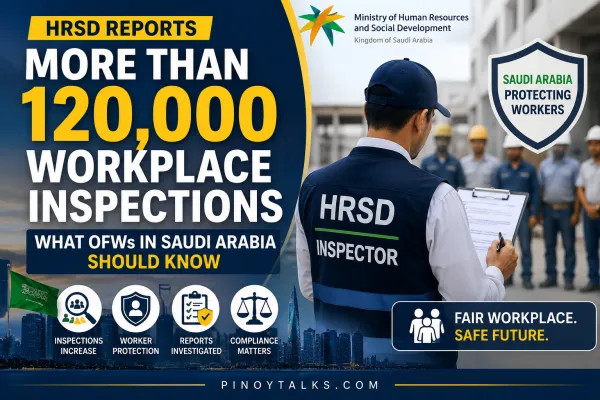
HRSD reports more than 120,000 workplace inspections in Saudi Arabia during Q1 2026, highlighting worker protection, labor compliance, and what OFWs should know about Saudi labor enforcement.
According to HRSD, authorities carried out more than 120,000 proactive workplace inspections during the first quarter of 2026 as part of initiatives to monitor compliance and identify possible indicators of forced labor and human trafficking.
During the same period, HRSD also reported receiving more than 1,600 suspected human-trafficking reports, which were referred to the competent authorities for review and investigation.
While this announcement does not introduce a new Saudi Labor Law, Qiwa rule, or employment policy, it reflects the government’s continuing enforcement efforts to protect workers and encourage employer compliance with existing regulations.
OFWs who want to understand the broader rules governing employment may also visit the Saudi Labor Law section of PinoyTalks.
Why Is HRSD Conducting Workplace Inspections?
HRSD stated that its enforcement efforts aim to:
- Monitor compliance with Saudi labor regulations.
- Detect possible indicators of forced labor or human trafficking.
- Support investigations involving reported labor abuses.
- Promote safer and fairer working environments.
- Strengthen protection for Saudi and expatriate workers.
- Hold establishments accountable for serious violations.
These inspections form part of Saudi Arabia’s broader efforts to improve labor standards and prevent workplace exploitation.
Inspections do not necessarily mean that every establishment visited has committed a violation. Authorities may conduct proactive inspections to check records, workplace conditions, wage compliance, employee documentation, and other regulatory requirements.
What Does This Mean for OFWs?
For most Overseas Filipino Workers who are legally employed and whose employers comply with Saudi regulations, this announcement does not directly change their salary, contract terms, Qiwa status, iqama, or employment benefits.
However, it serves as an important reminder that Saudi authorities continue to inspect workplaces and investigate reports involving potentially serious labor violations.
OFWs should regularly review the information registered in their employment records. For a detailed explanation of contract terms, salary, job title, duration, and notice period, read the complete PinoyTalks guide to Qiwa contracts.
Workplace Situations That May Require Attention
Depending on the circumstances, the following situations could warrant documentation or reporting through the appropriate official channels:
Repeated salary delays
An occasional administrative delay and a prolonged pattern of unpaid wages are not necessarily treated in the same way. Workers experiencing repeated or extended non-payment should preserve their bank statements, payslips, employment contract, and communications with the employer.
Read the related guide: What OFWs can do when salary is delayed for three months.
Withholding personal documents
Workers should keep copies of their passport, iqama, employment contract, work permit information, and other important records.
A dispute involving personal documents does not automatically constitute human trafficking. Its classification depends on the circumstances and the assessment of the competent Saudi authorities.
Threats, intimidation, or coercion
Serious threats or coercion intended to force a worker to continue working could require official attention, particularly when combined with unpaid wages, restricted movement, violence, deception, or other forms of exploitation.
Misrepresentation of the agreed job
A worker may discover that the actual salary, occupation, workplace, hours, or responsibilities are materially different from what was promised during recruitment.
Workers should compare their actual conditions with the employment information registered in Qiwa or Musaned and preserve copies of the original job offer.
Unsafe or abusive working conditions
Unsafe workplaces, severe mistreatment, physical violence, or persistent abuse should be properly documented and reported through the appropriate channels based on the circumstances.
Not every disagreement, contract dispute, salary concern, or employer violation constitutes forced labor or human trafficking. The competent Saudi authorities determine the proper legal classification after reviewing the facts and evidence.
The Difference Between a Labor Violation and Human Trafficking
It is important not to treat these terms as interchangeable.
A labor violation may involve matters such as:
- Delayed salary.
- Unpaid overtime.
- Contract discrepancies.
- Improper leave practices.
- Failure to provide an agreed benefit.
- Other breaches of employment requirements.
Human trafficking or forced labor generally involves more serious circumstances and indicators, which may include coercion, threats, exploitation, restriction, deception, abuse of vulnerability, or forcing someone to work against their will.
A worker should explain exactly what happened and submit the available evidence. The responsible Saudi authority will determine which rules or procedures apply.
In some serious employer-violation cases, workers may also want to understand Article 81 of the Saudi Labor Law. However, workers should not assume that Article 81 automatically applies without reviewing their circumstances and following the appropriate procedures.
Documents OFWs Should Keep
Proper documentation can help establish what happened if a worker later needs to submit a complaint or respond to an investigation.
Consider keeping copies of the following:
- Qiwa or Musaned employment contract.
- Original job offer.
- Passport and iqama.
- Work permit information.
- Salary payment records.
- Bank statements.
- Payslips.
- Attendance and overtime records.
- Employer emails or messages.
- Photos or videos relevant to workplace conditions.
- Medical reports involving a workplace injury or abuse.
- Complaint reference numbers.
- Written notices or termination documents.
Store copies in a secure personal account or device that you can access even when you are away from your workplace.
Use Official Saudi Platforms
OFWs should rely on official Saudi platforms when checking employment, residency, complaint, and visa information.
Important platforms may include:
- Qiwa for private-sector employment contracts and labor mobility services.
- HRSD for labor guidance, complaints, and employer compliance.
- Musaned for domestic-worker employment services.
- Absher for residency and visa-related government services.
- Najiz for services under the Ministry of Justice.
- GOSI for employment and social-insurance records where applicable.
For a practical overview, see the must-have Saudi government apps and platforms for OFWs.
Domestic workers should remember that Musaned regulations and procedures may differ from the rules applied to private-sector workers under Qiwa.
Avoid Rumors and Unverified Social-Media Claims
Major Saudi announcements are sometimes reposted with misleading headlines.
For example, some social-media posts may claim that:
- Every employer inspection means a violation was found.
- Every passport dispute is automatically human trafficking.
- A worker can immediately leave without following any procedure.
- New penalties have been introduced even when no updated penalty schedule was published.
- Filing a complaint guarantees transfer, compensation, or final exit.
These conclusions should not be assumed.
The HRSD report highlights enforcement and worker-protection efforts. It does not mean that every complaint will produce the same result or that every workplace dispute will be classified as forced labor or human trafficking.
Why This Matters to the OFW Community
Many Filipino workers ask whether Saudi authorities actively inspect workplaces and investigate employer violations.
The latest HRSD report indicates that proactive inspections remain part of Saudi Arabia’s worker-protection and compliance framework.
It also sends an important message to both employers and workers:
- Employers are expected to follow applicable regulations.
- Workers should understand their contracts and employment records.
- Serious concerns should be documented accurately.
- Complaints should be submitted through official channels.
- Public accusations should be avoided until the facts have been properly assessed.
For OFWs, staying informed and preserving employment records remain practical ways to protect themselves.
Final Thoughts
Ang pinakamahalaga ay manatiling updated at kumuha lamang ng impormasyon mula sa official Saudi sources.
HRSD’s report on more than 120,000 workplace inspections demonstrates the Kingdom’s continuing focus on labor compliance, worker protection, and the prevention of serious exploitation.
Although the announcement does not create new employment rights or change existing Qiwa contracts, it reinforces the importance of employer compliance and proper worker documentation.
Workers facing serious workplace concerns should describe the facts accurately, preserve available evidence, and follow the appropriate official procedures. The outcome and classification of any complaint depend on the circumstances and the determination of the competent Saudi authority.
Official Source
Saudi Press Agency: Human Resources Ministry Highlights National Efforts to Combat Human Trafficking
Disclaimer
This article is provided for general educational and informational purposes only. It does not constitute legal advice, legal representation, or a guarantee of any result.
Saudi labor regulations, Qiwa procedures, Musaned policies, and government services may change. Readers should verify information through official Saudi government platforms. The classification and outcome of any labor complaint or alleged violation rest with the competent Saudi authorities.
Stay Updated with the Latest Saudi OFW News
Don't miss important Saudi labor updates, Qiwa developments, iqama and work permit news, EOSB guides, and practical tips for OFWs.
👉 Join the PinoyTalks community today to ask questions, share experiences, and stay informed with verified updates based on official Saudi sources.
Visit: https://pinoytalks.com and become part of a growing community helping OFWs across Saudi Arabia.