Sick Leave in Saudi Arabia 2026: Article 117 Rules for OFWs and Expats
Learn Saudi Arabia sick leave rules under Article 117: 30 days full pay, 60 days at 75%, 30 days unpaid, dismissal protection, medical proof, and OFW rights.

Sick leave Saudi Arabia
May sakit ka at hindi ka makapasok sa trabaho sa Saudi Arabia?
Isa sa mga common questions ng OFWs ay:
“Bayad ba ang sick leave ko?”
“Ilang days ang full salary?”
“Pwede ba akong tanggalin kung matagal akong may sakit?”
“120 days ba talaga ang sick leave sa Saudi?”
For private-sector workers covered by the Saudi Labor Law, the main rule is found in Article 117.
Under the current law, a worker who can prove their illness may receive:
First 30 days — full pay
Next 60 days — 75% of pay
Following 30 days — without pay
These days may be continuous or intermittent during the applicable one-year sick-leave period. Importantly, that “one year” begins from the date of the worker's first sick leave, not automatically every January 1. You can verify the current wording directly through the official HRSD working conditions and leave provisions.
But sick-leave rights involve much more than simply counting 30 + 60 + 30 days.
Workers should also understand medical proof, annual leave overlap, dismissal protection under Article 82, what happens if you work for another employer while on sick leave, and the completely different rules that apply to domestic workers.
This guide explains those rules specifically for Filipino OFWs and other expatriate workers in Saudi Arabia.
What Does Article 117 of Saudi Labor Law Say?
Article 117 gives a worker whose illness is proven the right to sick leave during a one-year period.
The entitlement is divided into three stages:
Sick Leave Period | Salary Entitlement |
|---|
First 30 days | 100% pay |
Next 60 days | 75% pay |
Following 30 days | No pay |
Total statutory period | 120 days |
The official HRSD provision states that these sick-leave periods may be continuous or intermittent.
This means you do not necessarily need to be sick for 120 straight days.
You may use qualifying sick-leave days at different times during the applicable sick-leave year.
First 30 Days: Full Salary
For the first 30 days of proven sick leave, the worker is entitled to full pay.
Example:
Suppose your monthly wage is SAR 3,000 and you have a medically supported illness requiring 10 days away from work.
Those 10 days fall within your first 30-day sick-leave entitlement and are therefore covered by the full-pay portion of Article 117.
If later during the same applicable sick-leave year you need another 10 qualifying sick days, you would generally have used 20 out of the first 30 full-pay days.
Article 117 allows the leave to be intermittent, so separate qualifying absences can count toward the same statutory entitlement.
Next 60 Days: 75% of Pay
After the first 30 sick-leave days have been exhausted, the next 60 days are paid at three-quarters of the worker's wage, or 75%.
For example, if your relevant wage is SAR 3,000 per month:
75% of SAR 3,000 = SAR 2,250.
The actual payroll calculation should still follow the applicable wage and payroll rules, so use this only as a simple illustration.
This second sick-leave stage can extend the worker's paid sick-leave protection considerably beyond the first month.
Final 30 Days: Unpaid Sick Leave
After exhausting the first 30 days at full pay and the next 60 days at 75% pay, Article 117 provides another 30 days without pay.
That brings the statutory sick-leave structure to:
30 + 60 + 30 = 120 days.
But it is important not to call all 120 days “paid sick leave.”
Only the first 90 days carry statutory wage entitlement under the Article 117 structure:
30 days at full pay and 60 days at 75%.
The final 30 days are unpaid.
When Does the Sick-Leave Year Start?
This is one of the most important details in Article 117.
Many workers assume the sick-leave allowance automatically resets every January.
That is not what the current Article 117 says.
The law defines the relevant one-year period as the year beginning from the date of the worker's first sick leave.
Example
Suppose your first qualifying sick leave begins on:
June 15, 2026.
Your Article 117 sick-leave year would generally be measured beginning from that first sick-leave date—not from January 1, 2026.
This matters when calculating how many full-pay, 75%-pay and unpaid sick-leave days remain.
Workers who use several separate sick leaves during the year should therefore keep a record of their first sick-leave date and all subsequent leave days.
Continuous vs Intermittent Sick Leave
Article 117 expressly allows qualifying sick leave to be either:
continuous, or
intermittent.
This means a worker could potentially use sick leave several times within the same statutory period rather than taking it all at once.
For example:
January — 5 qualifying sick days
March — 4 qualifying sick days
June — 10 qualifying sick days
These may count cumulatively toward the Article 117 entitlement during the applicable sick-leave year.
That is why employees should not assume each new illness automatically gives them another fresh 30 days at full pay.
The cumulative use of qualifying sick leave matters.
Do You Need a Medical Certificate?
Article 117 applies to a worker who proves their illness.
As a practical matter, medical documentation is therefore central to claiming statutory sick leave.
Saudi Arabia's Ministry of Health provides electronic access to issued sick-leave reports through the Sehhaty Medical Reports Service.
Once a sick leave has been issued by a doctor, the worker can review, share or print it through Sehhaty under Medical Reports.
This is useful for OFWs because you can keep electronic evidence of your medical leave instead of relying only on a paper document.
Keep copies of:
- the issued sick-leave report;
- medical reports or supporting records;
- your Sehhaty sick-leave record;
- messages sent to your supervisor or HR;
- attendance records;
- salary slips; and
- any warning or deduction issued because of the absence.
Saudi MOH has also warned workers against fake or forged sick-leave services promoted through unofficial accounts and has emphasized using official medical channels.
Can Your Employer Reject Your Sick Leave?
Article 117 does not give an automatic entitlement simply because an employee personally says they are sick.
The law specifically refers to a worker whose illness is proven.
Therefore, valid medical documentation is extremely important.
If you have a properly issued medical sick leave and the employer disputes it, keep the official record and request the reason for rejection in writing.
Avoid relying only on verbal discussions with your supervisor.
If you have concerns about what is written in your Saudi employment contract, you can also review the PinoyTalks guide Qiwa Contract Explained: Complete Guide for OFWs in Saudi Arabia.
Can Your Employer Deduct Your Salary During Sick Leave?
It depends on which stage of Article 117 you are using.
For qualifying Article 117 sick leave:
Days 1–30 → full pay
Days 31–90 → 75% pay
Days 91–120 → unpaid
Therefore, a reduction during the second period is not automatically an illegal deduction—the law itself provides only three-quarters pay for those 60 days.
Likewise, the final 30 statutory sick-leave days are without pay.
The important question is whether the employer is applying the correct stage and calculation.
If your employer is withholding wages outside the lawful sick-leave calculation or your entire regular salary is being delayed, also see the PinoyTalks guide Salary Delayed for 3 Months in Saudi Arabia: Legal Guide for OFWs.
Can an Employer Terminate You While You Are Sick?
This is where Article 82 becomes important.
Article 82 states that an employer may not terminate the worker's service because of illness before the worker has exhausted the sick-leave periods provided by law.
You can read the current official text under HRSD Labor Relations — Article 82.
This gives workers important protection.
For example, if an employee has a legitimate medically documented illness and is still within the statutory sick-leave entitlement, the employer cannot simply terminate the worker because the worker is sick before those statutory periods have been exhausted.
However, Article 82 should not be interpreted as blanket immunity from every possible form of lawful termination.
A separate contractual or disciplinary issue can involve different Saudi Labor Law provisions.
The specific protection in Article 82 concerns termination due to illness.
What Happens After All 120 Sick-Leave Days Are Used?
Article 82 expressly prohibits termination due to illness before the worker exhausts the sick-leave periods provided by law.
That does not mean that employment automatically ends on day 121.
The actual outcome after exhaustion can depend on factors such as the employee's medical condition, ability to perform work, employment contract and the legal basis relied upon by the employer.
Therefore, do not assume:
“Day 121 = automatic termination.”
If an employer wants to end the employment relationship after a prolonged illness, the exact reason and procedure still matter.
Can You Combine Sick Leave With Annual Leave?
Yes.
Article 82 specifically states that a worker has the right to request that their annual leave be connected with sick leave.
This can be valuable when an employee still needs recovery time after using sick-leave days.
For a full explanation of regular vacation entitlement, read Annual Leave in Saudi Arabia Under Article 109.
Under Article 109, workers generally receive at least 21 days of paid annual leave, increasing to at least 30 days after five consecutive years with the same employer.
What If You Become Sick During Annual Leave?
This is another important rule.
HRSD's official sick-leave guidance states that when qualifying sick-leave days overlap with annual leave, the annual leave is put on hold until the sick leave ends, after which the annual leave resumes.
Example
You are on a 20-day annual vacation.
On day 7, you become genuinely ill and receive an approved five-day sick leave.
Those five qualifying sick-leave days should not simply disappear inside your annual vacation.
Under HRSD's guidance, the annual-leave period is paused during the qualifying sick leave and resumes afterward.
This is why proper medical documentation is important even when you become sick while already on vacation.
What If Sick Leave Overlaps With Eid or an Official Holiday?
Saudi leave rules also address overlap between certain official holidays and sick leave.
HRSD guidance states that when statutory holiday days overlap with sick leave, the worker is entitled to full wages for those overlapping holiday days without considering the wage treatment otherwise applicable to sick-leave days.
This can become important if you are already in the 75%-pay or unpaid stage of your sick-leave entitlement when an applicable statutory holiday occurs.
Because leave-overlap cases can become payroll-specific, keep the official dates and payslips if you believe the company calculated the period incorrectly.
What If a Weekly Rest Day Falls During Sick Leave?
HRSD's sick-leave guidance also says an employee is not separately compensated for a weekly rest day merely because that rest day overlaps with sick leave.
This is different from some holiday-overlap rules.
Workers should therefore avoid applying the same compensation rule to every type of overlapping leave or rest day.
Can You Work for Another Employer While on Sick Leave?
No—not under the leave provisions covered by Article 118.
Article 118 states that a worker may not work for another employer during any of the leaves covered by that section.
This includes sick leave under Article 117.
Therefore, taking officially recognized sick leave from Employer A while working for Employer B can create serious problems.
Saudi Labor Law also generally restricts workers from working for other employers unless the applicable legal procedures are followed.
Do not treat statutory sick leave as permission to temporarily work somewhere else.
Sick Leave vs Work Injury: They Are Different
Ordinary illness under Article 117 should not be confused with a work injury or occupational disease.
A work injury has separate rules.
HRSD states that when a worker suffers a qualifying work injury or occupational disease, the employer has obligations concerning necessary treatment and related expenses. Separate compensation rules also apply to temporary incapacity resulting from a work injury.
Therefore:
Flu, infection, surgery or ordinary illness → may fall under Article 117 sick leave.
Injury caused by work or occupational disease → may involve the separate work-injury framework.
PinoyTalks should treat work injuries as a separate guide because the compensation and employer obligations are materially different.
Does Article 117 Apply to Filipino OFWs and Expats?
For expatriates working as employees in Saudi private-sector establishments and covered by the general Saudi Labor Law, Article 117 is relevant regardless of the worker being Filipino or another nationality.
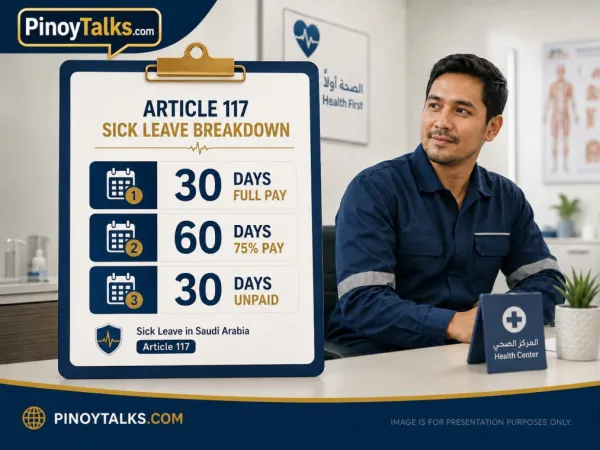
Article 117 of Saudi labor law
Your employment records and contract may normally be handled through Qiwa.
If you are unsure about your contract type, salary details, notice period or employment status, review the PinoyTalks Qiwa Contract Guide before making major employment decisions.
But there is one major exception OFWs must understand:
Domestic workers follow different sick-leave rules.
Domestic Workers: Sick Leave Is Different
If you are a domestic helper, household worker, private driver, caregiver or another worker covered by Saudi domestic-worker regulations, do not automatically apply the Article 117 30 + 60 + 30 formula.
Domestic workers have their own regulation.
Under Article 13 of the current domestic-worker leave rules, a domestic worker may receive up to 30 days of sick leave, continuous or intermittent, based on a medical report:
First 15 days — full pay
Next 15 days — half pay
The official rules are available through HRSD Leave and Healthcare for Domestic Workers.
The domestic-worker regulation also states that the employer may terminate the contract if the illness extends beyond 30 days, while requiring settlement of due entitlements and the applicable return-ticket obligation. It further states that the employer cannot terminate the domestic worker because of illness before the designated sick-leave period is exhausted, unless the worker requests termination in writing.
That is very different from Article 117.
Qiwa vs Musaned Sick Leave: Know Which Rule Applies
This distinction is critical.
Qiwa / Private-Sector Worker
Generally covered by Saudi Labor Law Article 117:
30 days full pay + 60 days at 75% + 30 days unpaid.
Musaned / Domestic Worker
Covered by separate domestic-worker regulations:
15 days full pay + 15 days half pay.
If you are a household worker and are confused why you do not see a normal company contract in Qiwa, read the Musaned Domestic Workers Complete Guide.
Using the wrong employment framework is one of the easiest ways to misunderstand Saudi labor rights.
What Should You Do If the Employer Refuses Your Sick Leave?
Start with documentation.
If you have a legitimate illness:
Obtain proper medical documentation.
Save the issued sick-leave record.
Send it to HR or the employer through a traceable channel.
Keep screenshots, emails or messages showing when it was submitted.
Review your payslip to see how the sick leave was calculated.
Ask for any rejection or deduction explanation in writing.
If the dispute cannot be resolved internally, consider the applicable HRSD complaint process.
For regular private-sector labor disputes, HRSD provides Friendly Settlement for Labor Disputes as the first stage of qualifying labor-dispute claims.
HRSD states that Friendly Settlement attempts mediation and, if no agreement is reached, a case may proceed toward the Labor Court according to the applicable procedure. The service specifically excludes workers classified as domestic labor.
Domestic-worker disputes follow a separate regulatory and dispute-resolution framework.
Evidence OFWs Should Keep
For any sick-leave dispute, keep:
- Qiwa employment contract;
- medical report;
- electronic sick-leave record;
- Sehhaty screenshots;
- company HR policy;
- attendance records;
- salary slips;
- bank salary records;
- written warning letters;
- emails or WhatsApp conversations with HR or the employer; and
- any termination notice received while sick.
The stronger your documentation, the easier it is to establish the dates, leave status and payroll treatment if a dispute occurs.
Frequently Asked Questions About Saudi Sick Leave
How many sick-leave days do I get in Saudi Arabia?
For a worker covered by Article 117, the statutory structure is up to 120 days during the applicable one-year period: 30 days full pay, 60 days at three-quarters pay and 30 days without pay.
Are all 120 sick-leave days paid?
No.
Only the first 30 days receive full pay. The next 60 receive 75% pay, and the following 30 are unpaid.
Does sick leave reset every January?
Not according to Article 117. The one-year period begins from the date of the worker's first sick leave.
Can the 120 days be separate sick leaves?
Yes. Article 117 says the leave may be continuous or intermittent.
Do I need proof that I am sick?
Yes. Article 117 refers to a worker whose illness is proven. Saudi MOH's Sehhaty system allows issued sick-leave reports to be reviewed, shared and printed electronically.
Can my employer fire me because I am sick?
Article 82 says an employer may not terminate a worker's service due to illness before the worker has exhausted the sick-leave periods provided by law.
Can I use annual leave after my sick leave?
Article 82 gives the worker the right to request that annual leave be connected with sick leave.
What happens if I become sick during annual leave?
Official HRSD sick-leave guidance states that annual leave is put on hold during qualifying sick leave and resumes after the sick leave ends.
Can I work somewhere else while on sick leave?
Article 118 prohibits workers from working for another employer during the leaves covered by that section.
Is domestic-worker sick leave also 120 days?
No. Domestic workers have a separate rule: up to 30 days based on a medical report, with the first 15 days fully paid and the next 15 days at half pay.
Related PinoyTalks Saudi OFW Guides
For more detailed Saudi employment guidance, you may also read:
Qiwa Contract Explained: Complete Guide for OFWs
Annual Leave in Saudi Arabia Under Article 109
Unused Leave Pay in Saudi Arabia — Article 111
Salary Delayed for 3 Months in Saudi Arabia
Musaned Domestic Workers Complete Guide
Final Takeaway
Kabayan, tandaan ang pinakaimportanteng formula for ordinary sick leave under Saudi Labor Law Article 117:
30 days — FULL PAY
60 days — 75% PAY
30 days — UNPAID
And these can be continuous or intermittent during the one-year period beginning from your first sick-leave date.
Article 82 also provides important protection: an employer cannot terminate your service because of illness before you have exhausted the statutory sick-leave periods.
But always remember:
Qiwa/private-sector rules and Musaned/domestic-worker rules are different.
Domestic workers generally follow the separate 15 days full pay + 15 days half pay sick-leave rule instead.
Most importantly, get legitimate medical documentation and keep copies of everything.
Do not rely only on verbal agreements with your supervisor.
May Saudi Labor Law Question Ka?
May sariling case ka tungkol sa sick leave, salary deduction, Qiwa contract, termination, transfer, EOSB or employer complaint?
Join PinoyTalks Ask the Community and post your situation.
Include your employment category, Qiwa or Musaned status, dates involved and what your employer told you so the community can better understand your case.
Official Saudi References
HRSD — Article 117 and Article 118 Leave Provisions
HRSD — Article 82 Labor Relations
Saudi Ministry of Health — Sehhaty Medical Reports
HRSD — Domestic Worker Leave and Healthcare
HRSD — Friendly Settlement for Labor Disputes
Disclaimer
This article is for general educational and informational purposes only and is not individualized legal advice.
Saudi Labor Law, implementing regulations, government procedures, platform requirements and individual employment contracts can affect the outcome of a specific case.
Workers should verify their current situation through official Saudi government platforms such as HRSD, Qiwa, Musaned and the Ministry of Health where applicable.
PinoyTalks is an independent informational platform and is not affiliated with the Saudi government.