Saudi Arabia says 1,360 collective-housing licenses now serve around one million foreign workers. Learn what the accommodation framework means for OFWs and companies with 20 or more workers.
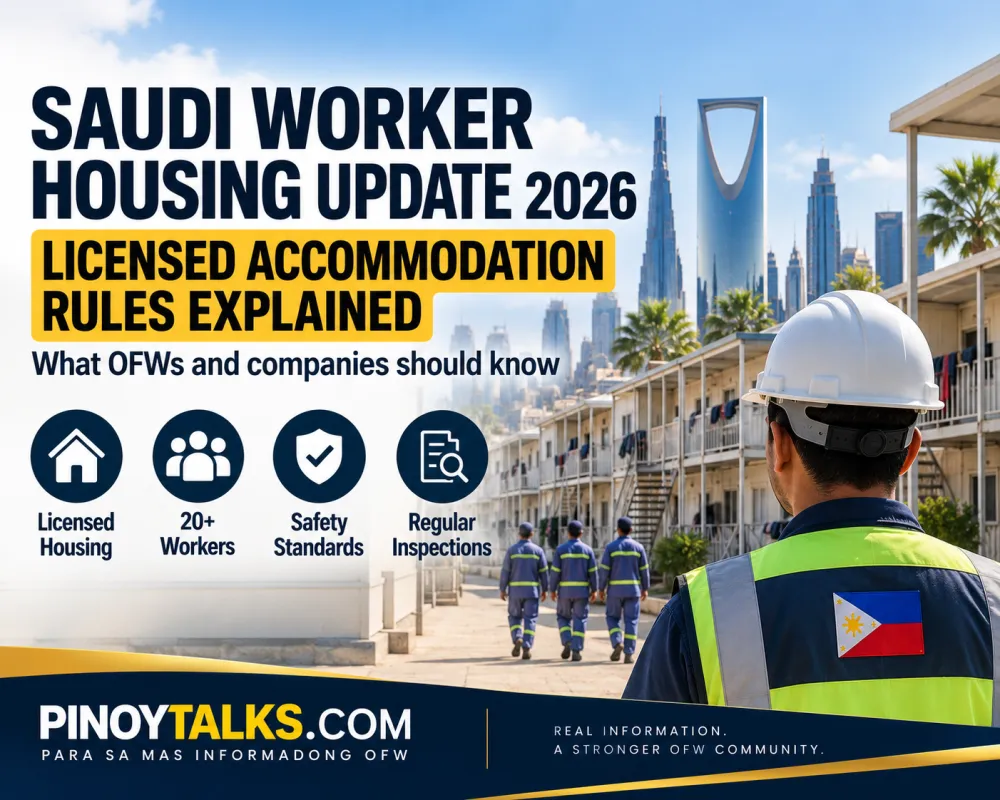
Saudi worker housing rules 2026
Kabayan, kung company accommodation o worker camp ang tinitirhan mo sa Saudi Arabia, magandang malaman na mas sistematiko na ang regulation at inspection ng collective worker housing.
Saudi Arabia's Ministry of Municipalities and Housing announced on September 3, 2026 that 1,360 licenses for collective housing have been issued, serving approximately one million foreign workers across the Kingdom.
The development is part of Saudi Arabia's regulatory framework designed to improve the safety, health, management and overall quality of collective accommodation for workers.
What Is the Saudi Worker Housing Requirement?
Under the framework explained by the ministry, owners of commercial establishments with 20 workers or more are required to either:
- provide licensed collective housing for their workers; or
- arrange alternative accommodation through licensed and approved facilities that meet regulatory requirements.
Licensed collective-housing providers are expected to comply with unified municipal, technical, health and safety standards.
Saudi authorities are also conducting inspection campaigns and taking regulatory measures against violations to maintain compliance.
This is important: the requirement does not necessarily mean that every employer with 20+ workers must build or own a worker camp. An establishment may instead secure appropriate accommodation through a licensed and approved provider.
Why Does This Matter to OFWs?
Maraming Filipino workers sa Saudi ang nakatira sa accommodation na provided or arranged by their company—particularly workers in construction, manufacturing, maintenance, logistics and other labor-intensive industries.
Housing conditions directly affect workers' daily lives.
A worker may spend 8, 10 or 12 hours at work, but the accommodation is where that worker sleeps, eats, showers, rests and recovers before another working day.
For that reason, worker accommodation should not be treated as an afterthought.
The Saudi framework specifically emphasizes municipal, technical, health and safety standards for licensed collective housing.
For OFWs, that means company accommodation is not simply a matter of “may tutulugan naman.”
Safety and proper management matter too.
What Should OFWs Check in Their Accommodation?
Workers do not need to become housing inspectors themselves.
However, it is reasonable to pay attention to obvious problems involving:
Fire and electrical safety - exposed electrical wiring, overloaded outlets, blocked exits or other serious hazards should not simply be ignored.
Sanitation - toilets, washing areas, waste disposal and shared facilities should be maintained appropriately.
Ventilation and living conditions - severe overcrowding or unsafe living arrangements may create health and safety concerns.
Basic facilities - accommodation should function as a proper living environment rather than simply a place where as many workers as possible can sleep.
The exact compliance determination belongs to the competent Saudi authorities, so workers should avoid declaring that a company is automatically “illegal” merely because they dislike a particular accommodation arrangement.
Document the actual condition instead.
What If the Company Accommodation Is Unsafe?
If you believe your accommodation presents a serious health or safety problem, start by documenting the issue when it is safe to do so.
Take clear photographs or videos of the actual problem and record when it occurred.
If appropriate, raise the matter through the employer or responsible accommodation management so there is a documented opportunity to correct it.
For serious or unresolved regulatory concerns, workers can verify the appropriate complaint or municipal channel through the official Saudi Ministry of Municipalities and Housing.
For employment-related concerns affecting private-sector workers, the Ministry of Human Resources and Social Development (HRSD) and Qiwa may also be relevant depending on the actual issue.
If you're unsure about your general employment rights, read our "Saudi Labor Law for OFWs: Complete Guide to Your Rights in Saudi Arabia".
Workers whose Qiwa job, Iqama profession or actual duties do not match can also read our "Qiwa and Iqama Profession Mismatch Guide".
My View: This Is a Positive Development for Workers and Responsible Employers
In my view, the most important part of this development is not simply the headline “one million workers.”
The important part is accountability.
When worker accommodation operates within a licensing framework, there are identifiable standards that accommodation providers are expected to follow.
That benefits workers, but it can also benefit responsible employers.
A company that spends money maintaining decent accommodation should not have to compete on equal terms with an operator that saves money through unsafe overcrowding, poor sanitation or inadequate facilities.
At the same time, OFWs should keep expectations realistic.
Licensed housing does not mean luxury housing.
It does not automatically mean every worker must receive a private bedroom, Wi-Fi, restaurant-style meals or hotel-level facilities.
The issue is compliance with the applicable regulatory, municipal, technical, health and safety requirements—not whether the accommodation feels luxurious.
That's an important distinction because exaggerating the regulation can create unnecessary conflict between workers and employers.
1,360 Licenses and Around One Million Workers
The scale of the latest announcement is significant.
The ministry says 1,360 collective-housing licenses now serve approximately one million foreign workers.
The National Program for the Development of Collective Housing, launched in 2025, involves 10 government entities working together on implementation, inspections and awareness activities.
The ministry says the initiative supports Saudi Arabia's broader Quality of Life and Vision 2030 objectives while improving living standards for workers.
For government information, workers should also verify current requirements directly with the Saudi Ministry of Municipalities and Housing and other competent Saudi authorities.
Important Reminder for OFWs
Don't interpret this update as:
“Lahat ng company accommodation na hindi maganda ay illegal.”
That's too broad.
And don't interpret it as:
“Every employer must provide free luxury accommodation.”
That's also not what this announcement says.
The accurate takeaway is:
Saudi Arabia is regulating collective worker accommodation through licensing, defined standards and inspections, and establishments with 20 or more workers are covered by specific accommodation requirements under the framework.
If your concern is actually about your Qiwa contract, Iqama, salary, transfer, resignation or other employment issue rather than accommodation, visit the "PinoyTalks Qiwa section" or "Ask the PinoyTalks Community".
Conclusion
Kabayan, ang company accommodation ay hindi lang simpleng “libreng tirahan.” May safety, health at regulatory standards na kailangang sundin kung sakop ng collective-housing framework.
The latest figures—1,360 licenses covering around one million foreign workers—show how large Saudi Arabia's regulated collective-housing system has become.
For OFWs, the practical message is simple: know your living conditions, document serious problems, use the proper channels when necessary, and avoid relying on exaggerated social-media interpretations of the rules.
For employers, proper worker accommodation should be viewed not simply as another compliance expense, but as part of maintaining a safe and sustainable workforce.
For more practical Saudi OFW guides about Qiwa, Saudi Labor Law, Iqama, contracts, salary, transfer and workplace concerns, visit PinoyTalks.com.
Disclaimer: This article is for informational and educational purposes only and does not constitute legal advice. Saudi labor rules, Qiwa procedures, municipal requirements, Musaned policies, and government regulations may change over time. Readers should verify current requirements directly through the competent official Saudi government authorities.
External Source:
Saudi gazette