Can a domestic helper transfer to a skilled company job in Saudi Arabia? Learn the legal DH-to-skilled-job process through Musaned, Qiwa, service transfer, profession change, and Saudi work permit rules.
Domestic worker to skilled job Saudi Arabia
Domestic worker ka ba sa Saudi Arabia—housemaid, household worker, private driver, caregiver, cook, o ibang profession under the domestic-worker system—and may company na gustong kumuha sa iyo bilang technician, office worker, skilled worker, tradesperson, o ibang private-sector position?
Possible ba talaga ang domestic worker papunta sa company or skilled job?
Yes, there is a legal route. But it is not as simple as finding a company and changing your profession.
The worker normally has to move from an individual/domestic employment relationship into an establishment/private-sector employment relationship, while meeting the applicable transfer, residency, contract, profession and work-permit requirements.
Saudi HRSD's rules expressly recognize a “new company employer” in the controls governing transfer of domestic-worker services. The controls also require, among other things, a valid residency, a verified Musaned contract and the ending of the contractual relationship with the current employer. (HRSD)
So kabayan, ang tamang goal ay hindi:
“Paano ko mapapalitan agad ang profession ko?”
The better question is:
“Paano ko maililipat nang legal ang employment ko mula domestic employer papunta sa eligible company, at pagkatapos ay masigurong tama ang profession at work permit ko?”
That distinction can save you from serious problems.
Quick Answer: Can a Domestic Worker Transfer to a Skilled Job?
Yes, it can be legally possible for a domestic worker to move from an individual employer to a private-sector establishment.
Saudi regulations recognize transfers involving a new company employer, while Qiwa provides the employment-transfer framework used by establishments. HRSD describes employee transfer as an electronic service that allows an establishment to request the transfer of an expatriate worker from another employer. (HRSD)
But three separate issues have to be understood:
- Transfer of employer – individual/domestic employer → company.
- Change or correction of profession – your official occupation must become compatible with your actual company job.
- Eligibility for the new occupation – some professions require qualifications, professional verification, accreditation, appropriate wage levels or other conditions.
Hindi sapat na sabihin ng company:
“Pasok ka na bukas. Kami na bahala sa transfer.”
The official transfer should actually be completed before you start working illegally for another employer.
Saudi Labor Law Article 39 generally prohibits a worker from working for another employer or for their own account outside the prescribed procedures. (HRSD)
Musaned and Qiwa: Understand This First
Ito ang isa sa pinakamahalagang differences.
While You Are a Domestic Worker
Domestic and household employment is generally handled through Musaned.
This includes household workers such as domestic workers, household drivers and similar occupations.
HRSD describes Musaned as the platform designed for domestic-worker recruitment and management, while Qiwa is the main platform for Saudi labor-sector services involving businesses and private establishments. (HRSD)
For a broader explanation, read the PinoyTalks guide:
Musaned Domestic Workers: Complete Guide for Household Workers in Saudi Arabia
After Moving to a Company
Once the lawful transfer into a private-sector establishment is completed, your employment relationship moves into the company/private-sector system where Qiwa becomes central for matters such as:
- employment contracts;
- work permits;
- occupation management;
- employee transfers; and
- employer/employee labor records.
Think of it this way:
Domestic household employment → Musaned
Private company employment → Qiwa
A DH-to-company move therefore involves more than simply editing one job title.
The Easiest Legal Route From Domestic Worker to Skilled Job
The safest route normally starts before you leave your current employer.
Do not resign, disappear from work or start working for the company first and hope the transfer can be fixed later.
Step 1: Find a Legitimate Company Willing to Transfer You
The strongest position is to first secure a genuine company that:
- has an actual vacancy;
- is willing to employ you officially;
- understands that you are currently registered as a domestic worker;
- is willing to process an individual-to-establishment employment transfer;
- can legally employ a non-Saudi in the proposed occupation; and
- meets Qiwa/HRSD establishment requirements.
For standard expatriate employee transfers, HRSD requires the receiving establishment to satisfy conditions including active establishment status, valid commercial registration where applicable, work-permit compliance, wage-protection compliance and the applicable Nitaqat requirements. (HRSD)
The domestic-worker transfer controls also specifically state that a new company employer must not have Ministry penalties or violations that prevent the transaction. (HRSD)
This is why a real company's HR department is much safer than relying on a middleman promising a “sure transfer.”
Step 2: Check Your Current Domestic-Worker Status
Before processing the transfer, review your current records.
Saudi HRSD's domestic-worker transfer controls identify important worker conditions including:
- valid residency;
- a verified employment contract on Musaned;
- the contractual relationship with the current employer having ended; and
- no applicable claim against the worker before the domestic-worker dispute mechanism. (HRSD)
Check your:
- Iqama validity;
- Musaned contract;
- contract expiry date;
- current registered employer;
- absence-from-work status;
- final-exit status;
- pending disputes;
- passport validity; and
- any existing transfer request.
Do this before paying anybody or leaving your employer.
Step 3: End the Domestic Contract Properly
One of the most important official conditions is that the domestic worker must have ended the contractual relationship with the current employer before the normal transfer is completed. (HRSD)
That can make contract completion or a properly documented agreement with the employer important.
But this does not mean:
“Natapos contract ko, automatic transfer na ako kahit walang system approval.”
Contract completion and transfer approval are different things.
The transfer must still go through the official mechanism and pass the relevant government-system conditions.
If your contract is approaching completion, it is usually much cleaner to coordinate the company transfer while your records remain legal and active rather than waiting until your residency or employment status becomes irregular.
For domestic workers considering transfer after completing a contract, see:
Domestic Worker Transfer in Saudi Arabia After Contract – PinoyTalks Guide
Step 4: Let the New Company Initiate the Official Transfer
This is where the new employer becomes very important.
HRSD's employee-transfer service allows an establishment to request the transfer of an expatriate worker into its workforce through the official labor system. (HRSD)
The digital journey can involve both Qiwa and Musaned because you are moving between two employment sectors.
In practical terms, the receiving company's HR department should start the employment-transfer process using the official system instead of asking the worker to personally “convert” the Iqama.
Do not accept arrangements such as:
“Work ka muna sa amin for two months. Transfer later.”
That creates a risk because the worker remains officially connected to the previous employer while physically working for another company.
Saudi Labor Law Article 39 restricts working for another employer except under the legally prescribed procedures. (HRSD)
Does the Current Domestic Employer Have to Approve?
For the ordinary and easiest route, cooperation from the current employer makes the process significantly simpler.
However, Saudi regulations also contain circumstances in which HRSD may permit a domestic worker's services to be transferred without the current employer's approval.
These are not automatic loopholes.
The circumstances must fit the official rules and normally need to be established through the proper government process.
Examples of No-Consent Transfer Situations
The HRSD domestic-worker controls include situations such as:
- proven non-payment of three wages, whether consecutive or otherwise under the stated conditions;
- failure by the employer to issue or renew the worker's residency within the prescribed period;
- the employer renting the domestic worker's services to others;
- assigning dangerous work threatening the worker's health or safety;
- proven ill-treatment;
- specified failures by the employer during domestic-worker dispute proceedings;
- certain circumstances in which continuing the relationship may harm the worker; and
- termination by the employer during probation. (HRSD)
These should not be used as invented reasons simply to bypass an employer.
If you believe one genuinely applies, raise the actual facts through Musaned/HRSD and let the official system determine eligibility.
Step 5: Review the New Qiwa Contract Carefully
Once the company-side employment arrangement reaches the appropriate stage, review the new employment contract carefully.
Do not focus only on the salary.
Check:
- company legal name;
- job title;
- basic salary;
- allowances;
- working hours;
- work location;
- contract duration;
- probation period;
- leave;
- notice period; and
- other contract clauses.
Your new contract should describe the actual employment relationship you are entering.
A Qiwa offer is not something you should accept blindly just because you want to escape your current domestic job.
The goal is not merely transfer.
The goal is legal, documented employment in the correct occupation.
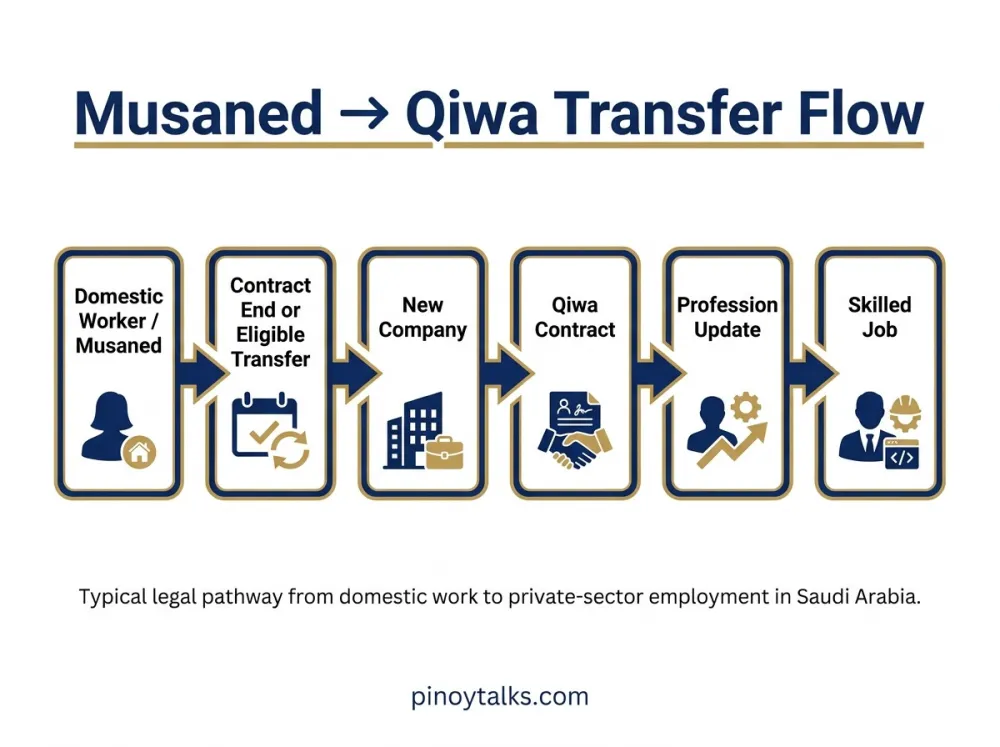
Musaned to Qiwa flowchart
Step 6: Make Sure Your Profession Is Changed Correctly
This is another major point OFWs often overlook.
Imagine this situation:
Your old status says Domestic Worker.
The new company hires you as an Salon worker.
Even after the employer transfer progresses, you should not assume the job-title issue fixes itself automatically.
Saudi Labor Law Article 38 states that an employer may not employ a worker in a profession different from the profession stated in the worker's work permit before the proper legal profession-change procedures have been completed. The worker is similarly prohibited from working in another profession before completing those procedures. (HRSD)
HRSD provides a Qiwa-based Change Expatriate Profession service specifically so establishments can change or correct an employee's occupation to match the work being performed. (HRSD)
That means the new company should make sure your registered profession is appropriate for your actual job.
For a detailed explanation:
Qiwa and Iqama Profession Mismatch in Saudi Arabia: Complete OFW Guide
Not Every “Skilled Job” Is Automatically Classified as Skilled
Saudi Arabia now officially classifies expatriate work permits into three main categories:
High-Skilled, Skilled and Basic.
The classification applies to non-Saudi work permits and is reflected through Qiwa. (HRSD)
Skilled Category
Under HRSD's classification framework, the Skilled category generally covers occupations falling within occupational groups 4 to 8 under the Saudi Standard Classification of Occupations, subject to applicable conditions.
The classification can consider:
- occupation;
- wage level;
- professional accreditation;
- educational qualifications;
- experience; and
- other applicable criteria. (HRSD)
So when an employer says:
“Skilled worker ang ilalagay namin.”
That does not automatically determine the official skill classification.
The government system evaluates the relevant criteria.
Qualifications Can Matter
One common misunderstanding is that anybody can simply transfer from domestic worker to engineer, accountant, healthcare professional or technician because a company is willing to hire them.
Not necessarily.
Saudi law requires non-Saudi workers to possess applicable professional competencies or qualifications, and certain professions can require additional licenses or approvals. Article 34 also makes clear that a work permit does not replace professional permits required by another authority. (HRSD)
Saudi Arabia also operates a Professional Verification/Accreditation framework designed to verify expatriate workers' qualifications, experience and professional skills. (HRSD)
Therefore, prepare documents such as:
- diploma or degree;
- TESDA or technical certificates where relevant;
- professional licenses;
- employment certificates;
- experience records; and
- updated CV.
Do not submit fake certificates just to obtain a higher profession.
Can the New Company Put Any Profession They Want?
No.
HRSD's profession-change service states that a resident's occupation cannot be changed into a profession restricted to Saudi nationals. The establishment must also meet the service's eligibility requirements. (HRSD)
Saudi localization policies change over time and different occupations can have different requirements.
Therefore, before promising you a position, HR should check whether:
- the occupation is available to expatriates;
- the company's activity supports that profession;
- applicable Saudization requirements are satisfied;
- professional accreditation is required; and
- your qualifications meet the occupation requirements.
Who Should Pay the Transfer and Profession-Change Fees?
For private-sector employment, Saudi Labor Law Article 40 states that the employer bears employment-related costs including work-permit and residency fees, profession-change fees, and the transfer fees for a worker whose services the employer wishes to receive. (HRSD)
So be careful when somebody tells you:
“Bigyan mo ako SAR 8,000 or SAR 10,000 para ma-transfer kita.”
There may be legitimate commercial or recruitment arrangements in some situations, but government employment obligations should not automatically be passed to the worker contrary to the applicable rules.
Ask for a clear written breakdown before paying anything.
Never transfer money to an unknown agent merely because they claim they can “change your sponsor.”
Can You Start Working for the Company While Waiting for Transfer?
Generally, do not treat a pending request as a completed transfer.
Your employment status should first be legally moved into the new establishment.
Article 39 restricts a worker from working for another employer outside the prescribed procedures, while Article 38 prohibits working in another profession before completing the required profession-change procedure. (HRSD)
So avoid:
- trial work without authorization;
- secretly working on your rest day for the future employer;
- staying at the company's accommodation while still registered under a household employer;
- accepting cash salary from the company before the lawful employment arrangement; or
- being told that “Qiwa request lang sapat na.”
Request submitted ≠ transfer completed.
What If the Company Says Transfer Is Impossible?
Do not immediately assume you need a fixer.
Ask the company's HR department for the actual system reason.
Possible issues can involve:
- current residency status;
- incomplete domestic-worker contract records;
- current employer status;
- final-exit or absence status;
- company eligibility;
- Saudization;
- occupation restrictions;
- professional accreditation;
- pending government requests; or
- another eligibility condition.
If an in-Kingdom transfer genuinely cannot be completed, a final exit followed by lawful recruitment under a new company work visa may be an alternative in some cases.
But do not final-exit first unless you understand the consequences.
Once you leave Saudi Arabia, the process becomes a different employment/recruitment journey.
The Best Strategy Before Leaving Your Domestic Job
For most workers, the cleanest sequence is:
Find the company → confirm the company can legally hire you → check your Musaned/Iqama status → properly end the domestic relationship → company initiates the official transfer → complete the government approvals → review the Qiwa contract → correct the profession/work permit → start the skilled job legally.
That is usually much safer than:
Run away → find company → work illegally → look for fixer → try to correct the records later.
The second route can turn a simple career move into an immigration, labor or residency problem.
Example: From Domestic Worker to Technician
Let's say Maria works as a household worker in Riyadh.
She previously worked in the Philippines as a hair dresser and has relevant training certificates.
A salon company wants to hire her.
The company should not simply tell Maria:
“Umalis ka sa amo mo, pasok ka dito.”
Instead, the better process is:
The company verifies that it can employ a non-Saudi in the intended occupation. Maria checks that her Iqama and Musaned records are in order. Her domestic employment relationship is ended properly. The receiving company processes the official employment transfer. The new company contract is documented. Her occupation/work permit is then made consistent with the technician role, subject to applicable qualification and professional requirements.
Only after the legal employment arrangement is completed should she work under the company as ahair dresser.
That is the difference between changing jobs and legally changing employment status.
Common Mistakes to Avoid
Running Away Because a Company Promised a Job
A verbal promise is not an approved transfer.
Secure the formal process first.
Paying a Fixer Before Checking Qiwa or Musaned
Many problems can be identified directly through the official platforms.
Assuming Contract Expiry Automatically Means Free Transfer
Contract completion can be important, but it does not mean every transfer automatically bypasses official approvals.
Accepting a Fake Profession
A profession should reasonably correspond with your legal work.
Working Before Transfer Completion
A pending transfer does not mean the old employment relationship has already disappeared.
Ignoring Qualifications
Some occupations require verification, accreditation or a separate professional license.
Is DH to Skilled Job Really Possible in Saudi Arabia?
Yes—but there is no legal “one-click shortcut.”
Saudi rules recognize domestic-worker transfers involving company employers, and private establishments have official employee-transfer and profession-management mechanisms. (HRSD)
The worker's chances are much better when:
- the residency is valid;
- the domestic contract is properly documented;
- the current employment relationship is properly ended;
- the new company is eligible;
- the occupation is legally available;
- the worker has the required skills or qualifications; and
- every change is completed through Musaned, Qiwa and the connected official systems.
Final Takeaway for OFWs
Kabayan, kung domestic worker ka ngayon, hindi ibig sabihin na domestic work na lang ang puwede mong gawin forever.
Kung mayroon kang experience bilang technician, welder, electrician, mechanic, office worker, logistics worker, caregiver, tradesperson o ibang profession, puwede mong paghandaan ang next career move.
Pero gawin sa tamang paraan.
Huwag unahin ang pagtakbo sa employer. Unahin ang job offer at legal transfer eligibility.
Huwag unahin ang trabaho. Unahin ang official employer transfer.
Huwag pumayag sa pekeng profession. Dapat tugma ang legal occupation sa actual work.
At higit sa lahat:
Ang tunay na “easy way” ay hindi shortcut. Ang pinakamadaling paraan ay iyong walang kailangang ayusin na violation pagkatapos.
For more OFW guides, explore the PinoyTalks domestic-worker and Qiwa resources:
PinoyTalks Domestic Workers & Musaned Guides
PinoyTalks Qiwa Guides for OFWs
Official Saudi References
The main official references used for this guide are the Saudi Ministry of Human Resources and Social Development's domestic-worker transfer controls, Qiwa employee-transfer service, profession-change service, Saudi Labor Law provisions on non-Saudi employment, and the work-permit skill-classification framework.
HRSD – Controls to Improve the Contractual Relationship of Domestic Workers and Their Equivalents
HRSD – Request for Transfer of Expatriate Workers
HRSD – Change Expatriate Profession
HRSD – Employment of Non-Saudis: Articles 32–41
HRSD – Guidelines for Classification of Work Permits by Skill Categories
HRSD – Professional Verification and Skills
Disclaimer
This article is for general OFW education and is based on official Saudi labor information available as of September 2026. Actual transfer eligibility is determined by the worker's individual records, the receiving employer's eligibility and the current status shown in Musaned, Qiwa, HRSD and other connected government systems.
Platform procedures, occupation eligibility, Saudization requirements and professional-accreditation rules can change. Before leaving your employer, paying transfer-related amounts or beginning work for another company, verify your actual status through the relevant official Saudi platform or HRSD.