Three Filipinos were apprehended while fishing in Yanbu. Learn Saudi Arabia’s fishing permit rules, prohibited equipment, relevant articles and possible penalties.
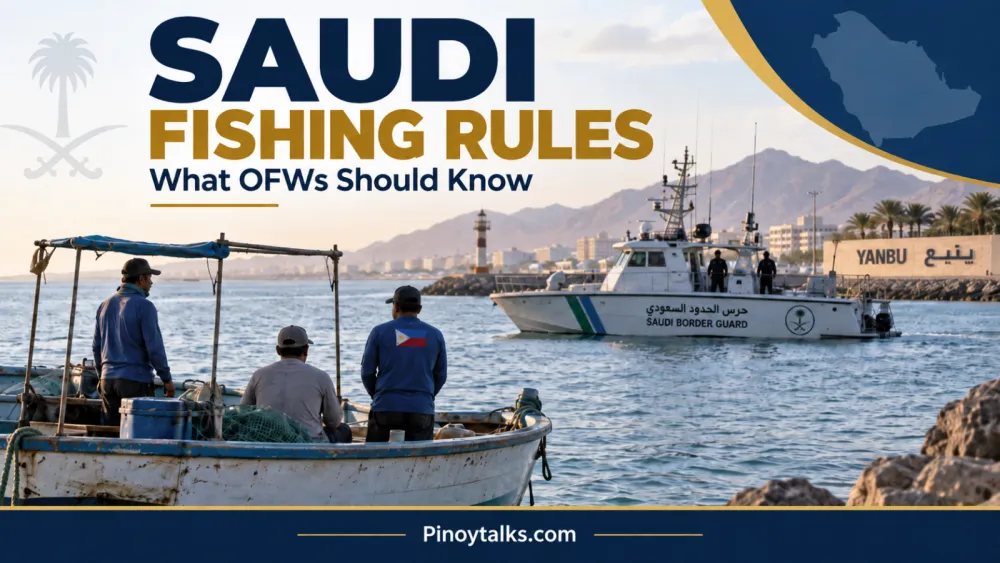
Saudi Arabia Fishing Rules for OFWs: Permit, Prohibited Gear and Yanbu Case Explained
Fishing is a common weekend activity for many OFWs in Saudi Arabia, especially those living near coastal areas such as Jeddah, Yanbu, Jubail, Dammam and Al Khobar.
Pero may important reminder para sa mga kabayan: hindi ibig sabihin na recreational or pang-libangan lang ang pangingisda ay wala nang regulations.
Saudi Arabia regulates fishing, fishing permits, marine activities, fishing equipment and the protection of living aquatic resources.
This became particularly relevant after Saudi authorities reported that three Filipino residents were apprehended in Yanbu, Madinah Region, on September 20, 2026.
According to the Saudi Border Guard report carried by Saudi media, the three were found fishing without a permit and using prohibited equipment. Authorities said legal procedures were initiated in coordination with the relevant agencies.
You can read the original English report here: Saudi Gazette: 3 Filipinos arrested for illegal fishing in Yanbu
But what exactly does Saudi law say about fishing?
Here is an explanation based on the Saudi Agriculture Law, its Executive Regulations, and the official Ministry of Environment, Water and Agriculture (MEWA) violations and penalties schedule.
What happened to the three Filipinos in Yanbu?
The coastal patrols of the Saudi Border Guard apprehended three Filipino residents in Yanbu for violating regulations governing security and safety for people engaged in marine activities.
The report specifically identified two alleged violations: fishing without a permit and using prohibited fishing equipment. It also said that the required legal procedures were taken in coordination with the competent authorities.
That distinction is important.
The published report confirms the apprehension and the alleged violations, but it does not state the final penalty, the exact type of prohibited equipment involved, or whether a final administrative or judicial decision has already been issued.
Therefore, it would be inaccurate to say that the three Filipinos have already been fined a particular amount or sentenced to imprisonment unless Saudi authorities later announce that outcome.
What Saudi law says about fishing without a permit
The main provision to understand is Article 159 of the Executive Regulations of the Agriculture Law.
Article 159(3): Fishing requires Ministry authorization
Article 159(3) states that fishing all types of living aquatic resources in Saudi Arabia's internal marine waters, territorial sea, contiguous zone and exclusive economic zone cannot be practiced without obtaining a license from the Ministry, subject to the conditions established by the Ministry.
Hindi dahil nasa dagat ka at hobby fishing lang ang ginagawa mo ay automatically free ka nang mangisda kahit saan. May licensing and regulatory requirements ang Saudi authorities.
Article 159(4): Fishing without a permit is treated as illegal or unregulated fishing
Article 159(4) goes further. It prohibits illegal and unregulated fishing activities in Saudi waters and specifically includes activities such as fishing without a permit, fishing in protected areas, fishing during prohibited periods, and destructive fishing methods using substances or techniques such as electricity, explosives, pesticides, chemicals or toxic substances.
So the phrase used in the Yanbu report — “fishing without a permit” — has a clear basis in the Saudi fishing regulatory framework.
However, the news release does not specify the precise legal subsection ultimately being applied to the three residents.
What if you are only fishing for recreation?
This is one of the most important provisions for ordinary OFWs.
Article 163: Recreational fishing is also regulated
Article 163 of the Executive Regulations says that recreational users may fish living aquatic resources for personal consumption using line and a single-hook fishing rod only.
The provision also places limits on the amount caught during one trip: up to 20 kilograms for two persons, or 30 kilograms where there are more than two persons on the trip.
So “pang-hobby lang naman” does not mean all fishing methods are allowed.
The regulation specifically controls the permitted method and quantity for recreational fishing.
For OFWs, the safer principle is simple: before fishing, verify the applicable permit, location and equipment requirements rather than assuming shore fishing or recreational fishing is unrestricted.
What fishing equipment is prohibited?
The Yanbu report also says the three Filipino residents allegedly used prohibited equipment.
Saudi regulations contain detailed restrictions on fishing gear.
Article 166: Certain nets and equipment are prohibited
Article 166 prohibits several specified types of fishing nets and equipment. These include certain bottom-trawling nets, three-layer nets, moving floating gillnets, specified nylon nets, encircling gillnets and certain types of fishing traps.
This does not mean we can conclude which equipment the three Filipinos possessed.
The Border Guard announcement simply described them as prohibited tools/equipment without publicly identifying the particular gear.
That is why PinoyTalks should avoid captions such as “nahuli dahil gumamit ng ganitong klaseng net” unless the authorities themselves identify the equipment.
Article 167: Prohibited equipment may also be restricted from possession
Article 167 expands the rule beyond actually catching fish.
It prohibits using prohibited fishing methods, nets, equipment, tools or materials on fishing vessels and also restricts possession of prohibited fishing equipment in relevant coastal and other locations. The article contains additional restrictions involving unauthorized bait and environmentally harmful practices.
In practical terms, kabayan, hindi lang actual use ang dapat tingnan. Depending on the particular equipment and circumstances, possession itself can also become relevant under the regulations.
Spearguns and similar fishing equipment
Another important rule appears in Article 170.
The regulation prohibits fishermen, divers and recreational users from using or possessing marine fishing guns/spearguns, spears and similar equipment for fishing.
Article 170 also says divers may not collect or catch marine organisms without the appropriate Ministry authorization, prohibits certain air-generating equipment for fishing, and says fishing nets or equipment not provided for in the regulations may not be used without Ministry approval.
Again, this does not mean a speargun was involved in the Yanbu case.
The official report has not identified what prohibited equipment was allegedly used.
There can also be a Border Guard sailing permit
This is where the word “permit” needs careful explanation.
A Ministry fishing authorization and a maritime sailing permit are not necessarily the same thing.
Article 223: Sailing permit through the Border Guard
Article 223 of the Executive Regulations requires fishermen and recreational marine users departing through fishing ports to obtain a sailing permit from the General Directorate of Border Guard.
The permit includes information such as the departure time, expected fishing location, equipment being used, expected return time and the number of passengers and crew.
This matters because the Yanbu report says the residents were fishing “without a permit,” but the short public announcement does not explain precisely which authorization was missing.
Why was the Saudi Border Guard involved?
Some OFWs may wonder why the Border Guard—not simply an environmental agency—handled the case.
The answer is found directly in the Saudi Agriculture Law.
Article 19 of the Agriculture Law
Article 19 states that the General Directorate of Border Guard, in cooperation with the Ministry, is responsible for monitoring fishermen, fishing equipment and fishing methods, implementing relevant instructions and recording fishing violations.
So Border Guard involvement in a fishing violation in Yanbu is consistent with the enforcement system established under Saudi law.
This is not simply a police action unrelated to fisheries regulation. Border Guard has an expressly stated role in monitoring marine fishing activities.
How much can the fine be for fishing without a license?
This needs careful wording because there is a difference between the official penalty schedule and the actual penalty eventually imposed in an individual case.
MEWA's official Classification of Violations and Determination of Penalties contains an entry for:
“Fishing living aquatic resources without a license from the Ministry.”
The published schedule shows a SAR 10,000 first-tier fine, followed by higher tiers of SAR 15,000 and SAR 20,000 for subsequent violations. The schedule also provides for confiscation measures involving the catch and fishing equipment in accordance with the law and regulations.
This is important because the applicable entry is not SAR 5,000 for ordinary unlicensed fishing under this table.
But this still does not mean the three Filipinos in Yanbu will automatically each pay SAR 10,000.
Their actual administrative case must first be determined by the competent Saudi authorities based on the facts recorded in their case.
What is the penalty for unauthorized fishing equipment?
The official MEWA penalties table separately covers the use of unauthorized fishing nets or equipment.
The relevant entry lists SAR 10,000 at the first penalty level. Subsequent levels shown in the table rise to SAR 20,000 and SAR 30,000, with additional measures at the higher levels such as confiscation of the catch and fishing equipment and temporary suspension of fishing activity.
Again, these are the published regulatory penalties.
We should not add SAR 10,000 + SAR 10,000 and announce that the Yanbu residents owe SAR 20,000 each.
Whether multiple penalties apply, what equipment was involved, whether the individuals have previous violations and what final sanction is imposed are matters for the Saudi authorities handling the actual case.
Why can penalties vary?
The Agriculture Law provides the broader legal framework for sanctions.
Under Article 25, violations of the Agriculture Law, its implementing regulations or licensing conditions can be punished by one or more sanctions, including monetary fines, suspension or cancellation of licenses and, where applicable, temporary closure of establishments. The article authorizes the Minister to issue detailed violation and penalty tables taking into consideration the nature and seriousness of each violation and aggravating or mitigating circumstances.
Under Article 26, the Ministry may impose fines of up to SAR 100,000 according to those classification schedules, while designated committees handle other cases and objections under the procedures established by the law.
This is why reading one number from a penalties table is not enough to determine the final outcome of an individual case.
What OFWs should learn from the Yanbu case
The main lesson is not that fishing itself is prohibited in Saudi Arabia.
Fishing is regulated.
There may be requirements concerning the fishing authorization, location, sailing permit, fishing method, equipment, species, season and allowable catch.
For a recreational fisherman, Article 163 is particularly important because it specifically recognizes recreational fishing for personal consumption but restricts the method to line and a single-hook rod and establishes catch limits.
If you are unsure whether your location, fishing equipment or planned activity is permitted, verify it with the competent Saudi authorities before fishing.
Do not rely solely on advice such as “marami namang nangingisda dito” or “hobby lang naman.”
Fact Check: Does the law say the three Filipinos will be jailed?
No such conclusion can be made from the published report.
The Border Guard report says the three residents were apprehended and that legal procedures were initiated. It does not announce a prison sentence, final fine, deportation order or final judgment.
Likewise, the existence of an official fine in the MEWA penalty schedule does not establish that the same amount has already been imposed in this particular case.
Until an official Saudi authority announces the outcome, posts should describe the case as an apprehension for reported fishing violations, not as a confirmed conviction or final sentence.
Bottom line
Kabayan, hindi automatically bawal ang fishing sa Saudi Arabia, pero hindi rin ito activity na puwedeng gawin anywhere, using any equipment, without checking the rules.
Saudi regulations specifically address fishing permits, recreational fishing, prohibited nets and equipment, marine fishing methods and sailing authorization.
In the September 20 Yanbu case, the Saudi Border Guard reported that three Filipino residents were apprehended for allegedly fishing without a permit and using prohibited equipment. The authorities said legal procedures were initiated, but the publicly available report has not announced their final penalties.
For PinoyTalks readers, the safest takeaway is:
Bago mangisda sa Saudi, check muna ang permit requirements, location at fishing gear na gagamitin. Ang recreational fishing ay regulated din, at may specific equipment na ipinagbabawal.
Disclaimer
This article is for general information and public awareness only. It is based on publicly available Saudi government regulations and reports available as of September 22, 2026. It is not legal advice and does not determine the guilt, innocence or final penalties of the individuals involved in the Yanbu incident. Regulations, permits and enforcement requirements may depend on the fishing activity, location, equipment and circumstances. For an individual case or planned fishing activity, verify the current requirements directly with the relevant Saudi authorities.
Official sources and further reading:
Saudi Agriculture Law — Saudi Board of Experts: Official Saudi Agriculture Law
Executive Regulations of the Agriculture Law — Saudi Official Gazette / Umm Al-Qura: Official Executive Regulations
Ministry of Environment, Water and Agriculture — official regulations and penalty schedule: MEWA Laws and Regulations Library
News report source: Saudi Gazette — 3 Filipinos arrested for illegal fishing in Yanbu