Saudi Labor Law Articles 101 and 102: Break Time, Rest Periods, and Working Hours Explained for OFWs
Learn how Saudi Labor Law Articles 101 and 102 regulate working hours, meal breaks, prayer breaks, and rest periods. Understand your rights and responsibilities as an OFW in Saudi Arabia.
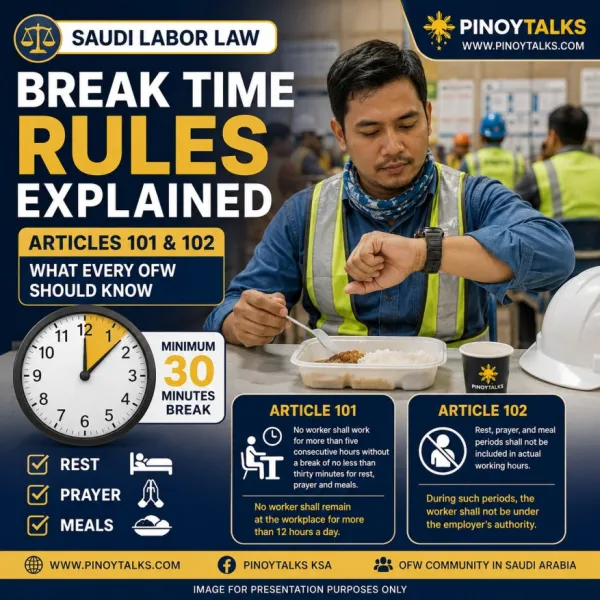
Saudi Labor Law Break Time
Introduction
Maraming OFW sa Saudi Arabia ang nagtatanong kung may karapatan ba silang magkaroon ng break kapag tuloy-tuloy ang trabaho sa buong araw.
Understanding Saudi Labor Law break time rules is important for both workers and employers. Saudi Labor Law Articles 101 and 102 establish guidelines regarding working hours, meal breaks, prayer breaks, and rest periods during the workday. These provisions are designed to help promote employee well-being while ensuring productivity in the workplace.
Many OFWs work in industries such as construction, manufacturing, hospitality, transportation, retail, and domestic services. Because work schedules vary across industries, understanding how break periods are treated under Saudi labor regulations can help workers better understand their employment conditions.
This guide explains Saudi Labor Law Articles 101 and 102 in a clear and practical way for Filipino workers in the Kingdom.
For more Saudi labor guides, visit https://pinoytalks.com and join discussions at https://pinoytalks.com/discussions.
Question from a Kabayan
"Hello,
Mag-ask lang po ako. I work in a corporate/Riyadh supposed to be 6 days/48 hours per week Lang ang trabaho ko, pero recently nabibigyan ako ng 7-8 consecutive days. Kapag po ba nag work ng 7 consecutive days may overtime or isang equivalent na compensated rest day off dapat na ma kukuha ang employee?
I asked my current supervisor, sinabi nya walang overtime kasi nakukuha ko parin naman ang required number of rest day per month. Nagtataka Lang ako kasi sa previous ko naman na supervisor dito sa Dammam pag pinag work nya ako ng 7 days na sunod sunod nagbibigay sya ng extra compensated off Please enlighten me thank you kabayan."
This question highlights a common concern among OFWs regarding rest days and break periods.
Articles 101 and 102 primarily focus on breaks during the workday rather than weekly rest days. Whether additional compensation, overtime, or a compensatory day off applies may depend on the worker's schedule, total hours worked, company policies, employment contract, and applicable labor regulations.
Workers should review their Qiwa contract and consult official labor resources for guidance specific to their situation.
What are Articles 101 and 102 of Saudi Labor Law?
Articles 101 and 102 regulate daily break periods and employee rest time during working hours.
Article 101
Article 101 states that:
Workers should not work more than five consecutive hours without a break.
The break must be at least 30 minutes.
Breaks are intended for:
Workers should not remain at the workplace for more than 12 hours in a day.
The purpose of this provision is to promote health, safety, and productivity.
Read Also: Understanding the Difference Between Article 77 and Article 81 Under Saudi Labor Law
Article 102
Article 102 clarifies that:
- Rest periods are not counted as actual working hours.
- During break periods, the worker is not under the employer's authority.
- Employers should not require workers to remain at the workplace during these designated breaks.
Together, Articles 101 and 102 establish the framework for Saudi Labor Law break time requirements.
Official labor information can be found through:
https://hrsd.gov.sa
How It Works in Saudi Arabia
Example 1: Eight-Hour Shift
An employee works:
8:00 AM to 5:00 PM
The employer may schedule:
- Work from 8:00 AM to 1:00 PM
- 30-minute meal and prayer break
- Work from 1:30 PM to 5:00 PM
This generally complies with Article 101 because the employee does not work more than five consecutive hours without a break.
Example 2: Ten-Hour Shift
A worker performing extended duties may receive multiple breaks to ensure compliance.
Employers often structure schedules based on operational needs while remaining consistent with labor regulations.
Example 3: Construction Site Worker
Many construction workers receive designated meal and prayer breaks during the day, especially during hot weather periods or long shifts.
Break scheduling may vary depending on project requirements.
Important Saudi Labor Rules Related to Saudi Labor Law Break Time
Breaks Are Separate From Working Hours
A common misunderstanding is that meal and prayer breaks are automatically counted as paid working hours.
Article 102 specifically states that designated break periods are not included in actual working hours.
Workers Should Not Work More Than Five Consecutive Hours
Employers are generally expected to provide breaks before employees exceed five continuous working hours.
Maximum Workplace Presence
Article 101 states that workers should not remain at the workplace for more than 12 hours per day.
Prayer and Meal Considerations
Saudi labor regulations recognize the importance of prayer and meal periods as part of employee welfare.
Additional guidance may be available through:
https://www.qiwa.sa
Common Problems OFWs Experience
No Scheduled Breaks
Some workers report situations where operational demands make breaks difficult to take.
Workers should communicate concerns through appropriate company channels.
Related Post: Can You Transfer Employer After Contract Expiry in Saudi Arabia?
Confusion Between Paid and Unpaid Breaks
Many OFWs assume break periods are automatically paid.
Article 102 indicates that designated rest periods are generally separate from actual working hours.
Breaks Taken at Workstations
Some employees continue performing duties while eating or resting.
This can create confusion regarding whether the break was actually provided.
Long Consecutive Workdays
Some OFWs experience schedules involving multiple consecutive workdays.
Questions regarding overtime, weekly rest days, and compensatory off days may require review of total working hours and applicable labor provisions.
For discussions with fellow OFWs, visit:
Pinoytalks/Discussion
Possible Scenarios and Options
Scenario 1: Employee Works Five Hours Straight
The employer should provide a break before requiring additional continuous work.
Scenario 2: Employee Chooses to Skip a Break
Company policies may still require scheduled breaks to comply with labor regulations.
Scenario 3: Employee Remains at Workplace During Break
Some workers voluntarily stay in break areas or cafeterias.
Article 102 generally indicates that workers should not be required to remain under employer authority during designated breaks.
Scenario 4: Seven Consecutive Workdays
Whether compensation or an additional day off applies may depend on:
- Total weekly hours
- Employment contract
- Company policies
- Applicable labor regulations
Workers should verify details through official channels.
Scenario 5: Rotational Work Schedules
Many OFWs in construction, oil and gas, and industrial sectors work under rotational schedules.
Break requirements still apply during daily working hours.
Read This Next: Risk of early termination of contract in Saudi Arabia
Important Tips for OFWs
Know Your Schedule
Review:
- Daily working hours
- Weekly rest days
- Break schedules
Check Your Qiwa Contract
Your contract may contain details regarding:
- Working hours
- Shift schedules
- Overtime provisions
Review your contract through:
https://www.qiwa.sa
Keep Records
Maintain records of:
- Attendance
- Shift schedules
- Overtime
- Approved leave
Communicate Professionally
If you believe there may be a misunderstanding regarding break periods, discuss the issue respectfully with management or HR.
Verify Through Official Sources
Labor regulations may be updated periodically.
Always verify information through:
FAQ Section
What does Article 101 say?
Article 101 states that workers should not work more than five consecutive hours without at least a 30-minute break.
Are meal breaks counted as working hours?
Article 102 states that designated meal, prayer, and rest breaks are generally not included in actual working hours.
Can an employer require me to stay at my workstation during break time?
Article 102 states that employers should not require workers to remain under their authority during designated break periods.
What is the minimum break under Article 101?
At least 30 minutes after no more than five consecutive hours of work.
Can I work more than five hours without a break if I agree?
Workers and employers should follow applicable labor regulations and company policies.
Does Article 101 apply to all sectors?
Application may vary depending on specific labor regulations and sector-specific provisions.
Does Article 101 guarantee overtime pay?
No. Article 101 primarily addresses break periods and working hours, not overtime calculations.
Conclusion
Kung nagtatrabaho ka sa Saudi Arabia, mahalagang maintindihan ang mga patakaran tungkol sa break time at rest periods habang nasa trabaho.
Saudi Labor Law break time rules under Articles 101 and 102 provide important protections regarding meal breaks, prayer periods, and daily rest schedules. Understanding these provisions can help OFWs better understand their working conditions while promoting a healthier and more productive work environment. Because each workplace may have unique schedules and operational requirements, workers should always verify specific concerns through official Saudi labor platforms and their employment contracts.
Want more Saudi labor law guides, Qiwa tutorials, OFW resources, and practical workplace information?
Visit:
https://pinoytalks.com
Join the discussion with fellow OFWs:
Pinoytalks/Discussion
Explore useful guides, calculators, and community resources designed specifically for Filipinos working in Saudi Arabia.
Disclaimer
Disclaimer: This article is for informational and educational purposes only and does not constitute legal advice. Saudi labor rules, Qiwa procedures, Musaned policies, and government regulations may change over time. Readers are encouraged to verify information directly through official Saudi government platforms such as Qiwa, MHRSD, Absher, Musaned, and Najiz.