Iqama in Saudi Arabia: Complete Guide for OFW's
Kabayan, ang Iqama ay isa sa pinakamahalagang dokumento na kailangan mong bantayan habang nagtatrabaho at naninirahan sa Saudi Arabia.
It serves as the official Resident ID of an expatriate in the Kingdom. Your Iqama details are commonly used for identity verification, government services, employment transactions, banking, telecommunications, healthcare, travel procedures, and other administrative matters.
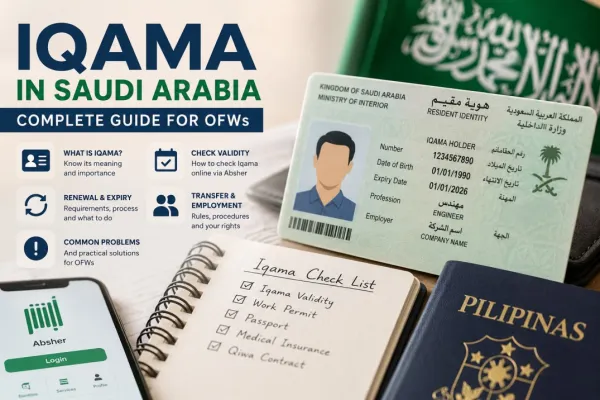
Iqama in Saudi Arabia: Complete Guide For OFWs
This complete guide explains what an Iqama is, how to check its validity, who is responsible for renewing it, what happens when it expires, and what an OFW should do when an employer fails to issue or renew it.
Important: An Iqama, work permit, employment contract, and visa are connected, but they are not the same document. Always verify each status separately through the appropriate official Saudi platform.
What Is an Iqama in Saudi Arabia?
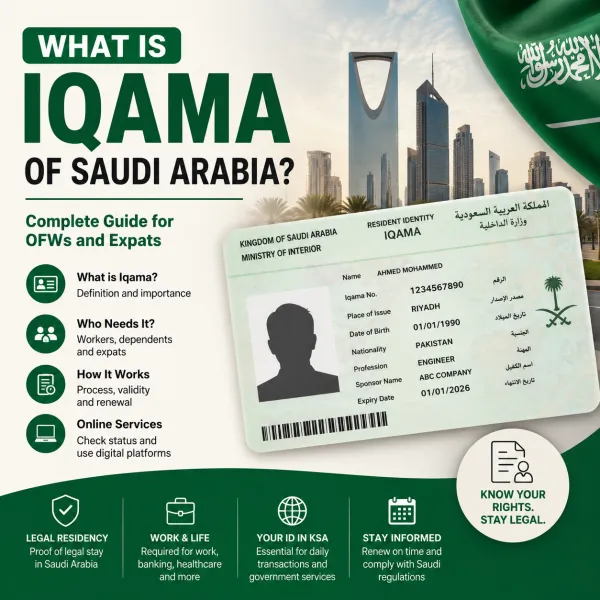
An Iqama, also called a Resident ID or residence permit, is the official identification document issued to eligible foreign residents in Saudi Arabia.
It normally contains information such as:
- Resident’s name
- Iqama number
- Nationality
- Date of birth
- Employer or sponsor information
- Registered profession
- Residency status and validity
For expatriate workers, the Iqama is normally connected to the worker’s legal residency and employment sponsorship.
However, having an Iqama does not by itself show every detail of your employment relationship. Your employment contract and transfer information are generally managed through Qiwa, while residency and visa-related services are handled through platforms under the Ministry of Interior, including Absher.
Related guide: No Iqama for 8 months
Why Is the Iqama Important for OFWs?
Your Iqama is commonly required when completing important transactions in Saudi Arabia.
These may include:
- Opening or maintaining a bank account
- Registering or updating a mobile number
- Accessing Absher and other government services
- Verifying your identity
- Receiving healthcare services
- Processing employment-related transactions
- Checking traffic violations
- Applying for certain permits or services
- Processing exit/re-entry or final-exit procedures
Because many Saudi services are digitally connected, expired or incorrect residency information may affect more than one transaction.
Do not wait until you need to travel, transfer employers, access your salary, or complete another urgent procedure before checking your Iqama.
Iqama Number vs Iqama Expiration Date
Your Iqama number is the permanent identification number assigned to your Saudi residency record.
Your Iqama expiration date shows how long your current residency authorization remains valid.
The number and expiration date are not the same.
Even when your physical card appears unchanged, the electronic record may have been renewed. The official digital record should therefore be treated as the primary source when confirming validity.
How to Check Iqama Validity Online
The safest way to check your Iqama is through an official Saudi government platform.
Check Through Absher
Absher provides an official Resident ID expiry inquiry service. The service allows a beneficiary to verify the status, validity, and expiration date of a Resident ID.
Depending on the service available to you, you may check through:
- The Absher website or official mobile application.
- Your Absher Individuals account.
- The official public Resident ID expiry inquiry.
- An authorized employer or sponsor account when the transaction must be completed by the sponsor.
When checking your record, confirm:
- Iqama status
- Expiration date
- Correct name and personal information
- Registered employer or sponsor
- Passport information
- Any relevant system alert
Step-by-step tutorial: [How to check iqama validity online]
Avoid entering your Iqama number, password, OTP, passport details, or banking information on unofficial websites.
Keep Your Absher Account Active
An active Absher account is important because many government services and identity-verification processes are connected to it.
Make sure that:
- Your registered mobile number is active.
- Your phone number is under your control.
- You can receive verification codes.
- Your password is secure.
- You never share your OTP with another person.
OFWs who have not activated their account may use authorized Absher activation channels, including eligible banks, self-service machines, and other officially approved methods.
Related tutorial: [How to Activate Absher Using a Kiosk Machine]
Who Is Responsible for Issuing and Renewing the Iqama?
For private-sector non-Saudi workers, Article 40 of the Saudi Labor Law states that the employer bears the fees for issuing and renewing the worker’s Iqama and work permit, as well as fines resulting from the employer’s delay.
The employer also bears certain other employment-related costs identified under Article 40, including recruitment expenses, profession-change fees when applicable, transfer fees for the employer receiving the worker, and specified travel-related costs.
This means a company-sponsored employee should not automatically assume that normal Iqama issuance or renewal expenses must be deducted from the worker’s salary.
However, expenses involving family dependents, personal requests, or situations outside the employment relationship may follow different rules or contractual arrangements.
Detailed explanation: [Saudi Labor Law Article 40 Explained]
Can an Employee Renew Their Own Iqama?
A company-sponsored private-sector employee normally cannot independently complete the entire employment Iqama renewal process.
The employer or authorized establishment representative generally needs to complete the required employment and residency procedures through the appropriate business platforms.
The worker can still help prevent delays by:
- Checking the expiration date regularly.
- Making sure the passport remains valid.
- Checking medical insurance status.
- Paying personal traffic violations when applicable.
- Keeping biometric information updated.
- Informing HR before the Iqama expires.
- Keeping written proof of follow-ups.
For family dependents and registered domestic workers, renewal procedures are normally handled by the authorized sponsor through the applicable Absher services.
Common Requirements for Iqama Renewal
The exact conditions displayed by the official system control whether a renewal can proceed.
Common requirements may include:
- Payment for the approved renewal period
- A valid passport
- A valid work permit for an employed worker
- Active medical insurance where required
- Registered fingerprints and photograph
- No disqualifying absence-from-work status
- Settlement of relevant traffic violations
- Correct dependent and passport records
A delay may therefore happen even when the employer says the renewal fee has already been paid. Another requirement, such as the work permit, insurance, passport, or establishment status, may still be incomplete.
Ask the employer for the specific reason shown in the official system instead of relying only on verbal explanations.
Iqama vs Work Permit vs Qiwa Contract
Many OFWs use these terms interchangeably, but they represent different records.
Iqama
The Iqama relates primarily to your residency and official identification in Saudi Arabia.
It is connected to the Ministry of Interior and Jawazat residency systems.
Work Permit
A work permit authorizes a non-Saudi employee to work under the registered employment arrangement.
Work permits are connected to the Ministry of Human Resources and Social Development. A valid work permit is commonly one of the requirements for renewing the Iqama of a private-sector employee.
Qiwa Employment Contract
Your Qiwa contract records the employment agreement between you and your employer.
It may show:
- Contract type
- Contract duration
- Salary
- Job title
- Notice period
- Renewal terms
- Employment status
- Termination or transfer transactions
An expired work permit does not automatically terminate your Qiwa contract. An expired Iqama also does not automatically cancel your employment contract.
Always check all three records separately.
Read next: [Qiwa in Saudi Arabia: Complete Step-by-Step Guide]
What Happens When an Iqama Expires?
An expired Iqama may affect residency, identity verification, employment transactions, banking services, mobile services, travel procedures, and access to other government or private services.
The exact effect depends on the transaction, the official system status, and the circumstances of the resident.
For a private-sector employee, the first question should be:
Is only my Iqama expired, or are my work permit, insurance, passport, and employment records also affected?
Do not assume that every expired-Iqama case has the same solution.
What to Do When Your Iqama Is Expired
1. Verify the Exact Expiration Date
Check your official Absher record.
Do not rely only on:
- The date printed on an old screenshot
- A verbal statement from HR
- A third-party application
- Information from another worker
- The expiration of your work permit
2. Inform Your Employer in Writing
Send a polite written request to HR, your manager, or the authorized company representative.
Include:
- Your full name
- Iqama number
- Expiration date
- Screenshot of the official status
- Request for the expected renewal date
Written communication helps establish that you informed the employer.
3. Check Your Work Permit
Log in to Qiwa and review your employment information.
An employer may be unable to renew the Iqama when the work permit has not been issued or renewed.
Related guide: [Expired Work Permit in Saudi Arabia: Complete Guide]
4. Check Your Passport and Medical Insurance
Make sure your passport is valid and your insurance status is active where required.
Report incorrect passport information to your employer immediately because the worker may not be authorized to update certain employer-managed records personally.
5. Keep Copies of Your Records
Save copies of:
- Iqama status
- Work permit status
- Qiwa contract
- Passport
- Medical insurance
- Salary records
- Messages sent to the employer
- Employer responses
These records may become important if the problem remains unresolved.
6. Use an Official Complaint Channel When Necessary
When the employer repeatedly fails to address the issue, the worker may seek guidance or submit a complaint through the Ministry of Human Resources and Social Development.
Explain the situation factually and avoid exaggerating the complaint.
Provide:
- Dates
- Screenshots
- Contract information
- Employer communications
- Other supporting documents
Do not leave work or disappear from the employer without first understanding the possible consequences of your action.
My Employer Has Not Issued My Iqama
Some newly arrived workers remain in Saudi Arabia for several months without receiving an Iqama.
When this happens:
- Ask the employer for the current issuance status.
- Confirm whether the work permit has been processed.
- Check whether medical insurance and required examinations are completed.
- Keep your passport and border-number information available.
- Save all messages and follow-ups.
- Seek help through an official channel when the delay remains unresolved.
Avoid paying unofficial agents who promise to create or renew an Iqama outside the authorized process.
A worker should also avoid running away or working for another person without completing the required legal procedure. Even when the employer has failed to meet an obligation, the worker should document the issue and use the proper government channel.
Related case guide: [Run away: What happen to Ofw in Saudi Arabia]
What is Iqama in Saudi Arabia
Can You Transfer to Another Employer With an Expired Iqama?
An expired Iqama by itself does not automatically guarantee that you can transfer.
Transfer eligibility may depend on:
- Work permit status
- Qiwa employment status
- Contract status
- Notice requirements
- Current employer compliance
- New employer eligibility
- Whether a transfer request or job offer is available
- Other conditions applied by the official system
Saudi labor regulations provide procedures intended to prevent workers from being unfairly affected when an employer fails to renew required employment documentation. In some qualifying situations, a transfer may be possible without the usual approval of the current employer.
However, Qiwa and the relevant authorities determine eligibility. Workers should not assume that an expired Iqama produces an automatic release.
Before making a decision:
- Check your Iqama in Absher.
- Check your work permit and contract in Qiwa.
- Ask the proposed new employer to verify transfer eligibility.
- Review your notice period and contract obligations.
- Keep proof of the current employer’s failure to renew.
- Wait for the official transaction instead of relying on a verbal promise.
Related guides:
Can You Continue Working With an Expired Iqama?
A worker should not treat an expired Iqama as a normal or harmless situation.
The employer should immediately address the residency and work-authorization requirements. The worker should verify whether the work permit, insurance, contract, and other records remain valid.
Continuing to work without resolving the documentation problem may expose both the employer and worker to administrative complications.
Do not agree to use another person’s Iqama, submit false information, or work under an unregistered employer.
Iqama and Exit/Re-Entry Visa
An Iqama and an exit/re-entry visa are separate records.
Before traveling outside Saudi Arabia, check:
- Iqama validity
- Exit/re-entry visa validity
- Passport validity
- Correct personal information
- Permitted travel dates
- Any applicable travel restriction
Having a valid Iqama does not automatically mean that you have a valid exit/re-entry visa.
Similarly, seeing an exit/re-entry visa in an old screenshot does not prove that it remains active. Verify its current status through Absher or the official Muqeem visa-validity service.
Iqama and Final Exit
A final-exit visa is used when an expatriate is leaving Saudi Arabia permanently under the relevant residency record.
The availability of final-exit processing depends on current system conditions and the person’s actual status.
Before traveling, verify:
- Final-exit visa status
- Visa validity period
- Passport validity
- Traffic violations
- Vehicles registered under your name
- Dependents included in the process
- Pending employment or legal issues
- Salary and final settlement
An expired Iqama does not mean a worker should simply go to the airport and attempt to leave. The proper visa and exit procedure must still be completed.
What If Your Iqama Is Lost or Damaged?
Report a lost or damaged Iqama immediately to your employer or sponsor.
Do not continue using a damaged card when important information can no longer be read.
An official replacement service is available for eligible residents, company owners, and workers. The employer or sponsor may need to complete or support the request, depending on the resident’s category.
Keep a digital copy of your Iqama for reference, but do not publicly post an unredacted image. Your Iqama contains personal information that can be misused.
Iqama Rules for Domestic Workers
Domestic workers do not always follow the same procedures as employees of private companies.
Their residency, contract, transfer, and employer obligations may involve:
* Absher
* Musaned
Domestic workers should follow guidance specifically applicable to household employment rather than assuming that every Qiwa rule applies to them.
The domestic employer is generally responsible for the domestic worker’s residency and work-related fees under the applicable domestic-worker regulations.
Common Iqama Mistakes OFWs Should Avoid
Depending Only on the Physical Card
Always verify the electronic record.
Confusing Iqama Expiry With Contract Expiry
Your residency record and employment contract are separate.
Assuming Transfer Is Automatic
An expired Iqama or work permit does not guarantee transfer approval.
Giving Your OTP to Another Person
Never provide your Absher, Nafath, bank, or government-service OTP to an agent or unauthorized person.
Ignoring an Incorrect Profession or Employer
Report incorrect information and request an authorized correction.
Waiting Until the Last Day
Check your Iqama well before its expiration date.
Leaving Work Without Documentation
Even when you have a legitimate complaint, preserve evidence and use the appropriate official process.
Frequently Asked Questions About Iqama
Is an Iqama the same as a Saudi national ID?
No. Saudi citizens have a national identity card. An Iqama is the Resident ID issued to eligible expatriates.
Is an Iqama the same as a work permit?
No. The Iqama concerns residency and identification, while the work permit concerns employment authorization.
Who should pay for an employee’s Iqama renewal?
For private-sector non-Saudi workers, Article 40 states that the employer bears the Iqama and work-permit issuance and renewal fees, including fines caused by the employer’s delay.
Can my employer deduct the Iqama renewal fee from my salary?
The employer bears the normal employee Iqama and work-permit costs identified under Article 40. Ask the employer for the legal and contractual basis of any deduction and seek official guidance when the issue is not resolved.
Can I check my Iqama without logging in to Absher?
Absher provides a public Resident ID expiry inquiry. The exact information and verification details required will appear on the official service page.
Does an expired Iqama automatically cancel my contract?
No. Iqama validity, work-permit validity, and contract status are separate records.
Can I transfer when my Iqama is expired?
Possibly, depending on your work permit, contract, Qiwa eligibility, employer status, and other official conditions. It is not automatic.
Can I renew my company Iqama personally?
The employer or authorized establishment representative normally completes the employment-related renewal process.
What should I do if I have no Iqama after several months?
Contact the employer in writing, ask for the issuance status, keep supporting records, and use an official complaint or assistance channel if the issue remains unresolved.
Can I travel when my Iqama is about to expire?
Check the current Iqama, passport, and visa requirements before traveling. Having an exit/re-entry visa does not remove the need to meet other official travel conditions.
What should I do when my Iqama information is incorrect?
Report the error to your employer or sponsor immediately and request correction through the authorized government process.
Iqama Checklist for Every OFW
Check these regularly:
- Iqama validity
- Work permit validity
- Passport expiration date
- Medical insurance
- Qiwa contract status
- Registered profession
- Registered employer
- Absher mobile number
- Exit/re-entry visa before travel
- Pending violations or official alerts
Save updated copies in a secure folder that only you can access.
Official Platforms to Use
Use only authorized Saudi platforms for residency and employment information:
- Absher for residency, identity, visa, and other government services
- Qiwa for private-sector employment contracts and labor mobility services
- HRSD for labor guidance and complaints
- Musaned for domestic-worker services
- Muqeem for authorized residency and visa-related services
- Jawazat for passport and residency matters
Avoid unofficial websites that request passwords, OTPs, or payment for services they are not authorized to provide.
Final Reminder for OFWs
Kabayan, huwag hintayin na magkaroon ng problema bago mo tingnan ang iyong Iqama.
Check your Iqama, work permit, passport, insurance, and Qiwa contract regularly. When something is wrong, report it early, communicate in writing, and keep copies of your records.
Most importantly, do not make major decisions based only on Facebook comments, verbal promises, or another worker’s experience. Every case may have different contract, residency, and system conditions.
For more practical OFW guides, visit PinoyTalks.com or post your question in the PinoyTalks community.
Disclaimer
This guide is provided for general educational and informational purposes only. It is not legal advice and does not replace an official decision from Saudi authorities.
Saudi laws, digital services, eligibility requirements, and administrative procedures may change. Always verify your personal status through Absher, Qiwa, HRSD, Musaned, Muqeem, Jawazat, or another appropriate official Saudi government channel.
PinoyTalks.com is an independent OFW information and community platform. It is not affiliated with, endorsed by, or officially connected to any Saudi government authority.