SAR 15,000 Penalty for Resigning? Understanding Saudi Contract Compensation Clauses for OFWs
Can a Saudi employer charge an employee SAR 15,000 for terminating a contract? Learn how Saudi Labor Law, Article 77, and contract compensation clauses affect OFWs.
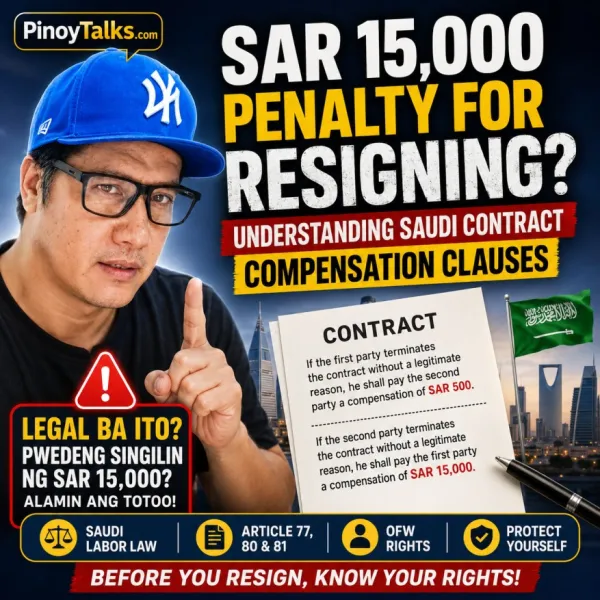
Saudi contract compensation clause
Introduction
Maraming OFWs ang nagugulat kapag may nakita silang malaking compensation amount sa kanilang Saudi employment contract.
One recently shared contract clause states that if the employer terminates the contract without a legitimate reason, the employee receives SAR 500 as compensation. However, if the employee terminates the contract without a legitimate reason, the employee must pay SAR 15,000.
Naturally, many workers ask:
- Is this legal?
- Can the employer automatically collect SAR 15,000?
- What does Saudi Labor Law say?
- Does this apply if the contract simply expires?
Understanding how a Saudi contract compensation clause works is important before making any decision about resignation, contract termination, or employer transfer.
For a better understanding of Saudi employment agreements, read our guide on Qiwa contracts:
Qiwa contract explained
What Does the Contract Clause Actually Say?
The highlighted clause states:
- If the employer terminates the contract without a legitimate reason, compensation is SAR 500.
- If the employee terminates the contract without a legitimate reason, compensation is SAR 15,000.
At first glance, many workers feel that the clause appears heavily weighted in favor of the employer.
However, it is important to understand that contract provisions do not exist in isolation. Employment contracts in Saudi Arabia are governed by Saudi Labor Law and may be reviewed in the event of a dispute.
Does a Contract Clause Automatically Mean You Must Pay SAR 15,000?
The simple answer is no.
Just because a contract contains a compensation amount does not automatically mean the amount will be immediately deducted or collected.
In the event of a dispute, authorities may examine:
- The contract wording
- The reason for termination
- Whether the contract was fixed-term or indefinite
- Whether the employee had a legally valid reason to leave
- Applicable provisions of Saudi Labor Law
Saudi labor disputes are generally reviewed based on both contractual obligations and labor regulations. Official labor information can be found through:
https://hrsd.gov.sa
You can also verify employment-related services through:
https://www.qiwa.sa
Understanding the Difference Between Contract Expiry and Resignation
One of the biggest mistakes OFWs make is confusing contract expiry with resignation.
Contract Expiry
A fixed-term contract naturally reaches its end date.
When this happens:
- The contract ends according to its terms.
- There is no early termination.
- Compensation clauses relating to early termination may not apply.
Early Resignation
This occurs when an employee chooses to leave before the contract reaches its expiration date.
In this situation:
- Contract compensation provisions may become relevant.
- Saudi Labor Law provisions may apply.
- The circumstances surrounding the resignation become important.
For a detailed explanation of fixed-term contracts, read:
Fixed-term contract in Saudi Arabia
Article 77 and Contract Compensation
Saudi Labor Law Article 77 is often mentioned whenever contract compensation is discussed.
Article 77 generally addresses compensation when a contract is terminated without a valid legal basis. Depending on the circumstances, compensation may be based on:
- Contract provisions
- Remaining contract duration
- Actual damages
- Applicable labor regulations
A detailed explanation can be found in:
Why its risky to resign before your contracts end in Saudi Arabia
The key point is that compensation issues are often connected to early termination of a valid contract rather than a contract reaching its natural expiration date.
What If the Employee Has a Valid Legal Reason?
Not all resignations are treated the same way.
There are situations where an employee may have legal grounds to leave employment.
Examples may include:
- Serious contract violations
- Salary payment issues
- Certain labor law violations
- Situations recognized under Saudi Labor Law
When a legally valid reason exists, the outcome may be different from a simple voluntary resignation.
This is why workers should avoid assuming that every resignation automatically triggers a compensation obligation.
Why OFWs Should Check Their Qiwa Contract
Many workers only rely on their agency contract from the Philippines.
However, your registered Saudi employment contract is equally important.
Always verify:
- Contract type
- Contract duration
- Salary details
- Notice period requirements
- Termination conditions
- Auto-renewal provisions
Our complete Qiwa guide explains these topics in detail:
Qiwa contract explained
You should also understand how notice periods work:
How notice period works in Qiwa
Common Misunderstandings About Contract Compensation
Myth #1: "The employer can immediately deduct SAR 15,000."
Not necessarily.
Any compensation issue may depend on contract terms, applicable law, evidence, and dispute resolution procedures.
Myth #2: "Contract expiry and resignation are the same."
They are not.
Contract expiry means the agreement reaches its natural end date. Early resignation means the contract is terminated before expiry.
Myth #3: "Every worker who resigns must pay compensation."
Not always.
The circumstances of the resignation and the applicable legal provisions are important factors.
Myth #4: "Verbal agreements override the contract."
In Saudi labor matters, written documentation carries significant importance. Workers should always keep copies of:
- Qiwa contracts
- Employment agreements
- Salary records
- Employer communications
Practical Advice Before Resigning
Before submitting a resignation:
1. Review Your Contract Carefully
Read every section related to:
- Contract duration
- Notice periods
- Compensation
- Termination
2. Verify Your Contract Status
Check whether your contract is:
- Fixed-term
- Renewed
- Auto-renewed
- Indefinite
3. Understand the Financial Impact
Calculate:
- Remaining contract period
- Potential compensation exposure
- End-of-service benefits
- Transfer options
4. Seek Clarification Through Official Channels
If uncertain, verify information through:
- Qiwa
- MHRSD
- Labor relations services
Official resources:
Qiwa
MHRSD
WATCH FULL VIDEO ON YOUTUBE:
[
)
Frequently Asked Questions
Can an employer put a SAR 15,000 compensation clause in a contract?
A contract may contain compensation provisions. However, enforceability and application depend on the circumstances and applicable labor laws.
If my contract expires, do I pay SAR 15,000?
Generally, contract expiry is different from early termination. The specific facts of each case remain important.
Can compensation be challenged?
Employment disputes may be reviewed through appropriate labor dispute processes and authorities.
Should I resign before my contract ends?
Workers should carefully evaluate their contract terms, notice requirements, and potential consequences before making a decision.
Conclusion
Kung may nakita kang SAR 15,000(case to case) compensation clause sa contract mo, huwag agad matakot—intindihin muna ang buong kontrata at ang mga probisyon ng Saudi Labor Law.
A compensation clause does not automatically mean the amount will be immediately collected. The type of contract, the reason for termination, and applicable labor regulations all play important roles. Before resigning or terminating a contract early, take time to review your Qiwa contract, understand your rights, and seek clarification when necessary.
The best protection for every OFW is knowledge. By understanding your contract before taking action, you can make informed decisions and avoid costly mistakes.
For more guides about Qiwa, Saudi Labor Law, contract termination, EOSB, and OFW rights, visit:
https://pinoytalks.com/
Disclaimer: This content is for educational purposes only and should not be considered legal advice. Please verify information with Qiwa, MHRSD, or other official Saudi authorities.