Can you leave Saudi Arabia with an expired Iqama? Learn the general final exit rules, Iqama validity requirements, and what OFWs and expatriates can do.
Can I Leave Saudi Arabia With An Expired Iqama?
An expired Iqama does not necessarily mean you can never leave Saudi Arabia, but you generally cannot simply go to the airport and depart without completing the proper exit process. Here is what OFWs and expatriates should know.
Introduction
Kung expired ang Iqama mo at gusto mo nang umuwi, ang pinakaimportanteng malaman ay ito: hindi sapat na may passport at plane ticket ka lang para makaalis sa Saudi Arabia.
For most expatriate residents, departure from Saudi Arabia requires the proper immigration status and an applicable exit visa or officially approved exit procedure.
Watch Video:
Can You Leave Saudi Arabia With an Expired Iqama?
This video explains the final exit process, important requirements, and what OFWs and expatriates should check before booking a flight.
[
)
So, can you leave Saudi Arabia if your Iqama is already expired?
The general answer is:
You normally cannot obtain and use the standard final exit process simply by ignoring an expired Iqama. Your residency and exit status usually need to be regularized first.
Current Absher requirements for issuing an exit or final exit visa include residency-related conditions, while official Jawazat guidance states that when a resident's ID has less than the required validity, renewal may be necessary before a standard final exit visa can be issued.
However, this does not automatically mean that a worker with an expired Iqama is permanently prevented from leaving Saudi Arabia. The correct procedure will depend on the person's employment category, sponsorship status, contract situation, and immigration record.
Can I Just Go to the Airport With an Expired Iqama?
Generally, no.
Going directly to the airport with an expired Iqama and a plane ticket does not automatically allow you to leave Saudi Arabia.
Before traveling, you should verify that you have the required immigration clearance, such as a valid final exit visa or another officially recognized departure procedure applicable to your situation.
The Saudi Absher platform provides electronic services for exit and final exit processes, subject to specific requirements. The current Absher service information also states that a passport must generally have at least 60 days of validity for a final exit visa.
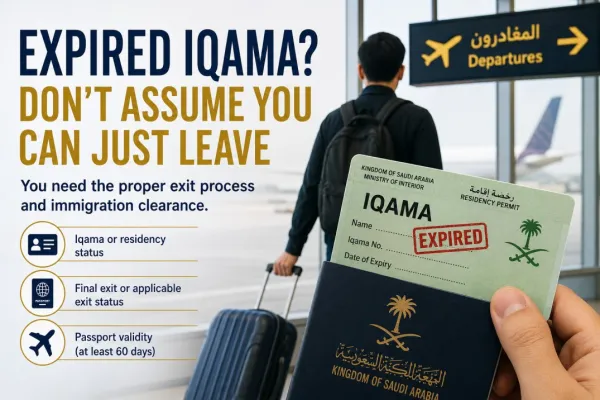
This means you should check at least three things before booking or confirming your flight:
- Your Iqama or residency status
- Your final exit or other applicable exit status
- Your passport validity
Do not assume that having an airline ticket alone resolves an expired residency problem.
Does My Iqama Need to Be Valid for a Final Exit Visa?
Under the standard process, yes, residency validity is generally required for the issuance of a final exit visa.
Official Jawazat guidance states that when a resident's ID has less than 30 days of validity remaining, a standard final exit visa cannot be issued until the residency is renewed.
If the Iqama has more than 30 days but less than 60 days remaining, the duration of the final exit visa is generally linked to the remaining residency validity. If the Iqama has at least 60 days remaining, the final exit visa may generally be issued with a validity of up to 60 days.
Because an already expired Iqama has no remaining validity, the normal electronic process may require the residency situation to be corrected before the final exit can proceed.
The exact system result may still depend on the worker's record and category, so the safest approach is to verify the case through Absher, the employer's authorized system, or Jawazat.
You can review the official Absher final exit visa requirements before making travel arrangements. official Absher final exit visa requirements
What Should I Do If My Iqama Is Already Expired?
The first step is to determine why the Iqama expired and what your current official status is.
Do not immediately assume that the only solution is to pay everything yourself or that you can simply leave without processing anything.
1. Check Your Iqama Status
Verify the actual expiration date through an official Saudi government platform such as Absher.
Sometimes workers rely on screenshots, old physical cards, or information from another person. Confirm the official electronic record first.
2. Check Whether a Final Exit Visa Already Exists
Check whether a final exit visa, exit/re-entry visa, or another immigration transaction has already been processed under your record.
A final exit request and an issued final exit visa are not always the same thing. Make sure you understand your actual status before making travel arrangements.
3. Contact Your Employer or Sponsor
For workers whose residency is connected to an employer or individual sponsor, contact the responsible party and ask about the required correction or exit procedure.
Keep the communication professional and preferably in writing.
For example, you may ask:
My Iqama has expired and I intend to complete the proper departure process. Please advise regarding the renewal or immigration procedure required to process my final exit.
Avoid accusations before you have verified the full situation.
4. Verify Through the Proper Saudi Authority
If the normal process cannot be completed, or if there is a disagreement about your status, verify your options through the relevant Saudi authority.
Depending on your case, this could include:
- Jawazat for residency and immigration matters
- Absher for applicable individual immigration services
- Qiwa or the Ministry of Human Resources and Social Development for private-sector employment matters
- Musaned for domestic-worker employment matters
Different categories of expatriates may be governed by different procedures.
Who Pays for an Expired Iqama?
For non-Saudi workers covered by the Saudi Labor Law in the private sector, Article 40 states that the employer bears the costs of issuing and renewing the worker's Iqama and work permit, as well as fines resulting from delays in those renewals.
Article 40 also addresses certain exit-related fees and the worker's return ticket at the end of the employment relationship, while also identifying circumstances in which the worker may bear the cost of returning home.
Private-sector workers should also check their contract and employment status through the official Qiwa platform. Qiwa platform
This means that, for a typical private-sector expatriate employee, an employer-caused delay in Iqama renewal should not automatically be treated as the worker's personal financial responsibility.
However, do not apply this rule automatically to every expatriate in Saudi Arabia.
The situation may be different for:
- Domestic workers
- Dependents
- Family members under individual sponsorship
- Self-sponsored residency categories
- Workers with special immigration circumstances
Always identify which legal and residency category applies to you.
What If My Employer Did Not Renew My Iqama?
If you are a private-sector employee and your employer has not renewed your Iqama, start by documenting the situation.
Keep copies of:
- Your Iqama status
- Employment contract
- Relevant Qiwa information
- Messages or emails requesting renewal
- Any responses from your employer
- Relevant system errors
Under the Saudi Labor Law framework for non-Saudi private-sector employees, the employer generally bears responsibility for Iqama and work-permit renewal costs and penalties resulting from delayed renewal.
Expired iqama in Saudi Arabia
However, this does not mean that every case automatically produces the same legal remedy.
The appropriate next step depends on several factors, including your contract status, work permit status, establishment status, and whether you are seeking renewal, transfer, or final departure.
If the issue cannot be resolved internally, you can verify the proper procedure through HRSD or the relevant official Saudi platform rather than relying solely on informal advice.
Can I Request Final Exit Without My Employer?
For qualifying private-sector expatriate workers, Saudi labor reforms introduced mechanisms allowing eligible workers to leave after the end of the employment contract without requiring the employer's consent, subject to the applicable conditions and procedures.
HRSD's official explanation of the labor reform initiative states that the final exit reforms allow an expatriate worker to leave after the employment contract ends without the employer's consent, with the employer being notified electronically.
However, this should not be interpreted as meaning that any expatriate with an expired Iqama can automatically issue a final exit independently.
Eligibility, residency status, contractual status, and system requirements still matter.
Workers should check the options actually available in their official Absher and Qiwa accounts and verify any system restriction through the appropriate authority.
What If My Contract Is Finished but My Iqama Is Expired?
Contract expiration and Iqama expiration are two separate issues.
Your employment contract may already have ended, but your immigration record may still require proper processing before departure.
Likewise, having an expired Iqama does not by itself cancel an employment dispute, unpaid salary claim, end-of-service benefit claim, or other contractual matter.
Before leaving Saudi Arabia, consider checking:
- Whether your employment contract has officially ended
- Whether a final exit has been issued
- Whether your Iqama and work permit require correction
- Whether you have pending salary or benefit concerns
- Whether your passport is valid
- Whether there are other restrictions affecting the immigration transaction
When the situation is complicated, obtain an official status confirmation before purchasing a non-refundable ticket.
Can I Leave Through Deportation Instead?
Do not intentionally violate Saudi immigration or residency rules in an attempt to obtain deportation as a shortcut to go home.
Deportation and immigration enforcement can have serious consequences for a person's record and possible future entry into Saudi Arabia.
If your Iqama is expired and you are unable to complete the normal departure process, contact the appropriate Saudi authorities and follow the legal procedure applicable to your case.
Saudi authorities may occasionally announce special correction campaigns, grace periods, or status-rectification initiatives for specific categories of people. These programs have their own eligibility requirements and should only be relied upon when there is a current official announcement confirming that the program applies to your situation.
Frequently Asked Questions
Can I buy a ticket if my Iqama is expired?
You can purchase an airline ticket, but having a ticket does not guarantee that you can complete departure formalities. Verify your final exit or applicable immigration status first.
Can my employer issue my final exit when my Iqama is expired?
Under the normal final exit process, residency validity requirements apply. An expired Iqama may therefore need to be addressed before a standard final exit can be completed.
Who should renew my Iqama if I am a private-sector worker?
For non-Saudi workers covered by the Saudi Labor Law, Article 40 generally places Iqama and work-permit renewal costs, including penalties caused by delayed renewal, on the employer.
Can I personally request final exit?
Some eligible private-sector expatriate workers may have access to final exit request mechanisms under Saudi labor mobility reforms. However, eligibility and immigration requirements still apply. Check your actual options through official Saudi platforms.
Where should I ask if my case is complicated?
For residency and final-exit issues, verify the case with Jawazat or through Absher. For private-sector employment issues, use Qiwa or the Ministry of Human Resources and Social Development. Domestic workers should check the applicable Musaned procedures.
Final Answer: Can You Leave Saudi With an Expired Iqama?
Kung expired ang Iqama mo, hindi ibig sabihin na hindi ka na makakauwi, pero hindi rin ibig sabihin na puwede kang dumiretso lang sa airport at umalis.
In the normal process, you need the correct immigration clearance, and standard final exit requirements generally include valid residency conditions. If your Iqama has already expired, the residency situation may need to be corrected or handled through the appropriate official procedure before departure.
For private-sector workers, remember that Saudi Labor Law Article 40 generally assigns Iqama and work-permit renewal costs and delay-related penalties to the employer. But your exact exit procedure will still depend on your individual employment and immigration status.
Best practical advice: Check your Absher, Qiwa, Iqama, passport, and final exit status before booking your flight. If there is a system problem or disagreement with your employer, document your situation and verify the correct process through the appropriate Saudi authority.
Ask the PinoyTalks Community
May similar situation ka ba tungkol sa expired Iqama, final exit, Qiwa, or employer concerns?
Share your question in the PinoyTalks Ask the Community forum so other OFWs can discuss their experiences and point you toward the appropriate official resources.
Disclaimer: This article provides general information based on publicly available Saudi rules and official government guidance. Individual cases can differ depending on employment category, contract status, residency record, and current government procedures. This is not individual legal advice. Always verify your specific case through the appropriate Saudi government authority or official platform.
Information reviewed: July 2026.