Saudi Arabia now allows Iqama issuance and renewal from three months for domestic workers. Learn who qualifies, fees, process, and OFW impact.
Saudi Arabia has introduced a more flexible Iqama system for domestic workers, allowing residency permits to be issued or renewed for periods starting from three months. Here is what Filipino domestic workers and their employers need to understand.
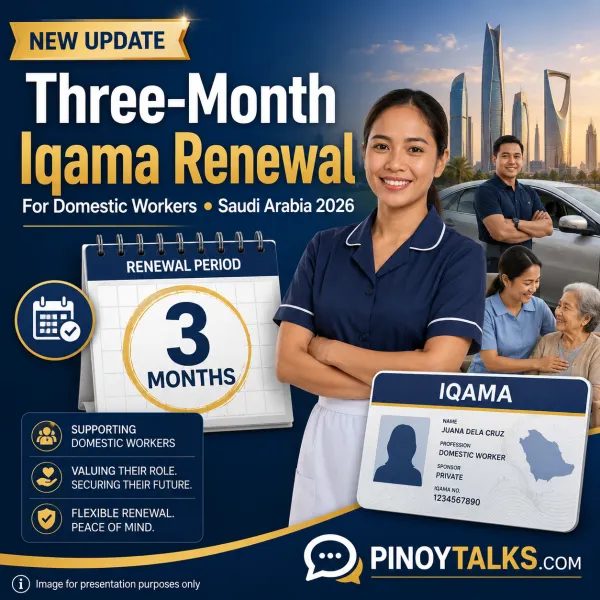
Three-month Iqama renewal for domestic workers
Kabayan, may bagong pagbabago sa Saudi Arabia na mahalagang malaman ng mga domestic worker at household employer: maaari nang mag-issue o mag-renew ng Iqama ng domestic workers para sa panahong nagsisimula sa tatlong buwan.
On July 19, 2026, Saudi Arabia announced the implementation of a more flexible residency-renewal arrangement for domestic workers and similar categories. Instead of requiring the employer to pay the residency fees for a longer period at once, the employer may select an issuance or renewal period beginning from three months or multiples of three months.
The change was implemented by the Ministry of Interior, represented by the General Directorate of Passports or Jawazat, in cooperation with the Ministry of Human Resources and Social Development and the national domestic-worker platform Musaned.
According to the official Saudi Ministry of Human Resources and Social Development announcement, the purpose is to give employers greater flexibility by allowing residency fees to be paid according to the selected issuance or renewal period.
Kabayan Question:
"Sir, ilang buwan ba ang expiration ng Iqama?"
What Is the Three-Month Iqama Renewal?
The three-month Iqama renewal allows eligible domestic-worker residency permits to be issued or renewed for a period beginning from three months.
The official announcement also states that the selected period may be a multiple of three months. Depending on the options available in the government system and the worker’s eligibility, this could include periods such as:
- Three months
- Six months
- Nine months
- Twelve months
The main change concerns the duration of the Iqama issuance or renewal and the corresponding residency-fee payment.
Previously, employers commonly processed the worker’s residency for a longer period and paid the corresponding fees at once. Under the new arrangement, the employer can divide the residency cost according to the shorter period selected in the system.
This does not mean that every domestic worker will automatically receive only a three-month Iqama. It simply gives the employer an additional option when issuing or renewing the residency permit.
When Did the New Rule Start?
The Saudi government announced that the implementation began on July 19, 2026.
The announcement came from HRSD and involved cooperation among:
- The Ministry of Interior
- The General Directorate of Passports or Jawazat
- The Ministry of Human Resources and Social Development
- Musaned
The change forms part of Saudi Arabia’s continuing development of digital residency and domestic-worker services.
Who Is Covered by the Three-Month Iqama Renewal?
The new arrangement applies to domestic workers and those in similar categories.
Under Saudi domestic-worker regulations, domestic work refers to personal services performed for a household employer or members of the employer’s family in exchange for wages.
Domestic-worker occupations may include:
- Housemaids
- Private or family drivers
- Household cleaners
- Domestic cooks
- Caregivers
- Gardeners
- Home guards
- Other approved household-service occupations
The exact classification depends on the worker’s registered profession and official records.
The HRSD definition covers men and women performing domestic services under the supervision and direction of a household employer. You can review the official HRSD definition of domestic workers for the complete regulatory wording.
Filipino household workers who are unsure which Saudi platform applies to them should also read the PinoyTalks guide on Musaned for domestic workers in Saudi Arabia. It explains the difference between Musaned and Qiwa and identifies the employment services commonly handled through each platform.
Does the Three-Month Renewal Apply to Company Workers?
Not automatically.
Private-sector employees working for companies, factories, restaurants, construction firms, shops, and other establishments are generally managed through Qiwa and the private-sector employment system.
Domestic workers are managed through a different framework involving Musaned, Absher, Jawazat, and HRSD.
Therefore, a technician, office worker, factory employee, engineer, salesperson, or restaurant worker should not assume that the domestic-worker three-month renewal arrangement automatically applies to their Iqama.
The worker’s registered profession, employer type, and government records determine which system applies.
For a broader explanation of residency records and the difference between Iqama, work permit, Qiwa, and Musaned, read the PinoyTalks complete Iqama guide for OFWs in Saudi Arabia.
Who Selects the Renewal Period?
The household employer or sponsor normally processes the issuance or renewal of the domestic worker’s Iqama.
The new arrangement allows the employer to choose an eligible period beginning from three months and pay the residency fees corresponding to that selected period.
After paying the applicable government fees, the employer generally completes the residency-renewal service through Absher.
The official Absher Iqama frequently asked questions explain that residency services for domestic workers are handled from the employer’s account under the worker or employee services section.
Domestic workers should never share their Absher password or one-time password with unofficial agents, social-media pages, or unknown individuals offering to process the renewal.
Who Must Pay the Iqama Renewal Fee?
The domestic employer is responsible for the worker’s residency issuance and renewal fees.
The new three-month option changes how the employer may divide or schedule the residency-fee payment. It does not transfer the financial responsibility to the domestic worker.
Under the current domestic-worker regulations, the employer’s obligations include paying residency fees, work-permit fees where applicable, renewal fees, service-transfer fees, and fines caused by the employer’s actions.
This obligation is explained under Article 15 on the official HRSD employer-obligations page.
A domestic worker should be cautious when asked to personally pay the normal Iqama renewal cost. Before paying anything, request a clear written explanation and verify the requirement through Musaned, HRSD, Absher, or Jawazat.
Does a Three-Month Iqama Mean a Three-Month Contract?
No. The validity of the Iqama and the duration of the domestic employment contract are separate matters.
The new announcement concerns the issuance and renewal period of the residency permit. It does not state that an existing one-year or two-year domestic employment contract will automatically become a three-month contract.
Saudi domestic-worker regulations require the employment relationship to be governed by a domestic work contract containing essential information such as:
- Type of work
- Wage
- Contract start date
- Contract duration
- Rights and responsibilities
- Rest and working arrangements
- Renewal and termination conditions
The official HRSD domestic-worker contract guidance states that domestic-work contracts are fixed-term contracts and should identify their duration and the method for extension or termination.
Therefore, an employer choosing a three-month Iqama renewal period does not, by itself, cancel, shorten, extend, or replace the worker’s employment contract.
Domestic workers should check both records separately:
- The Iqama expiration date.
- The Musaned or written employment-contract expiration date.
Does It Affect Salary, Leave or End-of-Service Benefits?
The three-month Iqama option does not automatically reduce the domestic worker’s salary, leave entitlement, rest period, or end-of-service benefits.
Those employment rights are based on the applicable domestic-worker regulations and the worker’s contract, not simply on whether the Iqama was renewed for three, six, nine, or twelve months.
For example, a domestic worker with an ongoing contract does not become a temporary worker merely because the employer selected a shorter Iqama-renewal period.
Employers and workers must continue following the agreed wage and other lawful employment conditions.
Domestic workers should also keep proof of salary payments. Saudi Arabia has expanded the documentation of domestic-worker wages through approved banking and digital-payment channels. Learn more in the PinoyTalks guide on domestic-worker salary transfers in Saudi Arabia.
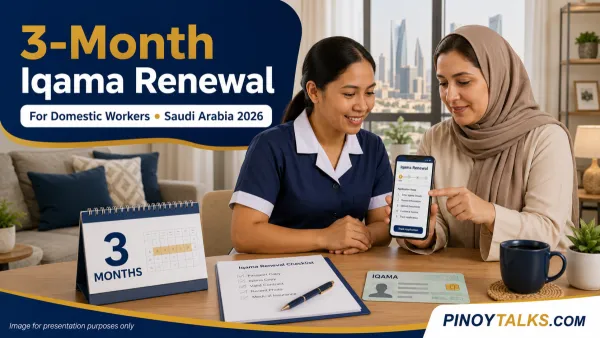
A Filipino domestic worker and her employer review the new three-month Iqama renewal option in Saudi Arabia. Image for presentation purposes only.
Does It Affect Employer Transfer?
A three-month Iqama renewal does not automatically approve or prevent an employer transfer.
Domestic-worker transfers depend on the worker’s contract, current employer, new employer, system eligibility, approvals, and any applicable transfer-without-consent conditions.
The Iqama renewal period is only one part of the worker’s overall status. A worker may still need to meet the Musaned or Absher transfer requirements.
Kabayan, huwag basta umalis sa employer or magsimulang magtrabaho sa ibang household dahil lamang maikli ang natitirang validity ng Iqama. A proper transfer must still be processed through the authorized Saudi system.
For a detailed explanation, read Domestic Worker Transfer in Saudi Arabia After Contract.
Does It Affect Final Exit?
The new renewal option does not automatically issue a final-exit visa and does not mean the worker must leave Saudi Arabia after three months.
A final-exit visa is a separate immigration process. The worker’s Iqama validity, passport, employment status, employer action, and other government requirements may affect the process.
A three-month Iqama could simply mean that the employer selected a shorter residency-renewal period. It should not be interpreted as proof that a final exit has already been processed.
Domestic workers planning to leave Saudi Arabia should verify the actual visa status through Absher or another authorized government service rather than relying only on verbal statements.
Why Did Saudi Arabia Introduce the Three-Month Option?
The official announcement explains that the change is intended to provide greater flexibility in managing residency-related obligations.
Instead of requiring the employer to pay for a longer renewal period at once, the employer may pay the fees according to the selected period.
This may help employers:
- Manage residency expenses more flexibly.
- Select a renewal period suited to their current circumstances.
- Complete residency services through integrated digital systems.
- Avoid delaying renewal simply because a longer payment period is difficult to manage.
The reform is also part of Saudi Arabia’s continuing digital transformation of government services.
However, employers must still renew the Iqama correctly and on time. The shorter option should not be used as a reason to leave the worker without valid residency documentation.
What Domestic Workers Should Check
Even though the employer normally processes the renewal, domestic workers should regularly check their records.
Check the Iqama expiration date
Review the expiry date through your Absher account when available. Do not rely only on the physical card because government records may be updated electronically.
Check the registered employer
Make sure the employer shown in your official records matches the household or sponsor for whom you are legally working.
Check your passport validity
An expired or nearly expired passport may affect residency or visa processing.
Keep a copy of your contract
Save a digital and printed copy of your Musaned or written domestic-work contract.
Keep salary records
Save bank transfers, digital-wallet payments, receipts, messages, and other evidence showing when and how your salary was paid.
Ask for clarification respectfully
When the employer renews your Iqama for only three months, you may respectfully ask whether the shorter period was selected under the new quarterly renewal option.
A three-month renewal alone is not necessarily evidence that the employer plans to terminate the worker.
Frequently Asked Questions
Can an Iqama now be renewed for only three months?
Yes. Saudi Arabia announced that Iqamas for domestic workers and similar categories may be issued or renewed for periods beginning from three months.
Can the employer choose six or nine months?
The official announcement permits periods starting from three months and multiples of three months. The actual options will depend on what is available and permitted in the government system for the individual case.
Can the domestic worker select the renewal period?
The employer or sponsor normally processes the residency issuance or renewal and selects the eligible period.
Must the worker pay the three-month renewal fee?
The domestic employer is responsible for the normal residency issuance and renewal fees under the domestic-worker regulations.
Does a three-month Iqama cancel a two-year contract?
No. The Iqama-renewal duration and employment-contract duration are separate records. The contract remains governed by its terms and applicable regulations unless it is lawfully changed or terminated.
Does this apply to private-company employees?
The announcement specifically covers domestic workers and similar categories. Company employees are generally managed under the private-sector and Qiwa systems.
Can a domestic worker transfer when the three-month Iqama expires?
Transfer eligibility is not based solely on the length of the Iqama renewal. The worker must follow the applicable Musaned, Absher, HRSD, and immigration procedures.
Does a three-month renewal mean the worker will receive final exit?
No. Final exit is a separate process and must be verified through the official government system.
Where can workers verify the new rule?
Workers and employers may verify information through HRSD, Absher, Jawazat, and the official Musaned domestic-worker platform. Musaned is Saudi Arabia’s national platform for domestic-worker services and employment-related transactions.
Final Reminder for Filipino Domestic Workers
Kabayan, ang three-month Iqama renewal ay isang bagong flexible option para sa residency processing, pero hindi nito awtomatikong binabago ang iyong kontrata, sahod, transfer status, o final-exit status.
Always check your actual Iqama validity, contract duration, registered employer, salary records, and visa status separately.
Do not make major employment or travel decisions based only on Facebook posts, verbal information, screenshots from other workers, or the duration printed on someone else’s Iqama. Each case may involve different records, eligibility conditions, and government requirements.
For more practical and easy-to-understand guides about Musaned, Iqama, contracts, salary rights, employer transfer, and working in Saudi Arabia, visit PinoyTalks.com.
May personal question ka tungkol sa iyong Iqama or Musaned contract? Join the PinoyTalks Ask the Community and post your situation. Include only the necessary details and hide your Iqama number, passport number, mobile number, and other private information.
Disclaimer
This article is provided for general educational and informational purposes only. It is not legal advice, immigration advice, or an official government interpretation.
Saudi regulations, eligibility conditions, fees, digital-service procedures, and platform requirements may change. The application of a rule may also depend on the worker’s registered profession, employer, contract, residency status, and official government records.
PinoyTalks.com is an independent Filipino OFW information and community platform. It is not affiliated with, endorsed by, or officially connected to the Saudi Ministry of Human Resources and Social Development, Ministry of Interior, Jawazat, Absher, Musaned, or any other Saudi government authority.
Always verify your personal case through official Saudi channels before making employment, transfer, payment, residency, or travel decisions.
Last verified: July 26, 2026