Learn how Musaned salary transfer works, including requirements, payment channels, salary records, deductions, delayed wages, and complaints.
Kung isa kang Filipino domestic worker sa Saudi Arabia, mahalagang malaman mo kung paano dapat ipadala at ma-document ang buwanang sahod mo sa ilalim ng Musaned salary transfer system.
Beginning January 1, 2026, the electronic transfer of domestic workers’ salaries became mandatory for all individual employers in Saudi Arabia, regardless of how many domestic workers they employ. The final phase followed the gradual rollout implemented during 2024 and 2025. (HRSD)
Musaned salary transfer
The system is part of Saudi Arabia’s Wage Protection initiative for domestic workers. It allows salary payments to be transferred through approved banks and digital wallets while creating an electronic payment record connected to Musaned.
This guide explains what Filipino domestic workers should prepare, how their employer completes the payment, how to verify each salary, what to do if wages are delayed, and why a cash-only arrangement may no longer be enough.
Workers who are still unfamiliar with the platform may first read this complete Musaned guide for domestic workers in Saudi Arabia, which explains contracts, household-worker classifications, employer transfers, and the difference between Musaned and Qiwa.
Important: Musaned covers domestic workers and similar household professions. Employees working for private companies are generally managed through Qiwa and other private-sector systems, not through Musaned.
What Is Musaned Salary Transfer?
Musaned salary transfer is an electronic wage-payment system for domestic workers employed by individuals in Saudi Arabia.
Through this system, the employer transfers the worker’s salary using an approved digital wallet or participating bank. The transaction is then documented in the worker’s financial record connected to Musaned.
The Ministry of Human Resources and Social Development introduced the service to:
- Provide reliable proof that the salary was paid
- Help workers receive their wages regularly
- Protect both the employer and domestic worker during disputes
- Make contract completion and final-departure procedures easier
- Allow workers to transfer money to their families through official financial channels
The Ministry describes the system as a way to improve transparency, security, and reliability in domestic-worker salary payments. (HRSD)
Is Musaned Salary Transfer Mandatory in 2026?
Yes. As of January 1, 2026, electronic salary transfer applies to all domestic-worker employers in Saudi Arabia.
The implementation was introduced in phases:
Implementation date | Employers covered |
|---|
July 1, 2024 | New domestic workers under new contracts |
January 1, 2025 | Employers with more than four domestic workers |
July 1, 2025 | Employers with three or more domestic workers |
October 1, 2025 | Employers with two or more domestic workers |
January 1, 2026 | All domestic-worker employers without exception |
This means an employer with only one housekeeper, private driver, caregiver, nanny, cook, or other covered domestic worker is now included in the electronic transfer requirement. (HRSD)
Who Is Covered by the Musaned Salary System?
The system applies to workers whose employment relationship is registered under Musaned, including household professions such as:
- Housekeeper or domestic worker
- Private driver
- Nanny or childcare worker
- Home caregiver
- House cook
- Gardener
- House manager
- Personal assistant
- Other domestic-worker professions approved in Musaned
The rules apply to domestic workers of all nationalities. Filipino workers do not have a separate Musaned salary-transfer procedure, although their employment contract may also involve Philippine recruitment requirements.
Workers employed by a company, restaurant, factory, shop, hospital, construction contractor, or other commercial establishment should check their Qiwa contract instead. The PinoyTalks guide explaining Qiwa for OFWs explains why company workers use Qiwa while household workers generally use Musaned.
Requirements Before a Salary Can Be Transferred
The official HRSD process identifies several important requirements.
1. The employment contract should be documented in Musaned
The domestic-worker contract must be properly recorded in the platform. Salary information should match the amount agreed upon by the employer and worker.
Electronic contract documentation helps establish important terms, including the worker’s salary and contract duration.
2. The worker should have an Iqama
The standard salary-transfer setup uses the worker’s residency identification information. A worker who has not yet received an Iqama may not be able to complete the normal digital-wallet registration process.
For a broader explanation of residency status, renewal responsibilities, validity, and common documentation issues, read the complete PinoyTalks Iqama guide for OFWs in Saudi Arabia.
3. The worker needs a Saudi mobile number linked to the Iqama
The mobile number used to create the financial account should be linked to the worker’s residency information.
The worker should have access to this SIM card because verification codes, account alerts, and payment notifications may be sent to that number.
4. A digital wallet or bank account must be created for the worker
The salary should be received in an account associated with the worker. The worker should control the account password, PIN, verification codes, and access credentials.
5. The employer must initiate the salary payment
The official service conditions state that the transfer should be made by the employer. The worker’s information appears in the participating bank or wallet under the employer’s registered domestic workers. (HRSD)
How the Musaned Salary Transfer Process Works
The exact buttons may differ depending on the bank or digital wallet, but the general official process works as follows.
Step 1: Create or activate the worker’s financial account
The domestic worker creates an account with a participating digital wallet or bank using the mobile number linked to the worker’s Iqama.
The worker may need to complete identity verification before the account becomes fully active.
Step 2: The employer opens the approved payment channel
The employer logs in to the participating bank or digital-wallet application.
Step 3: Select “Domestic Worker Salaries”
Inside the application, the employer selects the option for domestic-worker salaries.
The system should display the domestic workers legally registered under the employer’s identity.
Step 4: Select the correct worker
The employer chooses the worker who will receive the payment.
Before confirming, both parties should make sure that the displayed name and residency information are correct.
Step 5: Enter or confirm the salary payment
The employer confirms the salary amount and completes the transaction.
The payment should correspond to the salary stated in the Musaned contract, subject only to legally permitted adjustments or deductions.
Domestic workers may also review the PinoyTalks list of useful Saudi applications for OFWs to understand which official platforms are commonly used for employment, residency, government, and financial services.
Step 6: Keep the electronic transaction record
The completed payment creates documentation connected to the Musaned salary system. The worker should also keep the notification or statement showing the amount and transaction date.
HRSD lists the salary-transfer service itself as free and describes its processing as instant. Separate fees for optional financial services or international remittances may depend on the bank or wallet selected. (HRSD)
Which Banks and Digital Wallets Can Be Used?
Musaned connects with approved banks and digital wallets in Saudi Arabia.
In its 2026 report covering Musaned’s 2025 achievements, HRSD stated that the salary-payment network had expanded to eight banks and seven digital wallets. The Ministry also reported more than 1.6 million salary-transfer transactions during 2025. (HRSD)
Previously announced approved options included:
- Alinma Pay
- Enjaz Wallet
- Mobily Pay
- STC Pay
- Your Pay
The participating providers may be expanded, renamed, or updated. Employers and workers should therefore check the current options displayed inside Musaned or the employer’s banking application rather than relying only on an older list. (HRSD)
What Should the Filipino Worker Do After Receiving the Salary?
Do not rely only on a verbal statement that the salary has been sent. Check the actual account.
For every salary payment:
- Confirm that the money has entered your own wallet or bank account.
- Compare the amount with the salary in your Musaned contract.
- Check which month the payment covers.
- Save the transaction date and reference.
- Download or screenshot the account statement when possible.
- Keep your contract, salary records, and important messages together.
- Report any incorrect worker name or account information immediately.
The worker should never give their wallet PIN, password, bank password, or one-time verification code to another person.
An employer may assist with registration, but the worker should retain reasonable access to the account where their salary is deposited.
What Are the Official Salary Rules for Domestic Workers?
Under Saudi Arabia’s Regulation for Domestic Workers and Those in Similar Positions:
- Wages and other amounts due must be paid in Saudi riyals.
- The employer must pay the worker monthly.
- The payment method must follow the method determined by the Ministry.
- A worker who is ready to perform the agreed work but is prevented from working for a reason attributable to the employer remains entitled to wages for that period. (Musaned)
The salary amount, payment arrangement, and other benefits should also be checked against the authenticated Musaned contract.
Can an Employer Pay the Salary in Cash?
Because electronic salary transfer is now mandatory for all covered employers, a cash-only payment does not produce the required Musaned-linked electronic salary record.
Even when the employer says that the worker has already received cash, the absence of an official electronic record may later create difficulty for both sides when proving whether the salary was paid.
The worker may calmly ask the employer to use the approved Musaned-connected payment channel for future salaries.
Avoid participating in arrangements where:
- A fake salary transfer is made and the worker is required to return the money
- The worker is asked to confirm receiving a salary that was not actually received
- The worker is asked to surrender their wallet, ATM card, PIN, or OTP
- The salary is transferred to another person’s personal account instead of the worker’s account
The purpose of the electronic system is to create transparent and reliable proof of wage payment for both parties. (HRSD)
Can the Employer Deduct Money From the Worker’s Salary?
An employer cannot make arbitrary deductions from a domestic worker’s salary.
The current domestic-worker regulation permits deductions only for specific reasons:
- Damage intentionally or negligently caused by the worker
- Repayment of a salary advance provided by the employer
- Implementation of a judicial ruling or administrative decision
The total deduction should generally not exceed one-quarter of the worker’s wage, unless a judicial or administrative decision expressly allows a higher amount. (Musaned)
Routine deductions should not be made simply because the worker receives accommodation or food. Providing suitable accommodation and food, or an approved monetary alternative, forms part of the employer’s obligations under the domestic-worker regulations. (Musaned)
What If the Transferred Amount Is Lower Than the Contract Salary?
First, compare the payment with the salary written in the authenticated Musaned contract.
There may be a valid and documented reason, such as:
- A lawful salary-advance repayment
- A deduction connected to proven damage
- A judicial or administrative order
- A properly calculated absence from work
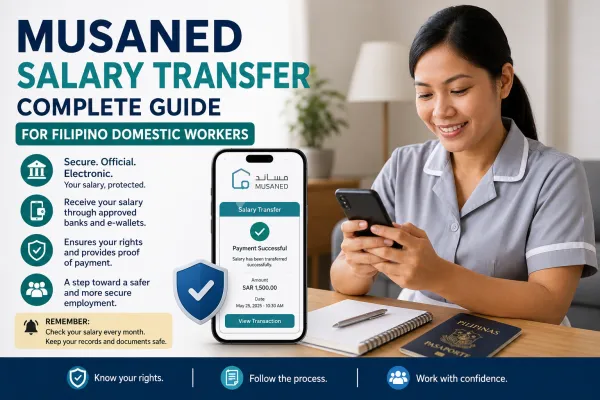
Musaned salary transfer guide for Filipino domestic workers in Saudi Arabia using approved banks and digital wallets
However, the worker should request an explanation when the amount is unexpectedly lower.
Keep copies of:
- The Musaned contract
- Wallet or bank statements
- Payment notifications
- Written salary calculations
- Messages discussing the deduction
- Any document presented by the employer
Do not sign a salary receipt containing an incorrect amount or an incorrect payment date without first understanding what the document states.
What If the Salary Is Delayed or Not Transferred?
A calm and documented approach is recommended.
First: Verify the payment account
Make sure the wallet or bank account is active and that the registered mobile and Iqama details are correct.
Second: Speak with the employer
Inform the employer that the salary has not appeared in the account. There may be a technical problem, an incorrect account setup, or an unfinished payment.
Whenever possible, communicate in writing so that the issue and response are documented.
Third: Collect evidence
Keep the following:
- Musaned contract
- Account statement
- Screenshots showing no payment
- Salary-due dates
- Messages with the employer
- Previous salary records
- Iqama and employment information
Fourth: Contact Musaned
Musaned currently offers support through phone, email, live chat, WhatsApp, its support-request form, and its official X account. Its official support number is 920002866. (Musaned)
Explain the issue accurately and provide only the documents requested through official channels.
Fifth: Submit an official complaint when necessary
When the problem cannot be resolved directly, the worker or employer may use the official complaint and dispute-resolution channels available through Musaned or HRSD.
HRSD also provides an electronic complaint service for beneficiaries. (HRSD)
Do not submit false information or exaggerate the amount owed. A clear timeline and complete records usually make the issue easier to review.
What If Three Salaries Have Not Been Paid?
Failure to pay three salaries—whether consecutive or separate—may have more serious consequences.
Under the official controls for improving the contractual relationship of domestic workers, the Ministry may allow a domestic worker’s services to be transferred to another employer without the current employer’s approval when it is proven that three consecutive or sporadic wages were not paid without a reason attributable to the worker.
This is not automatic. The worker must follow the official process, and the nonpayment must be established through the competent authority. (HRSD)
A worker should not leave the employer or begin working for another person without completing the required Musaned and government procedures.
Can the Worker Send the Salary to the Philippines?
Yes, provided the selected bank or digital wallet offers an international remittance service.
HRSD has stated that approved salary channels can help workers transfer money to their families in their home countries safely and conveniently. (HRSD)
Before sending money:
- Compare the exchange rate
- Check the transfer fee
- Verify the recipient’s full name
- Confirm the Philippine bank or e-wallet details
- Keep the remittance receipt
- Never send money through an unlicensed middleman
Receiving the salary and remitting money to the Philippines are separate transactions. The original salary payment should first appear in the worker’s official account.
Common Musaned Salary Transfer Problems
The worker’s name does not appear in the employer’s application
The employment contract, Iqama, mobile number, or worker registration may not be properly connected. The employer should check the worker’s Musaned record and contact support if necessary.
The worker does not have an Iqama yet
The standard digital-wallet process requires residency-linked information. The employer should complete the Iqama procedure and ask Musaned about the correct temporary arrangement rather than using another person’s account.
The worker has no personal Saudi mobile number
A Saudi mobile number linked to the worker’s Iqama is normally required for account creation and verification. The worker should not permanently rely on the employer’s personal phone number for access to their salary account.
The wallet is registered but cannot receive money
Check whether identity verification has been completed and whether the account has any restrictions. Contact the provider first, followed by Musaned if the worker’s employment information is not appearing correctly.
The salary was sent to the wrong account
Report the mistake immediately to the financial provider and Musaned. Do not make an informal repayment to an unknown person without verification and an official transaction record.
The employer asks the worker to return part of the transferred salary
Ask for the legal and contractual basis of the deduction. Keep the complete transaction record and do not share account credentials.
Musaned Salary Transfer Checklist
Before the first salary:
- Musaned contract is documented
- Worker has an Iqama
- Worker has a personal Saudi mobile number linked to the Iqama
- Bank or digital-wallet account is active
- Employer can see the worker under Domestic Worker Salaries
- Salary amount matches the contract
Every month:
- Check the amount received
- Confirm which salary month was paid
- Save the transaction receipt
- Record any lawful deduction
- Report missing or incorrect payments promptly
- Never share the OTP, PIN, or account password
Frequently Asked Questions
Is Musaned salary transfer mandatory for one domestic worker?
Yes. Since January 1, 2026, the electronic salary-transfer requirement applies to all domestic-worker employers, including those employing only one worker. (HRSD)
Is Musaned salary transfer also for company workers?
Generally, no. Musaned manages domestic-worker relationships. Most private-company employees are covered by Qiwa and private-sector wage systems.
Can my employer continue paying me only in cash?
A cash-only payment does not provide the mandatory electronic Musaned-linked salary documentation. The employer should use an approved bank or digital wallet.
Can my salary be transferred to my employer’s account?
The salary account should be associated with the worker. The worker should be able to access and verify the funds received.
Can I use another worker’s mobile number?
The official setup requires a number linked to the worker’s residency information. Using another person’s number may cause verification, access, and ownership problems. (HRSD)
Is the Musaned salary-transfer service free?
HRSD lists the salary-transfer service as free. Banks or digital wallets may have separate fees for optional services, especially international remittances. (HRSD)
What should I do if my employer paid only part of my salary?
Check your contract and ask for a written calculation. Deductions are allowed only in limited cases and generally cannot exceed one-quarter of the wage.
Can I transfer to another employer after three unpaid salaries?
Proven nonpayment of three consecutive or separate wages may be a ground for transfer without the current employer’s approval, but the worker must file the case and complete the official Musaned process. (HRSD)
Final Reminder
Bilang Filipino domestic worker sa Saudi Arabia, ang pinakamahalagang proteksiyon mo ay isang tamang Musaned contract, personal access sa salary account, at kumpletong electronic records ng bawat buwanang bayad.
Electronic salary transfer does not remove the need for respectful communication between the worker and employer. Instead, it gives both parties a clearer and more reliable record of the employment relationship.
Check every payment, protect your account credentials, keep your documents, and use only official Musaned and HRSD support channels when assistance is needed.
For individual questions about delayed salary, contract discrepancies, deductions, transfer requests, or other Musaned concerns, post your situation on PinoyTalks Ask the Community so fellow Filipino workers can share practical guidance based on the details of your case.
Disclaimer: This article provides general information based on official Saudi sources available as of July 27, 2026. Platform procedures and participating payment providers may change. Always verify your current status through Musaned, HRSD, and other competent Saudi authorities.
Last Updated: July 27, 2026