Kabayan may unpaid salary, overtime, EOSB or contract dispute ka ba? Narito ang factual step-by-step process for filing a labor complaint through HRSD Friendly Settlement in Saudi Arabia.
How to file a labor complaint in Saudi Arabia
The Ministry of Human Resources and Social Development, commonly called HRSD or MHRSD, provides an electronic service called Friendly Settlement for Labor Disputes. It is generally the first formal stage for resolving a labor dispute between a private-sector worker and an employer.
Through this process, the Ministry reviews the claim, notifies the parties, schedules a settlement session and attempts to help them reach an acceptable resolution. If the dispute is not settled, it may proceed to the competent Labor Court under the applicable procedures.
This guide explains the current official filing steps, documents to prepare, what happens during the session and common mistakes OFWs should avoid.
Important: This guide is for employees covered by the Saudi Labor Law in the private sector. Domestic workers and similar categories generally follow a separate dispute-resolution procedure.
What Is Friendly Settlement in Saudi Arabia?
Friendly Settlement, sometimes called amicable settlement, is the first stage in handling many labor disputes between a worker and an employer.
The process is intended to:
- receive the worker’s claim electronically;
- review the employment relationship and supporting documents;
- notify the worker and employer;
- schedule a settlement session;
- mediate between the parties;
- record an agreed settlement when possible; or
- move an unresolved dispute toward the competent Labor Court.
According to the official HRSD service page, the service is free and has an indicated duration of 21 days. HRSD states that the dispute may be referred to the Labor Court within 21 working days from the first settlement session when an amicable resolution is not achieved. ([HRSD][1])
You can access the official service information here:
HRSD Friendly Settlement for Labor Disputes
Is This the Same as Terminating a Contract in Qiwa?
No. A contract action in Qiwa and a labor claim filed through Friendly Settlement serve different purposes.
For practical purposes:
- Qiwa manages employment-contract records and certain contract-related actions.
- Friendly Settlement handles a formal claim or dispute against an employer.
- Najiz and the Labor Court handle the judicial stage when a dispute is not resolved administratively.
Submitting a resignation, non-renewal or contract-termination request in Qiwa does not automatically create a labor claim for unpaid salary, overtime, EOSB or compensation.
Similarly, filing a Friendly Settlement claim does not automatically terminate the employment contract or authorize the worker to stop reporting for work.
Before taking any contract action, review your employment details through the PinoyTalks Qiwa Guide for OFWs.
What Employment Problems May Be Raised?
The exact main categories and subcategories available to a worker are displayed inside the HRSD claim form. The currently linked official user guide confirms that a claimant selects a main category and subcategory and may add more than one subject to the same claim.
Depending on the facts and the categories shown by the system, a worker may need to raise concerns such as:
- unpaid or delayed salary;
- unpaid overtime;
- unpaid unused leave;
- unpaid End-of-Service Benefits;
- delayed final settlement;
- unauthorized salary deductions;
- employment-contract disputes;
- compensation arising from termination;
- other employment-related financial claims.
For detailed information about common claims, read these PinoyTalks guides:
The legal basis and amount of a claim depend on the worker’s contract, wage records, reason for termination, evidence and applicable Saudi regulations. Filing a claim does not guarantee that every requested amount will be awarded.
Who Can Use the Friendly Settlement Service?
The HRSD Friendly Settlement service generally applies when:
- There is an employment relationship between the worker and employer.
- The worker is not legally classified under domestic labor for purposes of this service.
- The claim is filed with the settlement office having territorial jurisdiction over the workplace connected to the dispute.
- The worker provides an employment contract or other evidence proving the employment relationship.
- The complaint is filed within the applicable legal period.
The official HRSD page states that the claim should be submitted according to the city connected to the worker’s last workplace and that supporting proof of the employment relationship must be attached. ([HRSD][1])
What if there is no written contract?
The absence of a paper contract does not necessarily mean that the worker has no employment rights. HRSD allows the applicant to attach a contract, if available, or other evidence establishing the employment relationship.
Possible proof may include:
- a documented Qiwa contract;
- job offer or recruitment documents;
- salary bank transfers;
- payslips;
- company identification;
- work schedules;
- attendance records;
- official company messages;
- other genuine records showing that the person worked for the employer.
Read: Article 51 of the Saudi Labor Law: What If There Is No Written Contract?
Important Deadline for Filing a Labor Claim
Do not delay filing a legitimate employment claim.
The HRSD service conditions instruct the claimant to file electronically within 12 months. Article 234 of the Saudi Labor Law also provides that a labor court generally may not hear a claim after 12 months from the termination of the employment relationship, unless the claimant presents a justification accepted by the court or the defendant acknowledges the right being claimed. (HRSD)
This does not mean that every worker should wait until the employment ends. When salary or another entitlement remains unpaid, document the issue and take appropriate action promptly.
Official Saudi Labor Law reference:
Saudi Labor Law – Official HRSD PDF
Documents and Evidence to Prepare
Before opening the online form, prepare clear and organized copies of your evidence.
Basic identity and employment records
Prepare, when applicable:
- Iqama or identification details;
- employment contract;
- Qiwa contract screenshots or PDF;
- employer’s registered name;
- workplace location;
- job title;
- employment start and end dates;
- agreed basic wage and allowances.
Evidence for unpaid salary
Prepare:
- bank statements showing missing salary deposits;
- payslips;
- salary-transfer records;
- written salary requests sent to HR or management;
- a list of the unpaid months and amounts.
Evidence for unpaid overtime
Prepare:
- attendance sheets;
- biometric records available to you;
- work schedules or duty rosters;
- approved overtime forms;
- written instructions requiring overtime;
- payslips showing that overtime was not paid;
- a date-by-date computation that can be explained.
Evidence for EOSB or final-settlement claims
Prepare:
- contract start and end dates;
- resignation, termination or non-renewal notice;
- Qiwa contract status;
- final salary records;
- leave balance;
- employer’s settlement computation;
- your own calculation with an explanation.
You may use the PinoyTalks EOSB Calculator for an initial estimate, but the competent Saudi authority determines the legally recognized amount after reviewing the contract, wage components and termination circumstances.
Keep the evidence truthful
Do not alter screenshots, change dates, fabricate attendance records or exaggerate the amount being claimed. Submit only records that are genuine and relevant.
Avoid posting accusations, confidential company documents, Iqama numbers, bank details or other sensitive information publicly on social media. Use the official complaint channel.
Step-by-Step: How to File a Labor Complaint Online
The following steps are based on the current HRSD service page and the official Friendly Settlement user guide linked by the Ministry. The appearance of the portal may change after system updates, but the core official workflow remains the same. ([HRSD][1])
Step 1: Open the official HRSD service page
Go to:
HRSD Friendly Settlement for Labor Disputes
Select the official Service Link or Start Service option.
The service page redirects users to the HRSD electronic labor-services portal:
HRSD Electronic Services Portal
Use only an official Saudi government domain. Be careful with links sent by unknown persons asking for passwords, verification codes or payment.
Step 2: Sign in to the portal
Sign in using the official authentication method currently presented by the portal.
Do not give your login password, Nafath approval or verification code to anyone claiming that they will “fix” the complaint for you.
After signing in, select the Individual Portal when filing as a worker. The official HRSD user guide identifies the Individual Portal as the entry point for labor claimants.
Step 3: Select Friendly Settlement – File a Claim
From the available Friendly Settlement services, choose the option corresponding to:
Friendly Settlement – File a Claim
or
Friendly Settlement – Raise a Lawsuit
The English wording may vary slightly depending on the portal translation, but it should be under the Friendly Settlement service.
Do not select a general inquiry when your purpose is to lodge a formal employment claim.
Step 4: Confirm the claimant’s information
The system may automatically display the information of the logged-in claimant.
Review the details carefully, including:
- name;
- Iqama or identification number;
- mobile number;
- email address;
- claimant capacity.
Use a mobile number and email address that you can access because HRSD may send claim acceptance, hearing and session notifications electronically.
The official user guide also indicates that an international mobile number may be entered when its country code is supported by the system. Access and identity-verification requirements still apply.
Step 5: Choose the correct employer
Select the establishment against which the claim is being filed.
The system may display employers where the claimant was previously registered. The official guide also describes an Another Establishment option for manually entering establishment information when necessary.
Check the employer’s:
- registered legal name;
- establishment details;
- workplace branch;
- city or region.
Do not file against a trade name or branch that is unrelated to your actual employer merely because the names look similar.
Step 6: Enter the employment information
Complete the required work details, which may include:
- employment start date;
- last working date, when applicable;
- job title;
- wage;
- workplace;
- contract information;
- reason connected to the dispute.
Enter the information shown in your records. When the Qiwa wage differs from the amount actually paid, do not hide the difference. State the documented facts and attach records explaining both figures.
Step 7: Select the correct settlement office
Choose the settlement office with territorial jurisdiction over the dispute.
The official HRSD instructions state that jurisdiction is matched according to the workplace and the settlement office selected for the case. Therefore, the correct office is generally connected to the place of work—not simply the city where the claimant currently lives. ([HRSD][1])
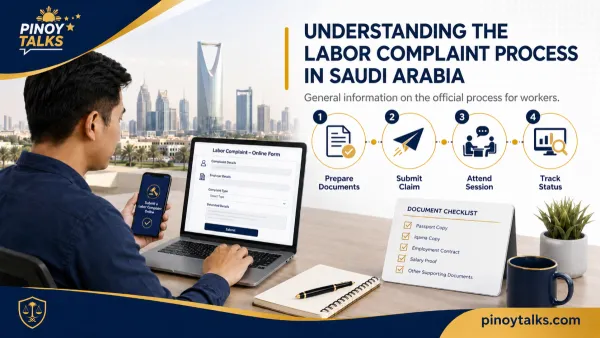
Understanding the labor complaint process in Saudi Arabia
Selecting the wrong location may delay the review or result in a rejection that requires correction.
Step 8: Add the subject of the claim
Select the appropriate:
- Main category
- Subcategory
After selecting the category, complete the requested details and add the subject to the claim.
The official guide confirms that more than one subject may be added. For example, a worker may have separate supported claims involving unpaid salary, overtime and final settlement.
Do not place every concern inside one long emotional statement. Separate each claim according to the relevant category and explain its amount.
Step 9: State the amount and facts clearly
The statement should answer four questions:
- What employment relationship existed?
- What obligation was allegedly not fulfilled?
- When did the issue happen?
- What amount or remedy is being requested?
Use dates, amounts and documentary references. Avoid insults, threats and unrelated allegations.
Sample factual statement for unpaid salary
I worked for [registered employer name] from [start date] as a [job title] under a monthly wage of SAR [amount]. My wages for
have not been paid. I requested payment through [email/message/letter] on [dates], but the amount remains unpaid. The total salary claimed is SAR [amount]. I have attached my employment contract, bank statement, payslips and written requests. I respectfully request payment of the documented unpaid wages and any other entitlement determined by the competent authority.
This is a general writing example only. The worker should replace it with truthful information supported by their own records.
Step 10: Attach the supporting documents
Upload the documents supporting each subject of the claim.
The currently linked HRSD user guide lists PDF, JPG, JPEG, TIF and PNG as accepted attachment formats and states that a single file should not exceed 5 MB. Check the portal’s current upload notice before submitting because technical limits may be updated.
Use clear file names, such as:
Qiwa-Contract.pdfBank-Statement-Jan-to-March.pdfUnpaid-Salary-Calculation.pdfOvertime-Attendance-February.pdfWritten-Request-to-HR.pdf
Make sure the text, dates and amounts are readable.
Step 11: Accept the non-vexatious claim declaration
The system requires the claimant to read and accept a declaration confirming that the claim is not malicious or filed merely to harass the other party.
Review the declaration before accepting it. Do not submit a false claim or deliberately conceal material information.
Step 12: Review everything before submission
The portal displays a review page before final submission.
Check:
- employer identity;
- settlement office;
- employment dates;
- claim categories;
- requested amounts;
- uploaded documents;
- mobile number and email.
Correct errors before pressing the final submission button.
Step 13: Submit the claim and save the reference number
Select Submit Claim.
After submission, the system should display an electronic claim number. Save:
- the claim number;
- confirmation screenshot;
- submission date;
- downloaded application, when available;
- all SMS and email notifications.
The official guide states that the request then enters review and that the claimant is notified of the review result. The guide indicates notification within 48 hours, although actual handling may depend on the application and system processing.
A hotline inquiry or general complaint does not necessarily replace the formal Friendly Settlement claim. Your electronic claim number is important proof that a case was submitted.
What Happens After the Claim Is Submitted?
HRSD specialists review the application and its attachments.
If the application is rejected
The HRSD service instructions state that the reason may be viewed through the claims service in the electronic portal. Correct the stated problem rather than filing repeated duplicate applications without understanding the rejection. ([HRSD][1])
Possible issues may involve:
- incorrect employer;
- wrong territorial office;
- missing proof of employment;
- unsupported claim category;
- incomplete mandatory fields;
- unreadable attachments.
The actual rejection reason shown in the portal should be followed.
If the application is accepted
HRSD sends notifications to the parties. A separate notice normally provides the session date, time and access details. ([HRSD][1])
Do not ignore an Arabic SMS merely because you cannot immediately understand it. Translate it carefully and check the claim inside the official portal.
How to Prepare for the Settlement Session
The official Friendly Settlement user guide describes remote sessions and advises the parties to:
- show identification to the conciliator;
- attend at the specified time;
- use a device with a camera and microphone;
- have a reliable internet connection;
- follow the remote-session link issued for the claim.
The guide describes Webex as the session tool, but workers should follow the actual link and technical instructions sent for their current case because government platforms may update their conferencing system.
Before the session:
- Arrange your evidence by date.
- Prepare a one-page summary.
- Write the exact amount for every claim.
- Test your camera, microphone and internet.
- Keep your original identification nearby.
- Join early.
- Remain respectful and answer only what is asked.
- Do not accept a settlement you do not understand.
The HRSD service page lists Arabic, English and Urdu as service languages. However, the linked remote-session guide states that interpretation is not provided for non-Arabic speakers. Contact HRSD through 19911 before the hearing if language assistance is a concern. Do not assume that an informal companion will automatically be allowed to represent you.
What If the Employer Does Not Attend?
The currently linked HRSD user guide states that if the respondent does not attend, another session may be scheduled and the parties may receive another notification. Employer absence does not automatically mean that the worker immediately wins every amount claimed.
Continue monitoring:
- SMS messages;
- email;
- the “My Claims” section;
- session updates inside the portal.
What If the Worker Misses the Session?
The claimant should make every reasonable effort to attend.
According to HRSD, if the claimant does not attend, the claim may be saved, closed or dismissed. The claimant may be able to reopen it, provided the applicable 21-working-day period has not passed. ([HRSD][1])
Do not assume that a missed session will automatically be rescheduled. Check the claim immediately and contact HRSD at 19911 when necessary.
What Happens If the Parties Reach an Agreement?
When the parties agree, HRSD prepares settlement minutes or a settlement record. The document becomes available through the claims service for printing or downloading.
The official guide also explains that remote settlement minutes may be authenticated using a verification code sent by SMS. Read the settlement carefully before confirming it. ([HRSD][1])
Before accepting, verify:
- total amount;
- payment deadline;
- payment method;
- whether the agreement covers all claims;
- whether any right is being waived;
- what will happen if payment is not made.
Do not share an authentication code with the employer or another person without personally reading and understanding the document being authenticated.
What Happens If No Settlement Is Reached?
If no agreement is reached, HRSD issues a record showing that the dispute could not be settled amicably.
The current Arabic HRSD service page states that the claimant may then submit a statement of claim to the competent Labor Court according to Ministry of Justice procedures. HRSD also describes the Friendly Settlement process as reaching settlement or moving the matter toward the Labor Court within 21 working days from the first session. Follow the exact instructions issued in your case because the required court step may depend on how the claim is processed. ([HRSD][1])
The Ministry of Justice currently lists these general steps:
- Sign in to Najiz using National Single Sign-On.
- Open All Electronic Services.
- Select the Judiciary package.
- Choose File Statement of Claim.
- Select New Application.
- Choose the case category.
- Enter the case and party details.
- Upload the required documents.
- Submit the application.
The Ministry of Justice states that the service includes claims before Labor Courts and generally does not require a court visit unless the applicant receives a notice requiring attendance. (Ministry of Justice)
Official links:
Do not file an unrelated new court case while the Friendly Settlement claim is still pending unless HRSD, the Ministry of Justice or a qualified professional instructs you to do so.
Special Warning for Domestic Workers
A domestic worker should not automatically follow the same private-sector filing route described in this article.
The HRSD Friendly Settlement service conditions specifically state that the worker using this service should not be classified as domestic labor. Saudi Arabia issued separate rules and procedures in 2026 for the amicable settlement of disputes involving domestic workers and similar categories. (HRSD)
Domestic-worker categories may include workers such as:
- housemaids;
- household drivers;
- domestic cleaners;
- private caregivers;
- other workers legally registered under the domestic-worker system.
The worker should check their official classification and contact HRSD at 19911 or use the applicable Musaned and HRSD channel.
Official reference:
HRSD Rules for Settlement of Domestic-Worker Disputes
Common Mistakes That Can Weaken a Labor Complaint
Filing against the wrong establishment
Use the employer’s registered identity rather than a nickname, project name or unrelated company in the same group.
Choosing the wrong settlement office
The competent office is generally connected to the workplace involved in the dispute.
Claiming an amount without showing the computation
List each unpaid month, overtime period or benefit separately.
Uploading incomplete screenshots
A cropped screenshot without the sender, date, amount or context may be difficult to evaluate.
Submitting emotional accusations instead of facts
Focus on dates, contractual obligations, payments, written requests and evidence.
Missing the hearing
Monitor your SMS, email and online claim status.
Stopping work immediately after filing
Filing a claim does not, by itself, terminate the contract or authorize absence. Continue following lawful employment procedures unless the contract has ended, an official authority directs otherwise or a valid legal ground has been properly established.
Signing a settlement without understanding it
A settlement may include waivers or confirm that the dispute has been resolved. Read every provision before confirming it.
Frequently Asked Questions
Is filing a Friendly Settlement claim free?
Yes. HRSD lists the Friendly Settlement service as free. ([HRSD][1])
Do I need a lawyer?
A worker may submit their own claim. When a representative files or appears for the claimant, HRSD requires an appropriate power of attorney authorizing participation in the Friendly Settlement process, including the relevant settlement powers. (HRSD)
Can I file without a Qiwa contract?
A Qiwa contract can be important evidence, but HRSD permits a contract or other proof establishing the employment relationship.
Can I include several unpaid entitlements?
The official user guide allows more than one claim subject to be added. Each subject should be correctly categorized and supported.
Does filing guarantee that I will receive the amount requested?
No. Filing begins the official review and settlement process. The recognized entitlement depends on the applicable law, contract, evidence, employer’s response and determination of the competent authority or court.
Can I leave Saudi Arabia while the case is pending?
Travel and visa consequences depend on the worker’s immigration status, visa, active court measures and case circumstances. Do not assume that submitting a claim automatically prevents travel or protects the claim after departure. Verify the current status with HRSD, Jawazat or the competent authority before making travel arrangements.
Where can I ask for official assistance?
For HRSD service inquiries, call 19911. For Ministry of Justice and Najiz assistance, the official Ministry of Justice service page lists 1950.
Official Sources
- HRSD Friendly Settlement for Labor Disputes
- Official Friendly Settlement User Guide
- HRSD Electronic Services Portal
- Saudi Labor Law – Official HRSD PDF
- Ministry of Justice – File Statement of Claim
- Najiz Portal
Final Reminder for Saudi OFWs
Kabayan, mas magiging malinaw at matibay ang labor complaint kapag maayos ang dokumento, tama ang employer at settlement office, at factual ang bawat statement.
Do not rely solely on verbal promises, social-media advice or unofficial agents. Keep copies of your contract, bank records, salary requests, attendance documents and all official notifications.
Use Friendly Settlement for a genuine employment dispute, attend every scheduled session and follow the instructions issued by HRSD or the competent Saudi authority.
May tanong ka tungkol sa iyong Qiwa contract, salary, EOSB, overtime o notice period?
Join the PinoyTalks Ask the Community and explain your situation without posting your full name, Iqama number, mobile number, bank information or other sensitive details.
Disclaimer: PinoyTalks is an independent educational OFW information and community platform. This article provides general information based on publicly available Saudi government resources and does not constitute legal representation or a guarantee of any case outcome. Procedures, portal interfaces and requirements may be updated by the relevant authorities. The competent HRSD office, Ministry of Justice, Labor Court or other Saudi authority makes the final determination based on the facts and evidence of each case.
[1]: https://www.hrsd.gov.sa/ministry-services/services/269970