Expired Exit/Re-Entry Visa While Outside Saudi Arabia: What OFWs Should Know
Outside Saudi Arabia with an expired exit/re-entry visa? Learn the extension options, Iqama requirements, new-visa rules, and steps OFWs should take.
An expired exit/re-entry visa cannot be used to enter Saudi Arabia. Learn when it may be extended, what happens if the Iqama is also expired, and whether an OFW can return using a new visa.
expired exit re-entry visa outside Saudi Arabia
Kabayan, what happens when you leave Saudi Arabia for vacation or an emergency, but your exit/re-entry visa expires while you are still outside the Kingdom?
This situation can be stressful, especially when:
- your flight is already booked;
- your employer is not responding;
- your Iqama is close to expiring;
- you are unsure whether the company still wants you to return; or
- someone tells you that you are automatically banned from Saudi Arabia.
The most important rule is simple:
An expired exit/re-entry visa cannot be used to return to Saudi Arabia.
The visa may still be extendable from outside the Kingdom if the applicable government platform permits it and the sponsor or employer completes the required procedure. If an extension is no longer available, returning may require a newly approved visa.
This guide explains the current process in a neutral and practical way based on Saudi government services and recent Jawazat guidance.
Quick Answer
If your exit/re-entry visa expires while you are outside Saudi Arabia:
- You cannot use the expired visa to board a flight and enter the Kingdom.
- Your employer, sponsor, or head of household should check whether the visa can be extended electronically.
- The extension may be processed through Absher or Muqeem, depending on your category.
- Your Iqama status and remaining validity may affect whether an extension can be completed.
- An exit/re-entry visa generally cannot be converted into a final-exit visa while the person is outside Saudi Arabia.
- If extension is impossible and the old residency record is closed, you may need a new visa to return.
Jawazat has confirmed that exit/re-entry visas for residents outside the Kingdom can be extended electronically through the applicable Absher or Muqeem service after the required government payment is completed.
What Is an Exit/Re-Entry Visa?
An exit/re-entry visa allows a Saudi resident to:
- leave Saudi Arabia temporarily; and
- return within the visa’s authorized period.
It is different from a final-exit visa.
Exit/re-entry visa
- Used for temporary travel
- Residency relationship normally remains active
- The resident is expected to return within the permitted period
Final-exit visa
- Used to leave Saudi Arabia permanently under the current residency record
- Normally connected with closing or ending the residency arrangement
For detailed information about permanent departure, read the PinoyTalks Final Exit Visa Rules Guide.
Exit/Re-Entry Visa and Iqama Are Different Records
Your exit/re-entry visa and Iqama are related, but they are not the same document.
A worker may have:
- a valid Iqama but an expired exit/re-entry visa;
- an active exit/re-entry visa but an Iqama that is close to expiry; or
- both an expired visa and an expired Iqama.
Having a valid Iqama does not automatically allow you to enter Saudi Arabia when the exit/re-entry visa has expired.
Likewise, extending the exit/re-entry visa may require sufficient Iqama validity under the conditions shown by the applicable government platform.
Before taking action, verify both records separately:
- Exit/re-entry visa expiry date
- Iqama expiry date
- Passport validity
- Current sponsor or employer
- Employment or dependent status
Read the PinoyTalks Complete Iqama Guide for OFWs for a broader explanation of Iqama validity and related visa records.
What Happens Immediately After the Visa Expires?
Once the return deadline passes, the traveler should not attempt to use the expired visa to enter Saudi Arabia.
A valid exit/re-entry visa and the required valid residency status are needed for normal re-entry. Recent Jawazat guidance also confirms that an exit/re-entry visa for a resident outside the Kingdom may be extended electronically after payment through the employer or sponsor’s applicable Absher or Muqeem channel.
The visa’s expiry does not necessarily mean that:
- the worker has committed a crime;
- the worker is automatically reported as huroob;
- the employment contract is automatically terminated;
- the worker can never return to Saudi Arabia; or
- a new visa is automatically approved.
The immigration record, employment record, and contract status are separate matters that may require different actions.
Can an Exit/Re-Entry Visa Be Extended From Outside Saudi Arabia?
Yes, Saudi electronic services allow eligible exit/re-entry visas to be extended while the beneficiary is outside the Kingdom.
Jawazat states that extensions for residents outside Saudi Arabia can be completed through Absher or the Muqeem Portal, after payment of the prescribed service fees. The announcement covers single and multiple exit/re-entry visas.
However, an extension is not guaranteed merely because the person is abroad.
The system may review factors such as:
- the beneficiary’s category;
- Iqama validity;
- passport validity;
- current sponsor or employer record;
- visa information;
- requested return date;
- payment of the prescribed fee; and
- any restriction or system issue affecting the record.
The safest approach is to act before the visa expires. When it has already expired, the employer or sponsor should immediately check whether the extension option remains available in the applicable platform.
Who Must Process the Extension?
The person outside Saudi Arabia usually cannot independently change the immigration record without action from the responsible sponsor, employer, or head of household.
The correct channel depends on the person’s category.
Private-sector employee
For a worker sponsored by a company or establishment, the employer normally checks and processes the available visa service through the employer-facing system, commonly Muqeem or another authorized business channel.
Jawazat identifies Muqeem as an official portal through which establishments can complete residency and visa-related transactions.
Dependent or family member
The resident acting as head of household may use the applicable Absher family-member service when its conditions are satisfied.
Domestic worker
The individual employer may use the applicable Absher worker service for an eligible domestic worker outside the Kingdom.
Do not assume that a private-company employee, domestic worker, and dependent follow identical steps. Their electronic menus and conditions may be different.
Current Absher Conditions for Family Members and Domestic Workers
The official Absher service for extending exit/re-entry visas for sponsorees outside the Kingdom applies to eligible family members and domestic workers.
The current service information states that:
- the person whose visa is being extended must be outside Saudi Arabia;
- the beneficiary must have a digital identity on Absher;
- when using a specific return date, that date must be no later than seven days before the Iqama expires; and
- when the extension is requested by a number of days, the Iqama must have at least 90 days of validity, including the requested extension period.
The official workflow includes:
- Sign in to Absher.
- Open the relevant employee or family service.
- Select visa services.
- Choose the service for extending an exit/re-entry visa for a sponsoree outside the Kingdom.
- Select the correct beneficiary.
- Enter the requested visa information.
- Review and confirm the request.
These conditions come from the Absher service for family members and domestic workers. A company employee’s employer should follow the requirements displayed in the employer’s authorized business or Muqeem account.
What If the Iqama Is Also Expired?
An expired Iqama creates a separate problem.
The visa extension may not proceed until the residency record is renewed or otherwise corrected, depending on the person’s category and the options available in the electronic system.
Jawazat has confirmed that certain Iqama renewal and exit/re-entry extension transactions can be completed for residents who are already outside Saudi Arabia through Absher and Muqeem after the prescribed payments are made.
For a private-sector employee, the employer should check:
- work-permit status;
- Iqama renewal eligibility;
- medical insurance or other linked requirements;
- Muqeem record;
- employment status; and
- the exit/re-entry extension option.
For a dependent or domestic worker, the head of household or individual employer should check the applicable Absher service.
Do not buy a ticket until the visa and residency records have been successfully updated and independently verified.
Can the Visa Be Extended After It Has Already Expired?
An already expired visa does not always produce the same result in every case.
Whether it can still be extended may depend on:
- how long ago it expired;
- whether the residency record remains active;
- the category of the beneficiary;
- whether the electronic service still displays the person as eligible;
- whether the record has been changed to “exited and did not return”; and
- any current Jawazat instruction applying to the case.
Therefore, avoid telling a worker that an expired exit/re-entry visa can always be extended.
The accurate advice is:
The employer or sponsor should immediately check the actual Absher or Muqeem record. If the extension service is available, complete it through the official system. If it is unavailable, contact Jawazat for the case-specific procedure.
What Does “Exited and Did Not Return” Mean?
The Arabic status commonly translated as “exited and did not return” may be recorded when a resident leaves Saudi Arabia on an exit/re-entry visa and does not return within the authorized period.
The exact system handling and timing may differ depending on whether the person is:
- a company employee;
- a domestic worker;
- a dependent; or
- another sponsored resident.
Official and published guidance has changed over time, including how and when records are removed or updated. For example, current published guidance for domestic workers describes category-specific handling through Absher and Tawasul rather than a single rule that applies to all residents.
Because of these differences, the sponsor or employer should check the live record rather than relying on an old screenshot or a general social-media post.
“Exited and did not return” is also not automatically the same as a labor-law huroob or absence-from-work report. Immigration and employment records should be checked separately.
Is There Still an Automatic Three-Year Ban?
Older Saudi visa articles often state that a worker who failed to return before an exit/re-entry visa expired would be prevented from entering Saudi Arabia for three years, except when returning to the previous employer.
That information became outdated after a reported policy change effective January 16, 2024.
Saudi Gazette and Okaz reported that Jawazat instructed relevant departments and ports to allow the entry of expatriate workers who had previously failed to return before their exit/re-entry visas expired, ending the earlier automatic three-year restriction.
This does not mean that every former worker can automatically enter Saudi Arabia.
A person returning under a new visa must still satisfy the applicable requirements, which may include:
- a newly approved visa;
- a valid passport;
- medical and recruitment requirements;
- employer and profession eligibility;
- no separate deportation or entry restriction;
- no unresolved identity or immigration issue; and
- compliance with current entry requirements.
Therefore, the accurate statement is:
The old automatic three-year rule was reported lifted in January 2024, but returning still requires a valid visa and successful immigration approval.
Can You Return With a New Work Visa?
A new work visa may be the practical route when:
- the old exit/re-entry visa cannot be extended;
- the former Iqama or sponsorship record has been closed;
- the old employer no longer intends to bring the worker back; or
- a new Saudi employer wishes to recruit the worker.
The new employer must complete the normal work-visa and recruitment process.
The worker should not assume that the old Iqama, old Qiwa contract, or old exit/re-entry visa will be reactivated through the new visa.
Before accepting a new job offer, verify:
- the recruiting company;
- visa profession;
- employment contract;
- salary and benefits;
- recruitment agency authority;
- medical requirements; and
- whether any immigration restriction appears in the official processing system.
A newly approved visa is separate from extending an existing exit/re-entry visa.
Can an Exit/Re-Entry Visa Be Converted to Final Exit While Abroad?
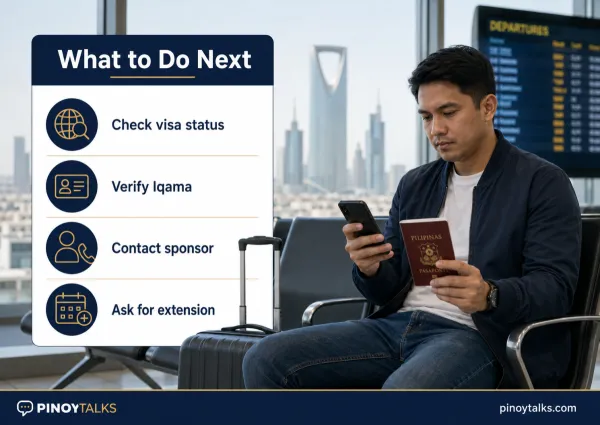
Expired Exit/Re-entry visa, What to do next?
Current Jawazat guidance states that an exit/re-entry visa cannot be converted into a final-exit visa while the beneficiary is outside Saudi Arabia.
This distinction is important.
An employer should not tell a worker:
“You are outside Saudi, so we will simply convert your re-entry visa into final exit.”
The employer may need to complete a different record-closing procedure after the visa expires, or the worker may need to return first if the employment and residency relationship is to be formally completed through an in-Kingdom final-exit process.
The correct procedure depends on the worker’s actual immigration and employment records.
What If the Employer Does Not Want the Worker to Return?
The employer should communicate its decision clearly and complete the appropriate employment and immigration procedures.
The worker should request written clarification about:
- whether the employer will extend the exit/re-entry visa;
- whether the employment contract remains active;
- whether the worker is expected to return;
- whether the employment relationship has been terminated;
- any unpaid salary or final entitlements; and
- what will happen to the worker’s Saudi records.
The worker should also check the employment contract through the PinoyTalks Qiwa Guide.
An expired immigration visa does not automatically settle:
- unpaid salary;
- unused leave;
- End-of-Service Benefits;
- contract compensation; or
- other employment claims.
Those matters may need to be addressed separately under Saudi labor procedures.
What If the Employer Refuses to Extend the Visa?
First, determine whether the employer is legally and contractually expected to bring the worker back.
Relevant questions include:
- Is the contract still active?
- Was the vacation formally approved?
- Did the worker return late without approval?
- Was there a documented emergency?
- Did the employer terminate the contract?
- Is the company still operating?
- Is the Iqama or work permit renewable?
- Is the worker still registered under the employer?
Send a written request asking the employer to confirm whether it will:
- renew the Iqama if necessary;
- extend the exit/re-entry visa; and
- confirm the worker’s return date.
Keep copies of emails, messages, approved leave, medical evidence, flight cancellations, and other relevant documents.
If the refusal creates a labor dispute involving salary, contract termination, benefits, or employer obligations, the worker may contact HRSD through the proper official channel.
Article 40 generally places employment-related Iqama, work-permit, and exit/re-entry visa fees on the employer for covered private-sector workers. Read the PinoyTalks Article 40 Guide for the broader rule and its limitations.
Can the Philippine Embassy or MWO Extend the Visa?
No Philippine office can directly extend a Saudi exit/re-entry visa or alter a Jawazat immigration record.
Only the authorized Saudi sponsor, employer, platform, or competent Saudi authority can complete the immigration transaction.
The Philippine Embassy or Migrant Workers Office may still assist with:
- welfare concerns;
- communication;
- documentation guidance;
- employer disputes;
- referral to the appropriate Saudi authority; or
- explaining available assistance for a distressed OFW.
However, workers should not be told that the Embassy or MWO can personally issue or extend a Saudi visa.
Step-by-Step Action Plan for an OFW Outside Saudi Arabia
Step 1: Check the exact visa status
Verify the current exit/re-entry visa status through an official Saudi service.
Do not rely only on:
- the original printed visa;
- an old screenshot;
- a travel-agency message; or
- the date remembered by the worker.
The Saudi National Platform provides an official Exit/Re-Entry Visa Status service.
Step 2: Check the Iqama expiry date
Confirm whether the Iqama is:
- valid;
- close to expiring; or
- already expired.
Step 3: Contact the responsible employer or sponsor
Send the following details:
- full name;
- Iqama number;
- passport number;
- exit/re-entry visa number;
- visa expiry date;
- intended return date; and
- reason for the delayed return.
Send personal documents only through a trusted and appropriate channel.
Step 4: Ask the sponsor to check Absher or Muqeem
Do not merely ask:
Ask the sponsor to open the official record and confirm:
- whether the extension option is available;
- the maximum available return date;
- whether Iqama renewal is required;
- the required fee; and
- whether the system displays an error.
Step 5: Save the successful confirmation
After extension, request a copy or screenshot showing:
- visa number;
- visa type;
- new return deadline;
- correct passport or Iqama details; and
- successful status.
Step 6: Verify independently
Check the visa again through an official inquiry service before booking or boarding.
Step 7: Confirm airline requirements
The airline may verify immigration eligibility before boarding. Present the current valid travel document, not an expired copy.
Common Mistakes to Avoid
Booking a flight before the visa is extended
A flight booking does not override an expired visa.
Checking only the Iqama
A valid Iqama does not replace a valid exit/re-entry visa.
Believing an old three-year-ban post
Many old articles remain online even though the previous automatic restriction was reported lifted in January 2024.
Paying an unofficial fixer
Do not give your Absher password, Nafath approval, bank OTP, or verification code to anyone promising an instant extension.
Assuming the Embassy can change the visa
The immigration record is controlled through Saudi authorities and platforms.
Confusing exit/re-entry with final exit
An exit/re-entry visa is for temporary travel. It generally cannot simply be converted to final exit while the person is abroad.
Waiting until the travel date
Resolve the visa before going to the airport.
Practical Scenarios
Scenario 1: Visa expired, but Iqama remains valid
The employer should immediately check whether an electronic extension is available through Muqeem or the appropriate platform.
If approved, the worker should verify the new deadline before traveling.
Scenario 2: Visa and Iqama are both expired
The employer may need to address the residency record first. The availability of remote renewal and extension depends on the current system eligibility and worker category.
Scenario 3: Employer ended the contract
The worker should request written termination details and clarification regarding final entitlements. If returning under the former record is no longer possible, a future return may require a new visa.
Scenario 4: Worker found a different Saudi employer
The new company cannot use the expired exit/re-entry visa. It must complete a lawful new work-visa process if the worker is eligible.
Scenario 5: Dependent stayed abroad too long
The head of household should check the Absher family-member service and confirm the dependent’s Iqama and visa status.
Frequently Asked Questions
Can I enter Saudi Arabia one day after my exit/re-entry visa expires?
No. The expired visa is no longer valid for normal re-entry.
Can I extend my own visa while outside Saudi Arabia?
The responsible sponsor, employer, or head of household normally initiates the applicable service. The available channel depends on your category.
Can my employer extend the visa through Muqeem?
Jawazat confirms that eligible exit/re-entry extensions for residents abroad may be completed through Absher or Muqeem after the required payment.
Does my Iqama need to be valid?
Iqama validity is an important condition. The required remaining period may depend on the beneficiary category and the extension option shown by the platform.
Can I return using the expired visa if the airline allows boarding?
No. Airline boarding does not make an expired Saudi visa valid.
Am I automatically huroob?
Not solely because the exit/re-entry visa expired. Employment absence reports and immigration status are separate records.
Am I automatically banned for three years?
The earlier automatic three-year restriction was reported lifted effective January 16, 2024. A valid new visa and normal entry approval are still required.
Can my employer issue final exit while I am outside Saudi Arabia?
Current Jawazat guidance states that an exit/re-entry visa cannot be converted into final exit while the beneficiary remains outside the Kingdom.
Can I return with a new employer?
Potentially, through a newly approved work visa, provided you meet the current immigration and employment requirements and have no separate restriction.
Who should I contact for an official visa inquiry?
Contact the General Directorate of Passports, commonly called Jawazat, or use the official electronic support channel connected to Absher or Muqeem.
Official and Supporting Sources
General Directorate of Passports – Jawazat
Absher Platform
Muqeem Portal
Saudi National Platform – Exit/Re-Entry Visa Status
Saudi Gazette – Three-Year Entry Restriction Lifted
Okaz – Return of Workers Whose Visas Expired
Final Reminder for Saudi OFWs
Kabayan, if your exit/re-entry visa expires while you are outside Saudi Arabia, do not panic—but do not ignore it.
Remember:
- an expired visa cannot be used to return;
- check the Iqama and visa separately;
- ask the employer or sponsor to inspect the live Absher or Muqeem record;
- complete any available extension through official channels;
- verify the new return date before booking;
- do not rely on outdated three-year-ban posts; and
- prepare for a new-visa process if the old record can no longer be extended.
Every case may be affected by the worker’s visa category, residency status, employment record, and the options currently shown by the Saudi electronic system.
Need help understanding your Saudi visa or Iqama situation?
Post a privacy-safe question in the PinoyTalks Ask the Community.
Do not publicly share your full Iqama number, passport number, visa number, QR code, bank details, OTP, or Absher login information.
Disclaimer: PinoyTalks is an independent educational and community platform and is not affiliated with Jawazat, Absher, Muqeem, HRSD, or any Saudi government authority. This article provides general information based on publicly available official services and recent published guidance. It is not immigration representation, legal advice, or a guarantee that a visa will be extended or approved. The applicable Saudi authority and electronic system make the final decision based on the person’s actual record.
Last Reviewed: August 2, 2026