No Medical Insurance in Saudi Arabia: What OFWs Should Do
No medical insurance despite having an Iqama? Learn how to check your Saudi health insurance, contact your employer, and file the correct CHI complaint.
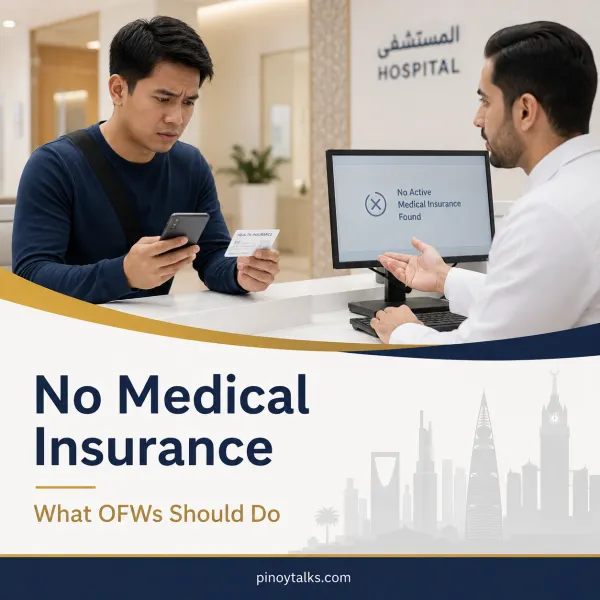
no medical insurance in Saudi Arabia
Kabayan, may valid Iqama ka pero kapag pumunta ka sa clinic o hospital, sinasabi nilang wala kang active medical insurance?
This situation may happen when:
- the employer has not issued a health insurance policy;
- the previous policy has expired;
- a new employer has not yet activated the worker’s coverage;
- the insurance policy exists but is not properly linked to the worker’s government record;
- the clinic is outside the approved provider network;
- the worker’s name, Iqama number or other information is incorrect; or
- the hospital cannot verify the policy through its system.
These are different problems and may require different solutions.
For private-sector employees covered by Saudi health-insurance regulations, employers are generally responsible for providing cooperative health insurance for their employees and eligible resident family members. Coverage also applies during the probation period, and the employer should not require the employee to contribute toward the mandatory insurance premium.
This guide explains how to check your insurance status, identify the actual problem and use the correct official complaint channel.
Quick Answer
If you have no medical insurance in Saudi Arabia:
- Check your insurance status through the official Council of Health Insurance service.
- Confirm whether the policy is missing, expired, inactive or incorrectly linked.
- Contact your employer or HR department in writing.
- Ask for the insurance company name, policy number and effective date.
- If the employer does not provide the required coverage, submit a confidential complaint against the employer through the Council of Health Insurance.
- If a policy already exists but the insurance company refuses a covered service, use the complaint channel against the insurance company.
- If the problem is with a hospital or clinic, use the complaint channel against the healthcare provider.
- If the policy exists but is not connected to your residency record, use the incomplete-data-linkage complaint service.
Do not submit several different complaints for the same issue without first identifying which party is responsible.
Is Medical Insurance Mandatory for Private-Sector Employees?
Saudi health-insurance rules generally require private-sector employers to provide cooperative health-insurance coverage for Saudi and non-Saudi employees and eligible family members covered by the system. The Council of Health Insurance also confirms that employees remain covered during probation.
Article 144 of the Saudi Labor Law separately states that an employer must provide workers with preventive and curative healthcare according to the applicable standards, while taking the Cooperative Health Insurance Law into consideration.
This means that medical insurance should not be treated merely as an optional company benefit when the worker falls under mandatory coverage.
However, the exact policy class, provider network, approval requirements, co-payments and covered services depend on the insurance policy and applicable regulations.
Does the Rule Apply During Probation?
Yes.
The Council of Health Insurance states that employers are responsible for insuring employees throughout the employment relationship, including the probation period.
An employer should therefore not simply tell a newly arrived worker:
“You will receive insurance only after completing three months.”
The worker should ask when the policy was activated and request the policy details.
For a non-Saudi employee, CHI guidance states that coverage begins from entry into Saudi Arabia or from the date of employment-service transfer, subject to completion within the stated processing period.
Can You Have a Valid Iqama but No Active Insurance?
Yes, this can happen.
A worker may still have an unexpired Iqama even if:
- the medical policy expired after the latest Iqama renewal;
- the employer cancelled or failed to renew the insurance;
- the policy is active but the worker’s record is not linked correctly;
- the worker recently transferred employers;
- the insurance company has incorrect identity information; or
- there is a temporary data or system issue.
A valid Iqama therefore does not prove by itself that your medical insurance is currently active.
Likewise, an insurance problem does not automatically mean that the Iqama is already expired.
Check each record separately.
For more information about residency requirements, read the PinoyTalks Complete Iqama Guide.
Medical Insurance, Iqama and Qiwa Are Different Records
Many OFWs confuse these systems.
Medical insurance
Your medical insurance record shows:
- whether coverage is active;
- the insurance company;
- the policy validity;
- covered beneficiaries; and
- the healthcare network available under the policy.
Iqama
Your Iqama is your Saudi resident identity and residency record.
Qiwa contract
Your Qiwa contract records employment information such as:
- employer;
- job title;
- salary;
- allowances;
- contract duration;
- notice period; and
- other contract conditions.
An active Qiwa contract does not automatically prove that the insurance policy is active.
Review your employment record through the PinoyTalks Qiwa Guide for OFWs.
How to Check Your Saudi Medical Insurance Status
Use the official Insurance Information Inquiry service of the Council of Health Insurance.
The current service allows a person to search using a valid document number, which may include:
- National ID;
- passport number;
- border number; or
- visa number.
The result is provided electronically, and the inquiry service itself does not require supporting documents or a fee.
General steps
- Open the Council of Health Insurance services directory.
- Select Health Insurance Inquiry Service or Insurance Information Inquiry.
- Enter the requested identity or document number.
- Enter the verification code.
- Consent to the processing of the information as required.
- Select Search.
- Review the insurance company, policy status and validity information.
Official service: Council of Health Insurance – Insurance Information Inquiry.
Take a screenshot of the result, but cover sensitive information before sharing it with anyone outside the official process.
What Should You Check in the Result?
Confirm the following:
- Is the insurance active or expired?
- What is the insurance company’s name?
- What are the start and expiration dates?
- Is your Iqama or identity information correct?
- Are you listed under your current employer?
- Are your eligible dependents included?
- Does the hospital you visited belong to the policy network?
The result may help determine whether you have:
- no policy at all;
- an expired policy;
- an active policy with incorrect linkage;
- an active policy but a hospital-network issue; or
- a dispute about a particular medical service.
Problem 1: There Is No Insurance Policy
If the official inquiry shows no policy, contact your employer or HR department immediately.
Send a written request such as:
My Council of Health Insurance inquiry currently shows no active health-insurance policy under my record. Please review my coverage and provide the insurance company name, policy number and activation date.
Attach a screenshot of the official result.
Allow the employer a reasonable opportunity to check whether the problem is caused by:
- delayed policy issuance;
- incorrect employee data;
- recent arrival;
- recent transfer;
- cancelled policy;
- unpaid premium; or
- incomplete system linkage.
If the employer does not correct the problem, the worker may file a complaint against the employer through CHI.
Problem 2: The Insurance Policy Has Expired
An expired policy cannot normally be treated as active coverage.
Contact HR and ask:
- When did the policy expire?
- Has renewal already been submitted?
- Is there a new insurance company?
- Is the new policy waiting for activation?
- Is there a data-linking delay?
- When will the updated policy appear in the CHI inquiry?
Keep a screenshot of both the expired status and your request to the employer.
Do not rely only on a verbal statement that “insurance is under process.” Request the new policy details or expected activation date in writing.
Problem 3: The Policy Exists but Is Not Linked Correctly
Sometimes the employer or insurance company may confirm that a policy exists, but it does not appear correctly in the connected government record.
CHI provides a service for complaints involving incomplete minimum-data linkage, including cases where insurance information has not been properly connected to the General Directorate of Passports. The service requires the complainant to identify the insurance company and attach supporting information.
Possible evidence includes:
- insurance certificate;
- policy number;
- insurance-company message;
- CHI inquiry screenshot;
- Iqama copy;
- passport or border-number information; and
- employer confirmation.
Use this service when the problem is a data-linking issue—not when the employer has never purchased a policy.
Problem 4: The Hospital Says Your Insurance Is Not Accepted
An active insurance policy does not mean that every hospital or clinic is part of your network.
CHI beneficiary guidance states that insured persons generally use healthcare providers within the network attached to their policy, except in emergency situations.
Before assuming that the insurance is invalid, ask:
- Is this hospital in my approved network?
- Is a referral required?
- Does this service need prior approval?
- Is there a co-payment?
- Was the request rejected because of missing medical information?
- Did the hospital enter the correct Iqama or policy details?
Contact the insurance company using the customer-service information shown on the policy or application and request a list of approved providers in your city.
Problem 5: The Insurance Company Rejects Treatment
If the policy is active but the insurance company rejects a service, ask for:
- the rejection reason;
- the medical-service code;
- whether prior approval was requested;
- the relevant policy provision;
- what documents are missing; and
- how to request reconsideration.
Do not file a complaint against the employer immediately if the employer has already provided active insurance and the dispute concerns the insurance company’s handling of a claim or approval.
CHI provides a separate complaint service for disputes involving insurance companies.
Prepare:
- policy details;
- medical report;
- prescription or treatment request;
- approval or rejection message;
- invoices;
- insurance-company correspondence; and
- identification information.
Problem 6: The Clinic or Hospital Is the Problem
An insured person may submit an electronic complaint against a healthcare provider when the issue concerns the provider’s handling of the insurance relationship or service. CHI’s provider-complaint service requires valid insurance, accurate provider details, a clear complaint statement and supporting documents.
This route may be relevant when a provider:
- refuses to verify an active policy;
- gives an unclear insurance-related rejection;
- charges an amount that should be reviewed;
- mishandles an approval request; or
- provides incorrect information about the policy.
The complaint should focus on documented facts rather than accusations.
How to File a Confidential Complaint Against the Employer
CHI provides a specific electronic service called Complaint Against Employer.
The service can be used when:
- the employee is not insured;
- eligible family members are not insured; or
- the employer requires the employee to contribute toward mandatory health-insurance premiums.
CHI states that these complaints are handled confidentially and that the employer is contacted without disclosing the complainant’s identity.
Official filing steps
- Open the CHI Complaint Against Employer service.
- Select Start Service.
- Sign in through Nafath.
- Select the complaint-against-employer service.
- Enter the establishment and employer information.
- Enter your personal details.
- Add a previous complaint number if the issue relates to a closed complaint.
- Explain the situation clearly.
- Upload supporting documents.
- Review all information before submitting.
- Save the complaint reference number.
Incorrect or incomplete information may delay the complaint or result in rejection.
CHI indicates that a completed complaint against an employer may be processed within approximately 15 working days when the required information and documents are complete.
Suggested Complaint Statement
Use factual wording:
I am employed by [registered employer name] and my employment relationship began on [date]. My official Council of Health Insurance inquiry currently shows that I do not have active medical-insurance coverage. I informed my employer on [dates] and requested activation, but the issue remains unresolved. I have attached my Iqama, employment information, insurance inquiry result and written communication with the employer. I respectfully request a review of my mandatory health-insurance coverage.
Replace the sample with your actual information.
Do not include claims that you cannot support with evidence.
Documents to Prepare
Depending on the issue, prepare:
- Iqama copy;
- passport or border-number record;
- Qiwa contract;
- employer name and establishment details;
- official insurance-status screenshot;
- expired policy details;
- insurance certificate, if available;
- HR messages or emails;
- hospital rejection message;
- insurance-company rejection;
- medical report;
- prescriptions;
- invoices and receipts; and
- previous complaint number, if applicable.
Do not upload altered screenshots or incomplete documents that hide important context.
Can the Employer Deduct the Insurance Premium From Your Salary?
CHI states that an employer should not ask employees to contribute toward mandatory insurance premiums for themselves or eligible covered family members. The employer-complaint service specifically accepts complaints where an employee is required to contribute to the premium.
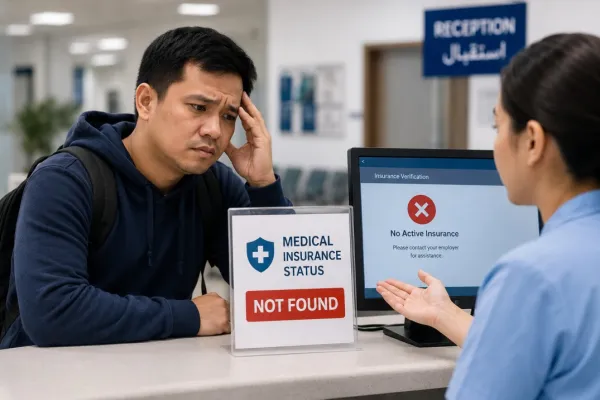
Health insurance in Saudi Arabia
If a deduction appears on your payslip, ask the employer for:
- the written reason;
- the amount;
- the policy involved;
- the contractual basis; and
- confirmation of whether it relates to mandatory coverage or a voluntary upgrade.
A voluntary enhanced policy or optional benefit may involve a different arrangement, but it should not be confused with the employer’s basic mandatory obligation.
Keep the payslip and bank statement showing the deduction.
What About the Employee’s Family?
For covered private-sector employees, CHI rules generally place responsibility on the employer for the employee and eligible resident dependents included under the mandatory system. CHI’s complaint service allows complaints when covered family members have not been insured.
However, not every relative sponsored by an employee is necessarily an employer-covered dependent.
CHI states that the employer is not obligated to insure accompanying relatives such as the employee’s parents, brothers or sisters merely because they reside in Saudi Arabia under the employee’s sponsorship. The sponsor may be responsible for their insurance. Visitors are also governed by visitor-insurance requirements rather than the employee’s workplace policy.
When the dispute concerns a family member, confirm:
- relationship to the employee;
- residency or visit status;
- whether the person is an eligible dependent;
- whether the employer has the correct dependent information; and
- whether another policy applies.
What About Domestic Workers?
Domestic workers follow a separate employment and insurance framework from ordinary Qiwa private-sector employees.
Mandatory health insurance for registered domestic workers began on July 1, 2024, where the number of domestic workers registered under the employer exceeds four. CHI states that the policy includes primary care, public health, emergency cases, hospital admission without cost-sharing, emergency outpatient treatment, vaccinations and examinations.
CHI’s current FAQ also states that the domestic employer is required to insure domestic workers when their number exceeds four.
A housemaid, private driver, household caregiver or another Musaned worker should therefore not automatically follow every Qiwa-based step described for company employees.
The worker or employer should check:
- Musaned record;
- domestic-worker insurance policy;
- number of workers registered under the employer;
- current CHI status; and
- the complaint procedure applicable to the domestic-worker category.
Does Article 40 Cover Medical Insurance?
Article 40 is mainly known for employment-related costs such as recruitment, Iqama, work permits and specified visa or travel expenses.
Medical insurance is more directly governed by the Cooperative Health Insurance framework and Article 144’s healthcare obligation.
For a broader explanation of employer-paid employment expenses, read the PinoyTalks Article 40 Guide.
Do not rely only on Article 40 when filing a medical-insurance complaint. The Council of Health Insurance is the more specific authority for mandatory insurance coverage and insurance-related complaints.
What If You Need Urgent Treatment?
Do not delay urgent medical attention while waiting for an employment dispute to be resolved.
Go to an appropriate emergency department or seek immediate medical assistance.
Keep copies of:
- medical reports;
- invoices;
- receipts;
- prescriptions;
- admission records;
- insurance inquiries; and
- messages to the employer or insurance company.
Whether costs can later be recovered depends on the policy, emergency circumstances and the decision of the competent insurance or legal authority.
CHI notes that normal healthcare access is through the policy’s approved provider network, except in emergency situations.
Can CHI Award Compensation?
CHI can review insurance compliance and complaints, but its FAQ states that it is not the authority that decides an employee’s separate compensation claim against an employer for damages arising from lack of insurance. Such compensation claims may need to be raised through the competent labor court.
This distinction is important:
- CHI complaint: seeks correction of the insurance violation or insurance-service problem.
- Labor claim: may concern financial compensation or damages arising from the employer’s conduct.
Do not assume that filing a CHI complaint automatically produces a cash award.
Penalties for Employers Who Do Not Provide Insurance
Article 14 of the Cooperative Health Insurance framework provides that an employer who fails to insure covered employees or pay the required premiums may be required to pay the outstanding premiums and may face a fine of up to the annual subscription amount for each affected person. Recruitment restrictions may also be imposed.
The decision to impose a penalty belongs to the competent Saudi authority.
A worker should not threaten the employer with a specific fine. The safer approach is to document the issue and submit it through the official channel.
Common Mistakes to Avoid
Assuming no hospital acceptance means no policy
The hospital may simply be outside your provider network.
Checking only the Iqama
A valid Iqama does not confirm that the health-insurance policy is active today.
Filing against the wrong party
Use the employer complaint for missing mandatory coverage, the insurer complaint for policy handling and the provider complaint for a hospital or clinic issue.
Paying an unofficial agent
Insurance activation and complaints should be handled through the employer, qualified insurer and official CHI services.
Sharing your OTP
Never give another person your Nafath approval, verification code or account password.
Posting private medical records publicly
Remove your Iqama number, medical details, policy number and QR codes before posting in a community.
Leaving work immediately
The absence of insurance does not automatically authorize the worker to disappear from the workplace or work for another employer.
Use the proper complaint process and obtain case-specific guidance before making a major employment decision.
Frequently Asked Questions
I have an Iqama but no medical insurance. Is that possible?
Yes. The policy may have expired, been cancelled, not yet activated or failed to link correctly to the worker’s record.
Who should provide insurance for a private-sector OFW?
The employer is generally responsible for mandatory insurance for covered employees and eligible family members.
Am I covered during probation?
Yes. CHI states that employer-provided insurance applies during probation.
Can my employer ask me to pay the premium?
The employer should not require employees to contribute toward the mandatory premium. CHI accepts confidential complaints about this issue.
How do I check my insurance?
Use the official CHI Insurance Information Inquiry service and enter the requested valid document number.
What if my insurance exists but is not linked to my Iqama?
Use the CHI incomplete-minimum-data-linkage complaint service and attach proof of the policy.
What if the hospital refuses my insurance?
Confirm whether the provider is inside your network and whether prior approval is required. Contact the insurer before filing the appropriate complaint.
Is the complaint against the employer confidential?
CHI states that employer complaints are handled confidentially and that the complainant’s identity is not disclosed when the employer is contacted.
Can CHI order compensation for my medical expenses?
CHI states that separate compensation claims against an employer fall outside its authority and may require a labor-court claim.
Can I file a complaint for my family member?
The CHI employer-complaint service covers eligible family members who should have been insured. The exact filing information depends on the relationship and insurance eligibility.
Official Saudi Sources
- Council of Health Insurance – Insurance Information Inquiry
- Council of Health Insurance – Complaint Against Employer
- Council of Health Insurance – Employer Duties
- Council of Health Insurance – Frequently Asked Questions
- HRSD – Saudi Labor Law Article 144
- Council of Health Insurance – Incomplete Data Linkage Complaint
Final Reminder for Saudi OFWs
Kabayan, kapag walang lumalabas na active medical insurance, huwag agad mag-assume na pareho ang problema sa lahat ng kaso.
First determine whether:
- no policy was issued;
- the policy expired;
- the policy is not linked;
- the hospital is outside the network;
- prior approval is missing;
- the insurer rejected a service; or
- the employer failed to include an eligible dependent.
Then use the correct official process.
Check your insurance regularly, keep your employer informed in writing and save copies of all policy records, hospital messages and complaint reference numbers.
For questions based on your personal situation, post a privacy-safe version in the PinoyTalks community. Do not include your full Iqama number, medical records, insurance number, OTP or other sensitive information.
Disclaimer: PinoyTalks is an independent educational and community platform. It is not affiliated with the Council of Health Insurance, HRSD, Qiwa, Absher, Musaned or any Saudi government authority. This article provides general information based on publicly available official sources and does not constitute medical advice, legal representation or a guarantee of insurance approval, reimbursement or compensation. The competent insurer, healthcare provider and Saudi authority make the final determination based on the applicable policy and the facts of each case.
Last Reviewed: August 5, 2026