Musaned Records 122,000+ Domestic Worker Service Transfer Requests in H1 2026: What OFWs Should Know
Saudi Arabia’s Musaned recorded more than 122,000 domestic-worker service transfer requests in the first half of 2026. Here’s what Filipino domestic workers should understand about Musaned transfers.
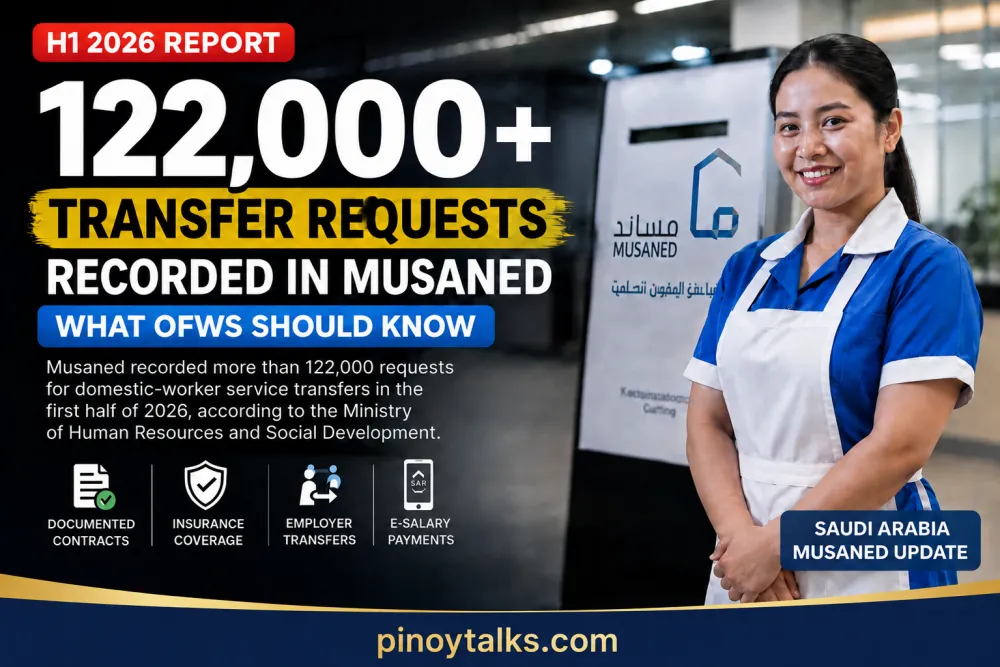
Musaned domestic worker transfer requests 2026
More Than 122,000 Transfer Requests Recorded in Just Six Months
May bagong update mula sa Saudi Ministry of Human Resources and Social Development tungkol sa Musaned—and this is particularly relevant for domestic workers in Saudi Arabia.
According to the Ministry, the Musaned platform recorded more than 122,000 requests for transfer of services during the first half of 2026, covering the period from January to June.
The same official report shows that Musaned is increasingly becoming the central digital platform for recruitment, contracts, salary documentation, employer transfers, insurance, and other services involving domestic workers in Saudi Arabia.
Pero mahalagang linawin agad ang isang bagay:
122,000+ service transfer requests does not necessarily mean that 122,000 workers successfully completed a transfer.
The Ministry specifically reported requests for transfer of services. The announcement did not state that every request was approved or completed.
For Filipino domestic workers, this distinction is important because every transfer can still depend on the worker's circumstances, contract status, employer participation, Musaned eligibility, and applicable Saudi regulations.
What Exactly Is a “Transfer of Services”?
In Saudi employment terminology, a transfer of services generally refers to moving the worker's registered employment relationship from the current employer to another eligible employer through the official system.
For domestic workers, the relevant platform is Musaned.
This is different from most private-sector company employees, whose employment contracts and labor mobility processes are generally handled through Qiwa.
Under the Musaned individual-to-individual transfer service, the current employer can initiate the transfer of a domestic worker to a new employer, subject to the required approvals and system conditions. The process includes the domestic worker's approval and the creation of a new employment contract, with the remaining procedures completed through the connected government systems.
If you are still unfamiliar with Musaned, read the PinoyTalks Musaned Domestic Workers Complete Guide, which explains how the platform differs from Qiwa and what services are available to household workers. Musaned Domestic Workers Complete Guide
Does the 122,000 Figure Mean Transfers Are Now Automatic?
No.
The new statistics show that Musaned is processing a significant volume of transfer activity, but they do not create a new automatic right to transfer in every situation.
For the standard transfer of a domestic worker between individual employers, the Ministry has previously explained that the process generally involves approval from the parties to the employment relationship: the current employer, the worker, and the new employer.
There are, however, specific cases under Saudi regulations where a domestic worker's services may be transferred without the current employer's approval, subject to the applicable conditions and verification by the competent authorities.
Examples found in official HRSD rules include certain cases involving prolonged unpaid wages, failure to issue or renew residency within specified conditions, mistreatment, assigning the worker to others, an incorrect absence report, and other circumstances recognized by the Ministry.
This means an OFW should not assume:
“Marami nang nakapag-transfer, kaya puwede na rin akong lumipat kahit walang approval.”
The 122,000+ figure is an operational statistic. A worker's eligibility still has to be determined according to the actual case and the official Musaned process.
For a deeper explanation, PinoyTalks also has a guide covering domestic-worker employer transfers and Musaned procedures. Domestic Worker Transfer in Saudi Arabia After Contract
Musaned Is Becoming a Much Bigger Domestic-Worker Platform
The 122,000 transfer requests are only one part of the Ministry's H1 2026 report.
During the same six-month period, Musaned also reported:
- More than 450,000 contractual insurance policies
- Recruitment access from 39 countries
- Recruitment covering 27 professions
- 6,164 external recruitment agencies
- 721 domestic recruitment offices
- An average worker-arrival period of approximately 50 days
- Expansion of electronic salary-payment channels to 16 channels
These numbers show how Saudi Arabia is moving more domestic-worker transactions into documented digital systems instead of relying mainly on informal or manual arrangements.
Why This Matters to Filipino Domestic Workers
For Filipino household workers, one of the biggest practical changes is that more stages of the employment relationship can now leave an official digital record.
Recruitment is documented.
Contracts can be documented.
Salary payments are increasingly documented.
Employer transfers can be processed digitally.
Insurance and other employment-related services are being linked to the same ecosystem.
This can make it easier for both the worker and employer to establish what officially happened during the employment relationship.
However, workers should still distinguish between what appears in Musaned and what someone verbally promises.
For example, if an employer says:
“Papayagan kitang mag-transfer pagkatapos ng contract.”
That verbal statement should not automatically be treated as proof that the transfer is already approved.
The actual transfer still needs to go through the applicable official process.
Salary Documentation Is Also Expanding
Another major development highlighted in the report is the continued expansion of electronic salary payments for domestic workers.
As of January 1, 2026, the final stage of Saudi Arabia's electronic domestic-worker salary-transfer requirement applies to all individual domestic-worker employers covered by the system.
The Ministry says these electronic payments help document whether salaries were paid, improve financial transparency, and provide reliable payment records for the employment relationship.
Musaned reported that salary-payment channels had expanded to 16 channels during H1 2026.
Filipino domestic workers who want to understand how salary transfers work can read the PinoyTalks Musaned Salary Transfer Guide for Filipino Domestic Workers in Saudi Arabia 2026. Musaned Salary Transfer Guide 2026
Musaned Also Expanded Worker-Protection Measures
The H1 2026 report also highlighted several regulatory initiatives connected to the domestic-worker sector.
These included the work-absence policy, medical insurance for domestic workers, and a grace period provided for certain domestic workers to correct their status.
The Ministry described these initiatives as part of its efforts to improve compliance, contractual stability, transparency, and protection of the parties involved.
This follows Musaned's broader development during 2025.
In a separate official report published in May 2026, the Ministry said more than 490,000 users benefited from employment-service transfer services during 2025. It also reported that 3,756 female domestic workers benefited from eligible transfer cases that did not require the current employer's approval.
The figures should not be directly compared as identical statistics because the Ministry described them differently: one refers to beneficiaries during 2025, while the H1 2026 figure refers specifically to transfer-service requests.
Still, both reports show the growing role of digital labor mobility within the domestic-worker sector.
What Should an OFW Check Before a Musaned Transfer?
If you are considering changing employers, do not base the decision only on the headline that Musaned processed more than 122,000 transfer requests.
Check your own official records first.
Confirm your Musaned contract and registered employer, your Iqama status, whether the current contractual relationship has actually ended or remains active, whether a transfer request has already been submitted, and whether Musaned is requesting an action or approval from you.
If you believe your situation qualifies for a transfer without the current employer's approval, the qualifying condition should also be verified through Musaned or HRSD rather than assumed from another worker's case.
Different domestic-worker cases can produce different results.
Important: Musaned and Qiwa Are Not the Same
One common source of confusion among OFWs is applying Qiwa procedures to domestic-worker cases.
Generally:
Private-sector/company employee → Qiwa
Domestic or household worker → Musaned
A company worker asking about resignation, contract termination, notice period, or transfer will normally be looking at a different regulatory and digital framework from a domestic helper, household driver, domestic cook, caregiver, or another profession classified under the domestic-worker system.
So before following advice online, first identify which system actually covers your employment.
Bottom Line
The latest official numbers are significant.
Saudi Arabia's Musaned platform recorded more than 122,000 domestic-worker service transfer requests during the first half of 2026, alongside more than 450,000 contractual insurance policies and continued expansion of digital salary-payment and recruitment services.
For OFWs, the important takeaway is not that transfer has suddenly become automatic.
The bigger development is that domestic-worker employment in Saudi Arabia is becoming increasingly digital, documented, and processed through Musaned.
Kung nagpaplanong lumipat ng employer, tingnan muna ang actual Musaned status, contract, Iqama, at eligibility ng iyong sariling case. Huwag i-assume na pareho ang proseso ng bawat worker dahil lamang may ibang OFW na nakapag-transfer.
May personal Musaned, domestic-worker contract, salary, o employer-transfer question? Join and ask your question in the PinoyTalks Ask the Community so your specific situation can be discussed separately.
Disclaimer
This article is provided for general educational and informational purposes only. It is not legal advice, immigration advice, or an official government interpretation.
Saudi regulations, Musaned procedures, eligibility requirements, digital services, and government policies may change. The outcome of an employer-transfer request depends on the worker's actual employment records, contract, residency status, applicable regulations, and decisions of the competent Saudi authorities.
PinoyTalks.com is an independent Filipino OFW information and community platform and is not affiliated with or endorsed by HRSD, Musaned, Absher, Jawazat, or any Saudi government authority.
Always verify your personal case through official Saudi channels before making employment, transfer, residency, or travel decisions.
Last verified: August 27, 2026