Unpaid salary in Saudi Arabia? Learn how qualifying Qiwa contracts may be enforced through Najiz after 30 days of full non-payment or 90 days of partial payment.
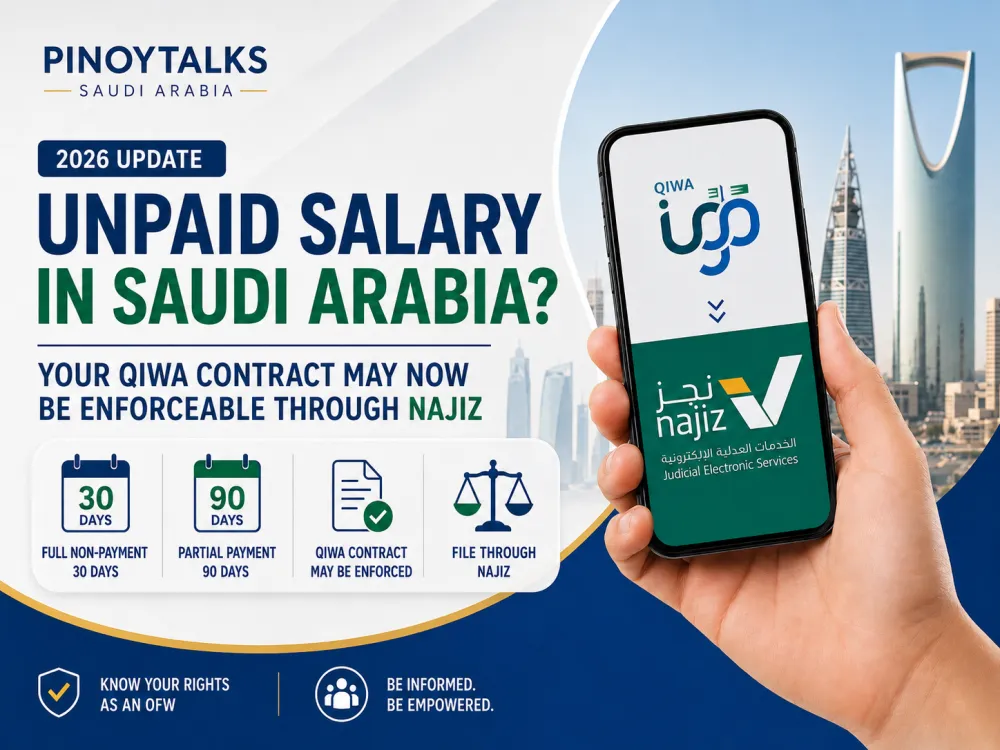
Qiwa contract unpaid salary Saudi Arabia
Kabayan, delayed na naman ba ang salary mo—or mas mabigat pa, isang buwan ka nang walang natatanggap kahit malinaw naman sa Qiwa contract kung magkano ang dapat mong sahod?
Saudi Arabia has introduced an important wage-enforcement mechanism that private-sector OFWs and other expatriate workers should understand.
Under the Documented Employment Contract as an Enforceable Instrument initiative, the wage clause of a qualifying employment contract documented through Qiwa can be treated as an enforceable instrument.
This means that in qualifying cases, a worker whose agreed wage has not been paid may be able to submit an enforcement request through the Ministry of Justice's Najiz platform, rather than first having to establish the wage obligation through a separate ordinary labor lawsuit.
The mechanism is supported by electronic integration involving Saudi labor and justice systems, including wage-payment information under the Wage Protection framework.
However, one important limitation must be understood from the beginning:
Not every contract visible in Qiwa is automatically enforceable through Najiz.
Specific eligibility requirements apply.
Quick Answer: When Can an Unpaid Wage Become Enforceable?
According to the official MHRSD guidance, the waiting period depends on whether the employer failed to pay the entire wage or paid only part of it.
Salary situation | Enforcement timing under the initiative |
|---|
Full wage was not paid | After 30 days from the wage due date |
Only part of the wage was paid | After 90 days from the wage due date |
For example, if your full salary was due on August 1 and you received nothing, the wage-enforcement mechanism may become available after the applicable 30-day period, provided your employment contract qualifies under the initiative.
If your employer paid only part of your contractual wage, the official guidance applies a longer 90-day period from the wage due date.
This distinction is critical:
Full non-payment: 30 days
Partial payment: 90 days
External source: MHRSD Official Guidance on the Documented Employment Contract as an Enforceable Instrument
What Does “Qiwa Contract as an Enforceable Instrument” Mean?
A normal employment contract records the rights and obligations agreed between the employer and employee.
If a dispute arises, the worker may normally need to establish what was contractually owed and what the employer failed to pay.
Saudi Arabia's enforceable-contract initiative strengthens the legal and procedural value of the documented wage clause.
Under the initiative developed by the Ministry of Human Resources and Social Development (MHRSD) in coordination with the Ministry of Justice, qualifying wage clauses in documented employment contracts can acquire enforceable status through electronic integration between government systems.
The purpose is to accelerate the enforcement of clear wage obligations and strengthen the reliability of documented employment contracts.
In practical terms, the salary recorded in a qualifying Qiwa contract may become more than simply a contractual reference.
It can potentially form the basis of a direct enforcement request when the required conditions are met.
Not Every Qiwa Contract Automatically Qualifies
This is one of the most important points in this guide.
According to MHRSD's official guidance, the enforceable-contract initiative requires more than simply having an employment contract displayed in Qiwa.
The contract must fall under the applicable documented executive employment-contract framework and must have the required integration with the Ministry of Justice.
A key requirement identified in the official guidance is an Execution Number issued through the Ministry of Justice Documentation Center.
Therefore:
Having a Qiwa contract does not automatically mean that the contract is already enforceable through Najiz.
Workers should first verify whether their particular employment contract has been brought under the enforceable-contract framework.
If you are still reviewing your Qiwa employment terms, read:
Qiwa Contract Explained: Complete Guide for OFWs in Saudi Arabia
Why August 2026 Is Important
The initiative was introduced in phases rather than applying to every employment contract simultaneously.
The rollout covered different types of contracts at different stages.
Phase 1 — October 6, 2025
The first phase covered new employment contracts and contracts whose terms were updated.
Phase 2 — March 6, 2026
The second phase expanded implementation to fixed-term contracts when renewed or extended.
Phase 3 — August 6, 2026
The third phase extended implementation to indefinite or open-ended employment contracts.
This makes the initiative especially relevant in 2026 for workers whose Qiwa contracts were recently created, renewed, extended, updated, or converted into an indefinite contractual relationship.
However, the rollout date alone does not prove that a particular contract is enforceable.
Workers should still verify the actual status and documentation of their contract.
Which Salary Components May Be Covered?
The enforceable wage clause is not necessarily limited to the worker's basic salary.
According to official MHRSD guidance, applicable documented cash wage components may include:
- Basic salary
- Housing allowance
- Transportation allowance
- Other documented cash allowances, where applicable
For example:
Basic salary: SAR 2,500
Housing allowance: SAR 500
Transportation allowance: SAR 300
If these amounts are properly documented as contractual wage components, the relevant wage clause may include more than the SAR 2,500 basic salary alone.
This is one reason workers should carefully review salary details before accepting or approving an employment contract in Qiwa.
Incorrect or incomplete salary information can become important later if a wage dispute arises.
How Is Wage Payment Verified?
The system does not rely only on the worker stating that a salary was not paid.
Saudi Arabia's wage-protection infrastructure allows payment information to be verified electronically.
According to MHRSD guidance, wage-payment data can be checked using information connected to the Wage Protection Program.
This helps determine whether the agreed contractual wage was paid according to the recorded wage amount and payment schedule.
The system therefore provides protection for both sides.
If an employer properly paid the agreed wage, electronic payment information may show that.
If the required salary was not paid or was only partially paid, the electronic wage records may likewise support the enforcement process.
How to Submit an Enforcement Request Through Najiz
For a qualifying enforceable employment contract, the process is handled through the Saudi Ministry of Justice's Najiz platform.
The general procedure described by MHRSD is:
Step 1: Access Najiz
Open the official Ministry of Justice Najiz platform.
Visit the Official Najiz Platform
Step 2: Go to Enforcement Services
Locate the Enforcement section.
Step 3: Select Submit Enforcement Request
Choose the appropriate service for submitting an enforcement request.
Step 4: Complete the Required Information
Follow the instructions shown in your Najiz account and provide the information requested by the system.
Because Saudi government platforms can update menus, labels, and workflows, workers should always follow the current instructions appearing in their own Najiz account.
What Happens After the Request Is Submitted?
Submitting an enforcement request does not automatically mean that the employer immediately loses the case.
The employer still has procedural rights.
According to the official MHRSD explanation of the initiative, once the employer is notified of the enforcement request, the employer is given a period in which to settle the obligation or raise an objection.
The Ministry states that the employer has five days to object or make payment after the relevant enforcement notification.
This is why workers should submit accurate information and should not use the process unless the contractual and wage-payment facts support the claim.
Example 1: No Salary Received for More Than 30 Days
Suppose an OFW has the following contractual wage:
Monthly salary: SAR 2,800
Salary due date: July 31
Amount received: SAR 0
More than 30 days have passed from the salary due date.
If the worker's employment contract qualifies as an enforceable documented contract and the required execution information exists, the worker may potentially use the Najiz wage-enforcement mechanism.
The important point is that the worker does not necessarily need to wait for three months in a case of complete wage non-payment under this specific mechanism.
The official guidance uses a 30-day period from the wage due date where the full wage has not been paid.
Example 2: Employer Paid Only Part of the Salary
Suppose the documented salary is:
SAR 3,000
But the employer transfers only:
SAR 1,000
The remaining SAR 2,000 is unpaid.
This is treated differently from receiving no salary at all.
Under the official enforceable-contract guidance, a 90-day period from the wage due date applies to partial-payment situations.
Workers should therefore not automatically assume that every salary shortage becomes enforceable after 30 days.
The answer depends on whether the entire wage was unpaid or only part of it.
Example 3: Qiwa Contract Exists but No Execution Number Is Available
This situation requires caution.
A worker may have an active Qiwa contract showing:
- Employer name
- Job title
- Basic salary
- Allowances
- Contract start date
- Contract end date
- Notice period
- Renewal conditions
However, these details alone do not establish that the contract satisfies the specific requirements of the enforceable-contract initiative.
MHRSD's official guidance identifies the applicable documented employment-contract framework and the Execution Number issued through the Ministry of Justice Documentation Center as important requirements.
Workers should therefore avoid assuming that simply downloading a normal Qiwa contract PDF and uploading it into Najiz automatically creates the same enforcement right.
If the contract does not qualify for this mechanism, other Saudi labor-dispute procedures may still be available.
Najiz Wage Enforcement Is Not the Same as Every Labor Complaint
This distinction is extremely important.
The documented-contract initiative discussed in this article concerns the enforceability of the wage clause in a qualifying employment contract.
It should not be interpreted as meaning:
“Every employment dispute can now be filed directly through Najiz.”
Many labor disputes involve issues that require a broader legal or factual determination.
Examples may include:
- Unpaid overtime
- Disputed termination compensation
- Article 77 compensation
- Article 81 claims
- Unused annual leave
- End-of-Service Benefits
- Unauthorized deductions
- Disputes involving the actual last working day
- Disputed resignation or termination
- Other employment entitlements
Those matters may require a different complaint, settlement, labor-court, or enforcement procedure depending on the circumstances.
The wage-enforcement initiative is specifically designed to accelerate enforcement of eligible documented wage obligations.
For workers facing several months of unpaid salary, also read:
Salary Delayed for 3 Months in Saudi Arabia: Legal Guide for OFWs
Does Filing for Wage Enforcement End Your Qiwa Contract?
No.
Wage enforcement and contract termination are separate matters.
Submitting an enforcement request for unpaid salary does not automatically terminate your employment contract.
Likewise, terminating an employment contract does not automatically settle unpaid salary, unpaid allowances, or other financial entitlements.
Workers should treat these as separate questions:
- What money does the employer owe me?
- What is the current status of my employment contract?
- Do I want to remain employed, transfer, resign, terminate, or leave after contract expiry?
The correct procedure depends on the worker's actual situation.
What If You Want to Leave Because the Employer Is Not Paying You?
Failure to pay wages can become relevant to broader Saudi Labor Law rights.
Article 81 of the Saudi Labor Law may apply where an employer fails to fulfill essential contractual or statutory obligations toward the worker.
However, workers should not treat Article 81 as an automatic resignation shortcut.
The facts, evidence, seriousness of the employer's breach, and applicable procedure remain important.
For a separate explanation, read:
Article 81 Saudi Labor Law Explained: When Can a Worker Leave Without Notice?
For workers who need to understand the Qiwa termination process first, also read:
How to Terminate a Contract in Qiwa: Step-by-Step Guide for OFWs
What If the Contract Already Ended but Final Pay Is Still Unpaid?
That is a related but different issue.
When the employment relationship has ended, Article 88 of the Saudi Labor Law addresses the settlement of the worker's financial rights after termination of employment.
Workers should distinguish between:
Unpaid monthly salary while employment is still active
and
Final financial settlement after employment ends
The final settlement may involve several amounts, including salary, unused leave, End-of-Service Benefits, and other applicable contractual or statutory entitlements.
Read the PinoyTalks guide:
Article 88 Saudi Labor Law Explained: Final Salary and EOSB
Does the New Wage-Enforcement Mechanism Automatically Cover EOSB?
Workers should not assume that it does.
The enforceable-contract initiative described by MHRSD specifically concerns the documented wage clause.
The official guidance refers to components such as basic salary and applicable documented cash allowances.
End-of-Service Benefits are a separate statutory employment entitlement.
An EOSB dispute can involve factors such as:
- Length of service
- Reason the employment relationship ended
- Resignation
- Termination
- Contract expiry
- Applicable salary basis
- Other statutory conditions
Therefore, the existence of a Qiwa enforceable wage clause should not automatically be interpreted as meaning that every EOSB claim can be directly enforced under the same mechanism.
Workers approaching the end of employment can estimate their potential entitlement using:
PinoyTalks End-of-Service Benefits Calculator
The calculator provides an estimate only and does not replace the employer's official computation or a legal determination in a disputed case.
What OFWs Should Check in Qiwa Today
Do not wait for a salary dispute before reviewing your employment contract.
Every worker should regularly check whether the information recorded in Qiwa matches the actual employment arrangement.
Pay particular attention to:
Salary
Confirm that the documented basic salary is correct.
Allowances
Check whether housing, transportation, and other contractual cash allowances are correctly recorded.
Contract Type
Determine whether the contract is fixed-term or indefinite.
Contract Dates
Check the official start date and, where applicable, the contract end date.
Renewal Clause
Review whether the contract contains automatic renewal provisions.
Notice Period
Check how much notice is required for resignation, non-renewal, or other contractual actions.
Latest Contract Version
Make sure the contract displayed in Qiwa is the current version that you actually accepted.
Workers should also keep personal copies of important evidence such as:
- Qiwa employment contract
- Salary slips
- Bank statements
- Wage-transfer records
- Employer emails
- WhatsApp messages concerning unpaid salary
- Qiwa notifications
- MHRSD communications
- Relevant government-case references
Government electronic records are important, but maintaining your own documentation can be valuable if the dispute later extends beyond the directly enforceable wage clause.
Why This Matters for OFWs and Expat Workers in Saudi Arabia
Saudi Arabia has been moving employment relationships toward stronger digital documentation.
Qiwa documents employment contracts.
Wage Protection systems help record salary compliance.
Najiz provides access to Ministry of Justice services.
When these systems are integrated, a properly documented contractual obligation can be easier to verify and enforce.
For workers, this means that the information recorded in Qiwa should never be treated as a minor administrative detail.
The salary written in your contract, the allowances listed there, the contract version you accepted, and the way your employer pays your salary can have significant consequences if a dispute later occurs.
Frequently Asked Questions
Can I use Najiz after only 30 days without salary?
Potentially, yes, if the entire wage was unpaid and the employment contract qualifies under the documented-contract enforceable-instrument initiative.
The official guidance uses a 30-day period from the salary due date for complete wage non-payment.
What if my employer paid only half of my salary?
Partial payment is treated differently.
The official guidance applies a 90-day period from the wage due date where only part of the contractual wage was paid.
Is every Qiwa contract automatically enforceable through Najiz?
No.
A contract being visible in Qiwa does not by itself prove that it qualifies under the enforceable-contract initiative.
The applicable contract documentation and Ministry of Justice execution requirements must be satisfied.
What is an Execution Number?
It is the execution-related identifier associated with a qualifying documented employment contract through the integration with the Ministry of Justice Documentation Center.
Its presence is important when determining whether the contract is covered by the direct wage-enforcement framework.
Does the enforceable amount include allowances?
Applicable documented cash components may include basic salary, housing allowance, transportation allowance, and other recorded cash allowances under the wage clause.
Does filing in Najiz terminate my employment contract?
No.
Wage enforcement and employment-contract termination are separate processes.
Can my employer object to the enforcement request?
Yes.
The employer retains procedural rights and may object or settle the amount within the applicable enforcement period.
Does this replace MHRSD labor complaints?
No.
This mechanism applies specifically to qualifying documented wage obligations.
Other employment disputes may still require the appropriate MHRSD settlement, labor-dispute, Labor Court, or other official procedure.
Can I claim overtime through the same wage-enforcement mechanism?
Do not automatically assume so.
Overtime can involve separate factual and legal questions, including working hours, authorization, records, and applicable overtime calculations.
A separate labor claim may be required.
Can I use the same process for End-of-Service Benefits?
The wage-enforcement initiative should not automatically be treated as an EOSB enforcement mechanism.
EOSB is a separate statutory entitlement and may require a different procedure where the amount or entitlement is disputed.
Official Saudi Sources
For verification, workers should prioritize official Saudi government sources:
Ministry of Human Resources and Social Development — MHRSD
https://www.hrsd.gov.sa/
Qiwa
https://www.qiwa.sa/
Ministry of Justice — Najiz
https://najiz.sa/
Workers should always check current government-platform instructions because electronic services, eligibility requirements, and interface steps can be updated.
Conclusion
Kabayan, kung hindi ka nasasahuran, huwag agad isipin na kailangan mong maghintay ng ilang buwan bago ka magkaroon ng official remedy. Sa qualifying Qiwa contracts, may mas direct nang wage-enforcement mechanism through Najiz—but the contract and the claim must meet the official requirements.
The most important lesson is to understand exactly what is documented in your Qiwa employment contract before a dispute occurs.
A qualifying documented wage clause may provide a significantly stronger enforcement route when the employer fails to pay the agreed salary.
However, workers should distinguish between wage enforcement, labor complaints, contract termination, EOSB claims, overtime claims, and other employment disputes. They are not automatically handled through the same procedure.
Always verify the status of your contract and follow the current instructions issued by MHRSD, Qiwa, and the Ministry of Justice.
If your situation is different or involves several issues at the same time, you can post your case in the PinoyTalks Ask the Community section so the details can be examined based on your actual Qiwa contract and employment situation.
Join and ask your question at PinoyTalks.com.
Disclaimer
This article is for general educational and informational purposes only. It is not legal advice and does not replace guidance from the Saudi Ministry of Human Resources and Social Development, the Ministry of Justice, Qiwa, Najiz, or a qualified legal professional.
Saudi government regulations, procedures, eligibility conditions, and electronic platform features may change. Workers should verify their individual case through the relevant official Saudi government platform before taking action.