Accepted a Qiwa job offer but your transfer is still pending? Learn what happens next, what each status means, and what OFWs in Saudi Arabia should do.
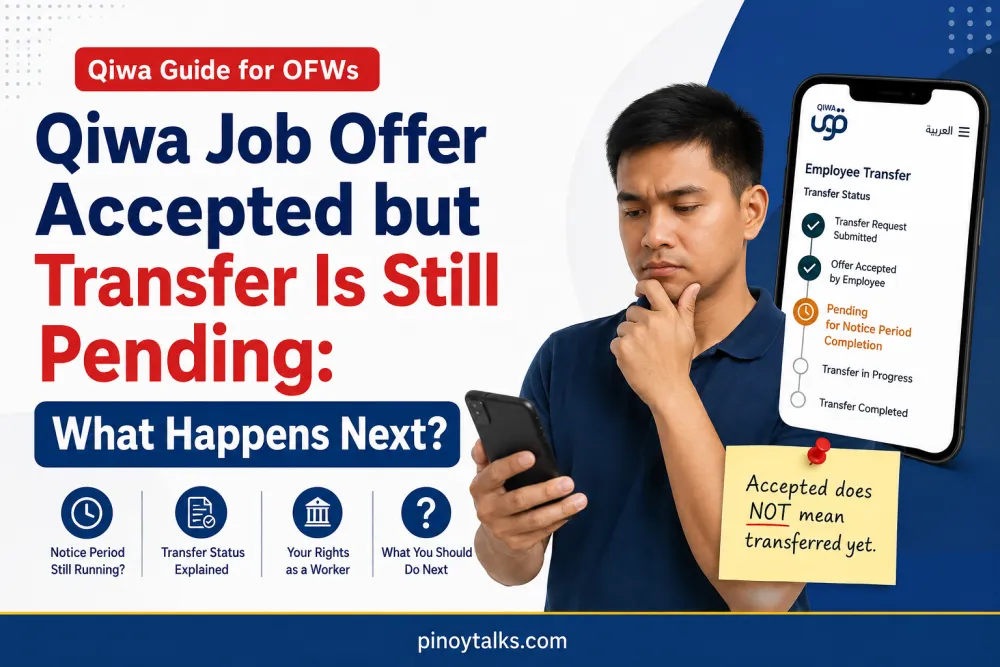
Qiwa job offer accepted but transfer pending
Na-accept mo na ang job offer ng bagong employer sa Qiwa, pero ilang araw na ang lumipas at “pending” pa rin ang transfer. Does this mean there is a problem? Can your current employer still stop you? Should you already stop reporting for work? Or does accepting the Qiwa offer mean transferred ka na automatically?
The most important thing to understand is this:
Accepting a Qiwa job offer does not automatically mean that your employment has already transferred to the new employer.
Your acceptance is an important step in the employee-transfer process, but there may still be a notice period, system verification, establishment eligibility checks, and completion procedures involving connected government systems before your records are officially reflected under the new employer. HRSD describes employee transfer as an electronic process initiated through Qiwa, with the worker reviewing and accepting or rejecting the transfer request.
So if your Qiwa status still says pending, the correct next step depends on exactly what the request is waiting for.
What Happens After You Accept a Qiwa Job Offer?
The normal transfer journey can involve several stages.
The new employer first initiates an Employee Service Transfer request through Qiwa and creates the proposed employment contract. The worker then reviews the request through Qiwa Individuals and accepts or rejects it.
HRSD's employee-transfer service confirms that the receiving establishment initiates the transfer through Qiwa and adds an employment contract for the worker.
After your acceptance, the transfer may still need to move through additional stages before it is considered complete.
A simplified flow looks like this:
New employer sends Qiwa transfer request → Worker reviews the contract → Worker accepts → Applicable notice/transfer conditions are processed → Connected government systems complete the transfer → Worker appears under the new employer
This is why seeing “Accepted”, “Approved”, or a similar status does not necessarily mean that you can immediately start working for the new company.
Why Is My Qiwa Transfer Still Pending After I Accepted?
There is no single reason for every pending transfer. Your Qiwa screen should be treated as the primary indicator of which stage your case has reached.
Common situations include the following.
1. Your Notice Period Is Still Running
One of the most familiar statuses workers encounter is something similar to:
“Pending for Notice Period Completion.”
This usually means the transfer has moved forward, but the employment transition cannot yet reach its effective stage because the applicable notice period has not finished.
Saudi Arabia's Labor Mobility framework allows expatriate employees to move to another employer after expiry of the binding employment contract without requiring the current employer's consent. It also recognizes mobility during an active contractual relationship subject to applicable notice requirements and other conditions.
If Qiwa displays a transfer date or remaining notice-period days, do not automatically interpret the waiting period as a rejection.
For a deeper explanation, read the PinoyTalks guide:
How Notice Period Works in Qiwa: Complete Guide for OFWs in Saudi Arabia
2. Your Current Contract Has Not Reached Its Proper End or Transition Point
A worker can receive and accept a new Qiwa offer while another employment relationship is still relevant to the transfer process.
That does not automatically erase the existing contract.
For non-Saudi workers, Article 37 of the Saudi Labor Law provides that employment contracts must be written and fixed-term. If a duration is not stated, the law treats the contract as one year from the actual commencement date, subject to the applicable renewal rules.
Likewise, Article 74 recognizes several lawful ways an employment contract may end, including expiry of a fixed term, resignation, mutual agreement, and other statutory grounds.
Therefore, accepting the new company's offer should not be confused with saying:
“My old contract disappeared the moment I clicked Accept.”
Those are two different events.
You can learn more about Qiwa contract status here:
Qiwa Saudi Arabia: Complete Guide for OFWs (2026)
Does the Current Employer Still Need to Approve the Transfer?
This depends on the transfer pathway and the worker's circumstances.
There is no safe rule saying that every Qiwa transfer always requires current-employer approval—or that current-employer approval is never required.
For example, HRSD's Labor Mobility framework specifically states that an expatriate worker may transfer to another employer when the documented employment contract ends without requiring the current employer's consent.
There are also regulatory circumstances in which transfer without the current employer's consent may be permitted, including certain cases involving expired documented contracts, work permits, or residence status, subject to the applicable regulations and Qiwa eligibility checks.
This is why two workers can both say:
“I accepted my Qiwa offer.”
Yet one receives a notice-period countdown while another progresses through a different route.
The exact Qiwa status and transfer eligibility matter more than comparing your case with a friend's transfer.
Can My Employer Block Me After I Already Accepted the Offer?
Not necessarily.
If you are legally eligible for mobility through a route that does not require current-employer consent, an employer simply saying “we will not release you” does not by itself establish that the Qiwa transfer can legally be stopped.
HRSD's contractual-relations reform expressly provides mobility after the expiry of the binding work contract without current-employer consent.
However, this does not mean that accepting a new offer allows a worker to ignore the existing contract, notice requirements, pending government procedures, or another legitimate legal issue.
A pending transfer can still fail or be delayed if the requirements of the transfer process are not completed.
Does “Pending” Mean the Transfer Was Rejected?
No.
Pending and rejected are not the same thing.
A pending status normally means that another step, condition, waiting period, or system action has not yet been completed.
For example:
- Pending notice period completion means the waiting period has not finished.
- Pending transfer completion can mean the request has progressed but final transfer procedures have not finished.
- A request awaiting action from the receiving employer may require the new company's HR or authorized representative to complete another step.
- A system-related pending status may involve processing through connected government systems.
HRSD's procedural guidance explains that transfer requests can be sent to other government systems and that the worker's information is reflected under the receiving establishment after completion of the transfer process.
Therefore:
Accepted ≠ Completed
and
Pending ≠ Rejected
Should I Stop Working for My Current Employer After Accepting the New Offer?
Generally, no—not simply because you accepted a Qiwa offer.
Until your current employment relationship has properly ended or the transfer becomes effective under the applicable process, do not assume you are already free to work for the new establishment.
Article 39 of the Saudi Labor Law states that an employer may not allow its worker to work for another employer, and a worker may not work for another employer except according to the prescribed rules and procedures.
That means the risky approach is:
Accept Qiwa offer → stop reporting to current employer → start working for new company immediately
unless the transfer and employment transition have actually been completed or you otherwise have a lawful arrangement allowing it.
Continue observing your contractual obligations, approved leave arrangements, and Qiwa transition dates while the transfer is pending.
PinoyTalks has discussed similar worker situations here:
Transfer and Sponsorship – PinoyTalks Community Discussion
Can I Start Working for the New Employer While the Transfer Is Still Pending?
Do not treat the accepted offer alone as authorization to start working for the new company.
Your Qiwa employment transfer should first reach the proper completion stage.
This matters because your new job offer, new employment contract, transfer request, and completed service transfer are related but not identical stages.
A recruiter saying:
“You accepted already, you can start tomorrow.”
should therefore be checked against your actual Qiwa status.
Ask the new employer's HR whether the employee transfer is already officially completed and whether your records have been transferred to their establishment.
What Should the New Employer Do While the Transfer Is Pending?
The receiving company's HR should monitor the transfer request from its Qiwa Business account.
HRSD lists several establishment-level requirements for employee transfers, including:
- Valid commercial registration
- Active establishment status
- Compliance with Wage Protection requirements
- Valid work permits across establishments under the unified number as applicable
- Required Nitaqat/establishment classification conditions
- Sufficient establishment transfer credit
This means a delay is not automatically caused by the worker or current employer.
The receiving establishment itself must also remain eligible to complete the transaction.
Who Pays the Qiwa or Sponsorship Transfer Fee?
The receiving employer bears the cost of transferring the worker's services.
Article 40(3) of the Saudi Labor Law states that the employer receiving the worker must bear the costs of transferring the worker's services.
Therefore, a worker should be cautious if told:
“You need to personally pay the sponsorship transfer fee before we can hire you.”
The official legal provision places that transfer cost on the employer to whom the worker wishes to transfer.
What If My Contract Already Expired?
This can materially change the transfer analysis.
The Labor Mobility Initiative states that an expatriate worker may transfer to another employer upon expiry of the binding employment contract without needing the current employer's approval.
Article 74 of the Labor Law also recognizes expiry of the fixed contract term as a basis for ending the employment relationship, unless the contract has been renewed according to the applicable rules.
But an expired contract does not mean you should ignore Qiwa.
Check whether:
- the contract truly shows as ended,
- a renewal occurred,
- a termination request is still processing,
- the transfer request is already active,
- Qiwa shows a notice period,
- another system requirement remains outstanding.
Workers dealing specifically with contract-expiry transitions may also find this useful:
Article 74 in Qiwa: Is It an Exit or the Start of a New Job?
What If Qiwa Shows “Pending for Notice Period Completion”?
If the Qiwa system itself shows a notice-period countdown, the safest practical approach is to follow that status rather than assuming the transfer should already have happened.
During this period:
- Continue monitoring Qiwa.
- Save a screenshot of the accepted transfer request.
- Save the expected transfer or notice-completion date displayed by Qiwa.
- Continue complying with your existing employment obligations unless you have a lawful earlier release.
- Keep the new employer informed of the Qiwa timeline.
- Ask the new employer's HR to monitor the request from Qiwa Business.
- Do not begin unauthorized work for the new company.
When the countdown reaches zero, check the status again.
Do not automatically assume the Iqama sponsorship will change at exactly midnight when the notice period reaches zero. Further completion actions or synchronization with connected systems may still be necessary.
What If the Notice Period Is Finished but the Transfer Is Still Pending?
This is the point where the new employer should actively investigate the request.
The worker should send HR a screenshot showing that the notice period is already complete and ask them to check the transfer request in Qiwa Business.
Ask specifically:
“Is there any transfer-completion action still required from your company in Qiwa or the connected government system?”
This is more useful than simply asking:
“Why am I still pending?”
The official HRSD transfer guidance indicates that the process involves connected government systems before completion is reflected in the worker's records.
If there is no clear explanation and the request remains stuck, contact Qiwa support.
How to Contact Qiwa About a Pending Transfer
For Qiwa-specific technical or transfer-status issues, HRSD's official expatriate-services guide lists:
Qiwa Support: 920000105
Email: [support@qiwa.sa](mailto:support@qiwa.sa)
For Ministry of Human Resources and Social Development inquiries, HRSD lists:
HRSD Unified Number: 19911
Official employee-transfer information:
HRSD – Request for Transfer of Expatriate Workers
Official Qiwa contract information:
HRSD – Contract Management Service
When reporting the problem, prepare:
- Iqama number
- Qiwa contract information
- Transfer request date
- Date you accepted the new offer
- Current Qiwa transfer status
- Notice-period completion date, if applicable
- Screenshots of the error or pending status
- New employer details
Avoid sending unnecessary sensitive personal documents publicly on social media or community forums.
Common Mistakes After Accepting a Qiwa Job Offer
Mistake 1: Assuming You Are Already Transferred
Acceptance starts or advances the process. It does not necessarily complete it.
Mistake 2: Stopping Work Immediately
A new offer does not automatically cancel your obligations to your existing employer.
Mistake 3: Starting With the New Employer Too Early
Wait until your transfer and employment status legally permit you to work for the new establishment.
Mistake 4: Ignoring the Notice Period
If Qiwa shows a notice-period countdown, take that date seriously.
Mistake 5: Depending Only on What HR Says Verbally
Check your Qiwa account yourself.
Mistake 6: Paying the Transfer Fee Yourself Without Checking
Article 40 places the transfer cost on the employer receiving the worker.
Mistake 7: Assuming Every Transfer Case Is Identical
Contract expiry, active contracts, establishment eligibility, worker status and other conditions can result in different transfer routes.
Quick Checklist: You Accepted the Offer—What Should You Do Now?
After accepting the Qiwa transfer request:
- Check the exact transfer status.
- Screenshot the accepted offer and transfer details.
- Check whether Qiwa shows a notice-period countdown.
- Verify the expected transfer date.
- Continue complying with your existing employment obligations.
- Do not start unauthorized work for the new employer.
- Ask the new employer to monitor the transfer from Qiwa Business.
- Check whether your current contract is active, terminated, expired, or under notice.
- After the notice period finishes, check Qiwa again.
- If the transfer remains stuck, contact Qiwa at 920000105.
- For labor-law or HRSD assistance, contact 19911.
Frequently Asked Questions
I accepted my Qiwa offer. Am I officially transferred?
Not necessarily. Acceptance is part of the transfer process. The transfer is complete when the required procedures are completed and your employment records are reflected under the new employer.
Why does Qiwa say pending after I accepted?
Possible reasons include an active notice period, pending transfer completion, establishment eligibility requirements, or processing through connected government systems.
Does pending mean my current employer rejected the transfer?
No. A pending status does not automatically mean rejection. Check the exact wording displayed by Qiwa.
Can I work for the new company while Qiwa still shows pending?
Do not assume you can. Article 39 prohibits working for another employer outside the prescribed rules and procedures.
Can my current employer stop my transfer after my contract expires?
HRSD's Labor Mobility framework provides that an expatriate employee may transfer after the binding employment contract expires without requiring current-employer consent, subject to the applicable transfer requirements.
Who pays the transfer fee?
The receiving employer. Article 40(3) places the service-transfer cost on the employer to whom the worker wishes to transfer.
What should I do after my Qiwa notice period reaches zero?
Check the transfer status again and coordinate with the new employer's HR. If it remains pending without a clear reason, the new employer should inspect the request in Qiwa Business and you can contact Qiwa support at 920000105.
Final Takeaway
Kabayan, kung accepted na ang Qiwa job offer pero pending pa rin ang transfer, huwag agad kabahan—but don't assume transferred ka na rin. Acceptance is an important milestone, pero kailangan pa ring tingnan kung may notice period, contract transition, employer-side requirement, o government-system completion na hinihintay.
The safest rule is simple:
Follow the status shown in Qiwa, continue fulfilling your current obligations while the transfer is not yet effective, and do not start working for the new employer until the legal transfer process allows it.
Kung tapos na ang notice period pero hindi pa rin gumagalaw ang status, coordinate first with the new employer's HR and then contact Qiwa support if necessary.
Disclaimer: This article provides general educational information based on Saudi Labor Law and official HRSD/Qiwa guidance available as of September 2, 2026. Individual transfer cases can differ depending on contract status, worker eligibility, establishment compliance, government-system records, and the specific Qiwa transfer pathway. For a case-specific official determination, contact Qiwa or HRSD directly.
Last Updated: September 2, 2026