Yes, Filipino workers continue to be deployed to Saudi Arabia.
The figure itself demonstrates this: 127,447 land-based Filipino workers were reportedly deployed to Saudi Arabia during the first six months of 2026.

Filipino worker deployment in Saudi Arabia
The important development is that the number was lower than during the comparable period in the previous year.
According to the latest reporting citing Department of Migrant Workers Secretary Hans Leo Cacdac, there had not been widespread job losses among existing Filipino workers in Gulf countries, and deployment to the Middle East is expected to recover.
This means OFWs should distinguish between:
“Deployment decreased”
and
“Saudi Arabia stopped hiring Filipinos.”
These statements mean very different things.
As of September 2026, the reported deployment decline should not be presented as evidence of a general Saudi hiring freeze for Filipino workers.
Workers who are already employed in Saudi Arabia should instead focus on their individual employment status. If you are a private-sector employee, our Qiwa Saudi Arabia Complete Guide for OFWs explains how employment contracts, status, transfers and other Qiwa services work.
Is There a New Saudi Work Visa Ban for Filipinos?
There is currently no basis in this deployment report to claim that Saudi Arabia has introduced a general work-visa ban against Filipino workers.
This distinction is particularly important because misleading posts can spread quickly on Facebook, TikTok and other social platforms whenever OFW deployment statistics change.
A decline in deployment numbers is not automatically a visa ban.
A genuine visa restriction or employment-policy change should be verified through official government channels.
For Saudi employment matters, workers should verify announcements directly through the Saudi Ministry of Human Resources and Social Development (HRSD) and Qiwa.
Domestic-worker applicants should also check Musaned for services and requirements applicable to domestic-worker recruitment and employment.
For Philippine deployment and recruitment matters, applicants should rely on the Department of Migrant Workers and other authorized Philippine government channels.
Do not cancel an application or pay someone to “fix” a supposed visa problem based solely on an unverified social-media post.
What Does This Mean for Filipinos Looking for Saudi Jobs?
The latest figures do not mean Filipinos should stop applying for Saudi employment.
They do mean applicants should become more careful about verifying actual opportunities.
1. Verify the recruitment agency and job opportunity
Before paying fees, submitting sensitive documents or committing to a recruitment process, verify the recruiter and overseas job through official Philippine channels.
Do not rely only on a Facebook page, Messenger conversation, WhatsApp number or recruiter ID.
Applicants can start with the Department of Migrant Workers and its official recruitment and overseas-employment services.
A professional-looking advertisement does not automatically mean the vacancy is legitimate.
2. Read the employment terms carefully
Before accepting an offer, understand the:
- Job title
- Basic salary
- Allowances
- Working hours
- Work location
- Accommodation
- Transportation
- Contract duration
- Probation period
- Leave entitlement
- Other contractual benefits
Workers entering Saudi private-sector employment should also understand how their Saudi employment contract will be documented.
Read our Qiwa Contract Explained: Complete Guide for OFWs in Saudi Arabia before accepting a contract you do not fully understand.
3. Make sure the actual job matches the documents
The job you were recruited to perform should be consistent with your employment documentation.
A major mismatch between the promised position, actual work and registered employment information can create complications after arrival.
Filipino workers sometimes also encounter differences between their pre-deployment contract and the employment contract recorded in Saudi Arabia. Our guide on Qiwa Contract vs Agency Contract explains why these documents should be checked carefully before accepting new terms.
4. Understand whether Qiwa or Musaned applies
This distinction is extremely important for first-time Saudi workers.
Private-sector employees working for companies and establishments commonly use Qiwa for employment-related services.
Domestic workers and applicable household occupations operate under a different regulatory framework where Musaned is the relevant government platform.
Visit the official Qiwa platform for applicable private-sector employment services or Musaned for applicable domestic-worker services.
Do not assume that every Saudi worker follows exactly the same employment procedures.
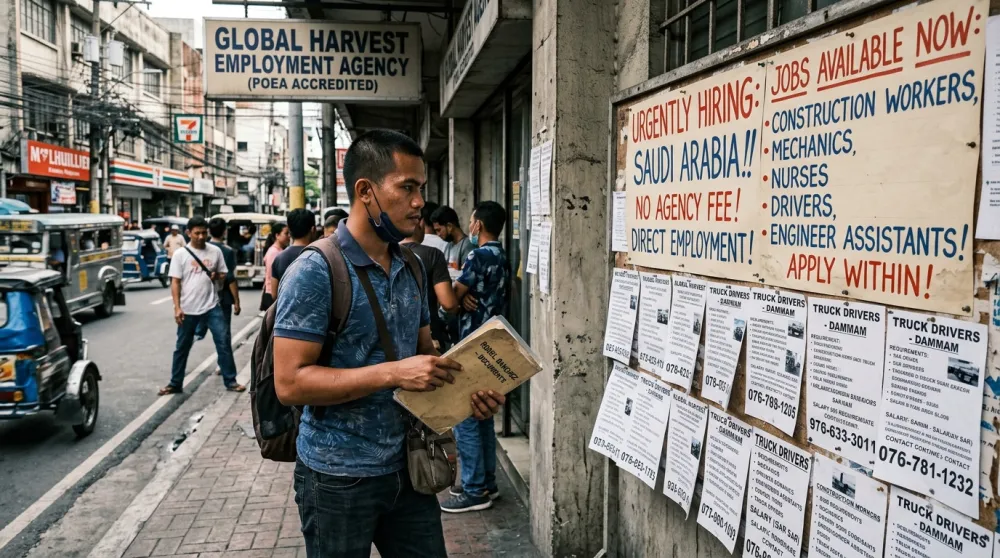
Filipino job seekers looking for work abroad
What About Saudization?
Another issue frequently misunderstood by OFWs is Saudization or Nitaqat.
Saudi Arabia continues to implement localization requirements across selected professions and economic activities as part of its labor-market strategy.
Depending on the occupation, these policies can affect how employers recruit expatriates.
However, Saudization should not automatically be interpreted as:
“Saudi Arabia will no longer hire foreign workers.”
Localization requirements vary according to the applicable profession, activity, establishment and government decision.
For the latest official localization and labor-market announcements, workers and employers should check HRSD rather than relying on screenshots or recycled social-media posts.
For OFWs, the more useful question is:
Is demand for my specific occupation changing?
A technician, construction worker, healthcare professional, engineer, hospitality employee, logistics worker and domestic worker may experience very different employment-market conditions.
Skilled Workers May Need to Pay More Attention to Qualifications
Saudi Arabia's employment system has increasingly emphasized occupational classification, qualifications and matching expatriate workers with appropriate professions.
For Filipino applicants, this makes accurate documentation increasingly important.
Depending on the occupation and applicable Saudi requirements, workers may need documents such as:
- Educational credentials
- Training certificates
- Professional licenses
- Certificates of employment
- Skills documentation
- Other qualification records
Applicants should ensure submitted documents are genuine and consistent.
Workers should never purchase fake certificates merely to satisfy a recruitment requirement.
Before deployment, verify current requirements through HRSD, the applicable Saudi government service and the Department of Migrant Workers.
Existing OFWs Should Not Panic Because of Deployment Numbers
If you are already legally working in Saudi Arabia, the 33.5% decline in new deployment does not by itself change your current Qiwa contract, Iqama, work permit, salary rights or employment relationship.
Deployment statistics primarily describe the movement of workers entering overseas employment during a particular period.
Your existing employment situation remains governed by your actual contract, applicable Saudi regulations and legal employment status.
Private-sector OFWs who are unsure what information is recorded against their employment should read the Complete Qiwa Guide for OFWs.
Your residency status is a separate issue. See our Complete Iqama Guide for OFWs in Saudi Arabia for an explanation of the difference between an Iqama, work permit, employment contract and visa.
If you are experiencing a contract, salary, transfer or employment issue, evaluate that issue based on your individual circumstances—not simply on national deployment statistics.
Could Filipino Deployment Increase Again?
Yes.
Deployment figures can rise or fall depending on economic conditions, recruitment demand, infrastructure projects, regional stability, travel conditions and government policies.
The more useful indicator for OFWs will therefore be what happens over the next several months.
Watch for:
- New Saudi recruitment requirements
- Changes in work-visa procedures
- New Saudization decisions
- Major infrastructure and construction hiring
- Healthcare recruitment
- Hospitality and tourism hiring
- Logistics and industrial recruitment
- Domestic-worker recruitment developments
- New DMW-approved Saudi employment opportunities
Official Saudi employment-policy announcements can be monitored through HRSD, while Philippine applicants should verify deployment information through the Department of Migrant Workers.
These developments will provide a clearer picture of Saudi employment demand than a single six-month statistic.
Beware of Fake Saudi Job Offers
Whenever legitimate overseas opportunities attract attention, scammers follow.
OFWs should be especially cautious about advertisements promising:
“Guaranteed Saudi visa.”
“No interview needed.”
“Pay today, fly next week.”
“Direct hiring—send payment through GCash.”
“100% guaranteed work visa.”
Those claims deserve careful verification.
Never send money, passport copies or sensitive personal information to an unknown recruiter simply because the offer appears urgent.
Verify first through official DMW channels.
Where Can OFWs Check Their Saudi Employment Information?
Use the government platform appropriate to the transaction rather than depending on social-media advice.
For private-sector employment contracts and applicable employment services, use Qiwa.
For domestic-worker services, use Musaned.
For Saudi labor information and official employment-policy announcements, use HRSD.
For Philippine overseas-employment and recruitment information, use the Department of Migrant Workers.
If you're new to these systems, start with the PinoyTalks Complete Qiwa Guide for OFWs and Complete Iqama Guide for a simpler OFW-focused explanation.
Frequently Asked Questions
Did Saudi Arabia stop hiring Filipino workers in 2026?
No general hiring stoppage can be concluded from the reported deployment figures. More than 127,000 land-based Filipino workers were reportedly deployed to Saudi Arabia during the first half of 2026, although the number was substantially lower year-on-year.
Why did Filipino deployment to Saudi Arabia fall?
The recent reporting associated much of the decline with regional conflict and related travel and deployment disruptions. The wider Middle East also experienced a significant decline.
Is there a new Saudi work visa ban for Filipinos?
The reported 33.5% deployment decline is not evidence of a general Saudi work-visa ban on Filipino workers.
Can Filipinos still apply for jobs in Saudi Arabia?
Yes. Applicants should verify the recruitment agency, employment opportunity, offer and applicable Saudi and Philippine requirements before proceeding.
What should I check before accepting a Saudi employment contract?
Check the salary, job title, contract duration, work location, benefits, notice provisions and other conditions. Private-sector workers can also read our Qiwa Contract Explained guide.
Does the deployment decline affect OFWs already working in Saudi Arabia?
Not automatically. The statistic does not itself change an existing worker's Qiwa contract, Iqama, work permit or employment rights.
Where should I verify Saudi employment rules?
Use official Saudi government platforms such as HRSD, Qiwa and Musaned where applicable. Philippine deployment and recruitment information should be verified through the DMW.
Bottom Line
Kabayan, huwag agad matakot kapag nakita mong “33.5% bumaba ang deployment ng Filipino workers sa Saudi.”
The decline is significant and worth monitoring, but the correct interpretation matters.
Saudi Arabia has not suddenly stopped hiring Filipino workers based on this report.
The available figures show fewer Filipino workers were deployed during the first half of 2026, amid broader regional disruptions, while Saudi Arabia remained an important employment destination for Filipino workers.
For jobseekers, the priority should be verifying legitimate opportunities, preparing proper qualifications and following official Saudi and Philippine employment procedures.
For existing OFWs, continue checking your own contract and legal employment status rather than assuming national deployment statistics have changed your individual rights.
Related PinoyTalks Guides
For more practical guides about Saudi Labor Law, Qiwa, Musaned, Iqama, work permits, transfers, contracts and OFW employment issues, visit PinoyTalks.com and join the community.
Disclaimer: This article is for informational and educational purposes only and does not constitute legal advice. Saudi labor rules, Qiwa procedures, Musaned policies, and government regulations may change over time. Readers are encouraged to verify information directly through official Saudi government platforms such as Qiwa, MHRSD, Absher, Musaned, and Najiz.