Learn Saudi Labor Law Article 61 in simple Taglish. Understand employer duties on salary withholding, worker dignity, discrimination, housing, transportation, and worker rights in Saudi Arabia.
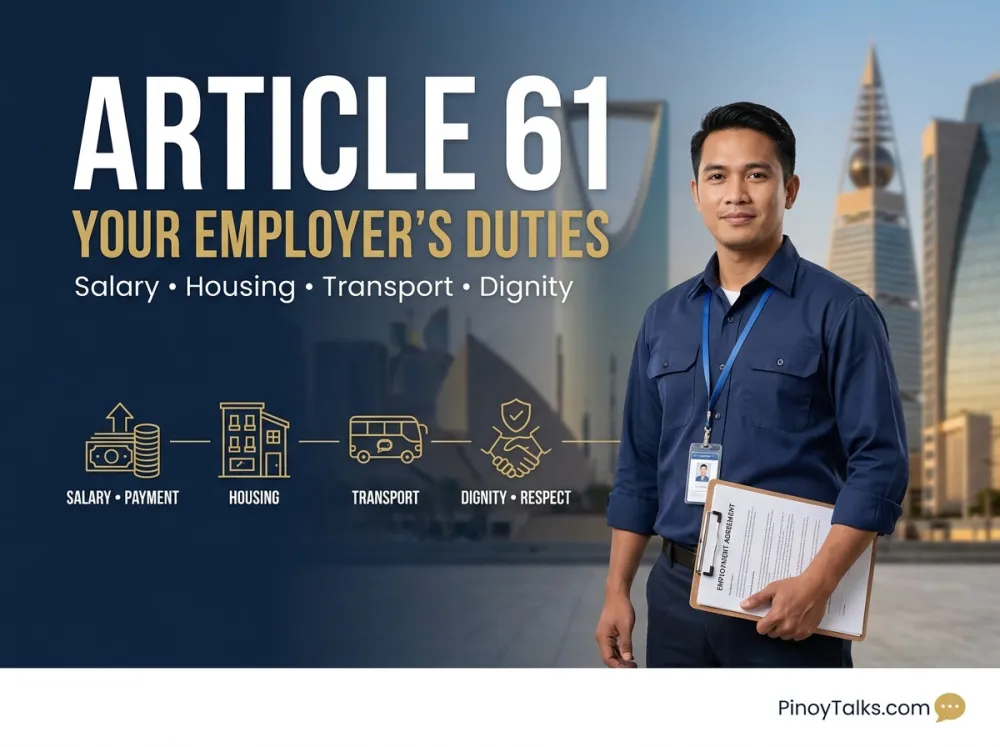
Saudi Labor Law Article 61
Kapag pinag-uusapan ang Saudi Labor Law, madalas ang naririnig ng OFWs ay Article 77, Article 80, Article 81, overtime, resignation, at End-of-Service Benefits.
Pero may isang importanteng provision na dapat ding alam ng bawat private-sector worker:
Saudi Labor Law Article 61.
Article 61 deals directly with the duties of the employer toward workers.
Kasama rito ang rules tungkol sa withholding of wages, forced labor, respectful treatment, worker dignity, equal treatment, suitable housing, at transportation.
At mahalagang malaman na ang Article 61 was affected by the Saudi Labor Law amendments that became effective on February 19, 2025. The current provision now contains six specific employer duties. HRSD confirmed that the 2025 reforms amended 38 Labor Law articles, removed seven provisions, and added two new articles.
For Filipino workers and other expatriates in Saudi Arabia, understanding Article 61 can help answer common questions such as:
“Pwede bang hindi ibigay ng company ang salary ko?”
“Required ba talaga ang accommodation?”
“Kung walang company accommodation, dapat ba may housing allowance?”
“Required ba ang transportation?”
“Pwede bang bastusin o ipahiya ng employer ang worker?”
“May protection ba laban sa discrimination?”
This guide explains the current Article 61 in practical Taglish, based primarily on official Saudi government sources.
What Is Article 61 of the Saudi Labor Law?
Article 61 appears under the section dealing with employers' duties.
Under the current official HRSD text, the employer has six major obligations:
Article 61 Duty | General Requirement |
|---|
Forced labor and wages | No forced labor and no arbitrary withholding of wages |
Exercise of statutory rights | Workers must be given necessary time to exercise Labor Law rights without wage deduction |
Cooperation with authorities | Employer must facilitate competent authorities' enforcement duties |
Equal treatment | Employer must not undermine equality of opportunity or treatment through discrimination |
Housing | Suitable housing or an appropriate cash allowance |
Transportation | Suitable transportation from residence to workplace or an appropriate cash allowance |
These requirements appear in HRSD's current Labor Relations publication.
1. Employer Must Not Use Forced Labor
The first part of Article 61 requires employers to refrain from exploiting workers through forced labor.
Hindi ibig sabihin nito na puwedeng tumanggi ang worker sa lahat ng instructions ng employer.
Employees still have obligations under their employment contract and Saudi law.
The important distinction is between legitimate work required under the employment relationship and work being imposed through unlawful coercion or circumstances amounting to forced labor.
There are also separate Saudi Labor Law provisions dealing with assigning a worker duties fundamentally different from the agreed job.
For example, Article 60 generally restricts an employer from assigning substantially different duties without the worker's written consent, except under specific temporary circumstances.
That is why workers should always know exactly what is written in their employment contract.
If you are unsure about your registered employment terms, read the PinoyTalks Qiwa Contract Explained: Complete Guide for OFWs in Saudi Arabia.
2. Can an Employer Withhold Your Salary?
One of the most important protections in Article 61 concerns wages.
The current HRSD wording states that an employer must not withhold a worker's wage, or part of it, without judicial basis.
In simple terms:
Hindi puwedeng basta hawakan o i-freeze ng employer ang sahod ng worker nang walang legal basis.
But this needs an important clarification.
Article 61 should not be interpreted as saying that every payroll deduction is automatically illegal.
Saudi Labor Law contains separate provisions governing certain lawful deductions and work-related liabilities.
Therefore, workers should distinguish between:
arbitrary withholding of salary
and
a deduction that is specifically permitted under Saudi law or properly established through the applicable legal process.
For example, do not automatically assume that every amount missing from a salary payment is an Article 61 violation. Check the payslip, employment contract, attendance records, loans or advances, and the employer's written explanation.
Saudi Arabia also operates the Wage Protection System, which allows the Ministry to monitor private-sector establishments' wage payment data and compliance. HRSD states that monthly-paid workers should receive their wages monthly.
If your salary has been delayed, you can also read our Salary Delayed for 3 Months in Saudi Arabia: Legal Guide for OFWs.
PinoyTalks also has an updated guide explaining the newer Qiwa wage-enforcement mechanism for applicable documented contracts: Qiwa Contract Wage Enforcement 2026: How OFWs Can Claim Unpaid Salary Through Najiz.
3. Employer Must Respect the Worker's Dignity and Religion
Article 61 is not only about money.
It also requires an employer to treat workers with due respect and refrain from words or actions that infringe upon their dignity or religion.
This is an important provision because workplace disputes are not always about salary.
Some workers experience humiliation, degrading treatment, insults, or other inappropriate treatment.
Article 61 establishes that respectful treatment is part of the employer's statutory responsibilities.
However, workers should also be careful when describing a dispute.
Not every disagreement with a supervisor automatically becomes a Labor Law violation.
There is a difference between a legitimate workplace instruction, criticism of job performance, disciplinary action conducted according to law, and treatment that crosses into humiliation, injustice, abuse, or conduct affecting the worker's dignity.
Documentation is important when the situation becomes serious.
Save relevant messages, written warnings, emails, attendance records, witness information, and other evidence instead of relying only on verbal claims.
4. Workers Must Be Given Time to Exercise Their Labor Law Rights
Article 61 also requires the employer to provide workers the necessary time to exercise rights granted under the Labor Law without deducting wages for that time.
At the same time, the employer may organize how that right is exercised so that normal operations are not unnecessarily disrupted.
This part is sometimes overlooked.
It means that where the Labor Law gives a worker a particular statutory right requiring time to exercise, the employer cannot simply defeat that right by automatically treating the necessary time as unpaid.
But this provision should not be stretched into a general right to leave work whenever the employee chooses.
Article 61 expressly allows the employer to organize the exercise of the right in a way that does not interfere improperly with workflow.
5. Employer Must Cooperate With Competent Saudi Authorities
Article 61 also requires employers to facilitate tasks performed by employees of competent authorities relating to enforcement of the Labor Law.
For workers, the practical point is simple:
Saudi labor compliance is not merely a private agreement between the worker and the employer.
The Ministry of Human Resources and Social Development and other competent Saudi authorities have regulatory and enforcement roles.
HRSD also provides an official service for reporting private-sector labor-regulation violations.
6. Article 61 Now Includes Equal Opportunity and Protection Against Discrimination
One of the important current provisions of Article 61 concerns equality of opportunity and treatment.
The law requires employers to refrain from actions that invalidate or weaken equal opportunity or equal treatment in employment and occupation through exclusion, differentiation, or preference based on factors including race, color, sex, age, disability, marital status, or other forms of discrimination.
This provision was part of the updated Article 61 following the Saudi Labor Law reforms that took effect on February 19, 2025.
This matters not only after hiring but also in employment-related treatment and opportunities.
It reinforces the principle that employment decisions should comply with the Kingdom's applicable labor rules rather than improper discriminatory treatment.
7. Is the Employer Required to Provide Housing?
This is one of the biggest questions for OFWs.
Under the current Article 61:
The employer must provide suitable housing for workers, or the employer may instead provide an appropriate cash allowance paid with the wage.
That means Article 61 provides two alternatives:
Suitable housing
OR
an appropriate cash allowance instead of that housing.
This distinction is very important.
Article 61 does not say that every worker must receive free company accommodation plus a housing allowance.
If the employer already provides suitable accommodation, you should not automatically assume Article 61 also requires a separate housing allowance.
Likewise, if accommodation is not being provided, the current Article 61 allows the housing obligation to be substituted with an appropriate cash allowance.
How Much Should the Housing Allowance Be?
Article 61 itself does not specify a fixed SAR amount or fixed percentage for the housing allowance.
This means claims such as:
“Saudi law requires exactly 25% housing allowance.”
or
“Every worker must receive SAR 500 housing allowance.”
should not be presented as a universal Article 61 rule unless another applicable regulation, contract, sector rule, or legally binding arrangement establishes that amount.
The actual employment arrangement should therefore be checked.
Review your Qiwa contract and payroll records to see whether your package includes basic salary, housing allowance, transportation allowance, or other contractual benefits.
Our Qiwa Saudi Arabia Complete Guide for OFWs explains why workers should examine the salary and allowance breakdown shown in their employment records.
8. What Does “Suitable Housing” Mean?
Article 61 uses the concept of suitable housing.
Workers should avoid assuming that the law guarantees a private apartment, private bedroom, or a specific type of accommodation in every employment situation.
The suitability of accommodation may depend on applicable regulatory standards and the circumstances of the workplace.
There are also additional Labor Law provisions dealing with accommodation in particular circumstances.
For example, Article 147 addresses employers carrying out work in remote areas, mines, quarries, and oil exploration centers, while Article 148 contains additional transportation requirements where workplaces cannot be reached by regular transportation compatible with work schedules.
Therefore, a worker's situation may involve Article 61 together with other applicable rules.
9. Is Transportation Required Under Article 61?
Yes, transportation is also specifically addressed.
Under the current Article 61, the employer must provide suitable transportation for workers from their place of residence to the workplace, or may substitute this with an appropriate cash allowance paid with the wage.
Again, the rule gives alternatives:
Suitable transportation
OR
an appropriate transportation cash allowance.
The law does not say that a worker who is already provided company transportation automatically receives an additional transport allowance.
Is There a Fixed Transportation Allowance?
Article 61 itself does not establish a universal fixed SAR amount or percentage for transportation allowance.
Therefore, always check the employment contract and documented salary structure.
If your Qiwa contract says, for example:
Basic salary — SAR 2,000
Housing allowance — SAR 500
Transportation allowance — SAR 300
then those documented contractual components become important employment records.
Workers should keep copies of the Qiwa contract, payslips, salary bank transfers, and any documents explaining allowances.
You may also obtain employment-related documentation through Qiwa. Read our guide: How to Get a Qiwa Employment Certificate: Free Salary and Tenure Record for Saudi Workers.
10. What If My Contract Says “All-In Salary”?
This is where workers need to be careful.
An employer may describe a salary package as “all-in,” but you should still review how the employment contract records the agreed wage and benefits.
Do not assume from the phrase all-in salary alone that every legal or contractual obligation has automatically been satisfied.
Likewise, do not automatically assume that Article 61 guarantees a specific additional amount on top of an agreed package.
The important questions are:
What does your Qiwa contract say?
Is housing physically provided?
Is transportation physically provided?
Are cash allowances recorded?
What was actually agreed and paid?
Does the arrangement comply with Article 61 and other applicable Saudi rules?
Employment disputes are determined from the actual contract, records, applicable law, and facts—not only from the label “all-in.”
Article 61 vs Article 81: Are They the Same?
No.
Article 61 describes employer duties.
Article 81 deals with specific circumstances in which a worker may leave employment without notice while retaining statutory rights.
Among the Article 81 grounds is the employer's failure to fulfill essential contractual or statutory obligations toward the worker. It also addresses situations involving deception, fundamentally different work assignments contrary to Article 60, certain serious misconduct, harsh or humiliating treatment, serious workplace danger, and conduct effectively forcing the worker to appear as the party terminating the contract.
That does not mean that every alleged Article 61 violation automatically gives the worker a guaranteed Article 81 case.
Whether Article 81 applies depends on the specific facts, seriousness of the violation, evidence, and applicable legal assessment.
Do not simply stop reporting for work because you believe Article 61 has been violated.
Read our full Article 81 Explained: When Can You Leave Your Job Without Penalty in Saudi Arabia? before making an employment decision.
Does Article 61 Apply to Domestic Workers?
This distinction is extremely important for Filipino OFWs.
Article 61 belongs to the general Saudi Labor Law framework applicable to covered workers.
Under Article 7 of the Labor Law, domestic workers and those considered similar are excluded from the general application of the Labor Law and are governed by separate regulations.
Therefore, if you are working as a:
household worker,
private driver,
domestic helper,
or another occupation legally classified under the domestic-worker regime,
do not automatically use Article 61 as though you were a normal Qiwa private-sector employee.
Domestic workers have separate protections under Saudi Arabia's Domestic Workers Regulation.
Those regulations also contain employer obligations involving wages, suitable accommodation, dignity, safety, and other rights, but the legal framework is different.
In practical terms:
Qiwa/private-sector worker → check the Saudi Labor Law and Article 61.
Musaned/domestic worker → check the Domestic Workers Regulation and Musaned framework.
What Should You Do If You Believe Article 61 Is Being Violated?
Do not immediately rely on social media advice or stop working without documenting the situation.
A practical approach is to gather the relevant evidence first: your Qiwa contract, payslips, bank salary records, accommodation or transportation arrangement, written employer communications, photographs where relevant and lawful, and any written request you already sent to HR.
Ask the employer or HR for clarification in writing.
For example, if accommodation is not provided and you cannot identify any housing arrangement in the salary package, ask how the company is implementing the Article 61 housing obligation.
The same principle applies to transportation.
If the issue involves salary, compare your Qiwa wage information, payslip, and actual bank payment.
If the matter cannot be resolved internally, HRSD provides official channels.
The Ministry's Reporting Violations of Labor Regulations service allows users to report private-sector labor-regulation violations.
For qualifying labor disputes, HRSD's Friendly Settlement for Labor Disputes is the first stage for labor-dispute claims between workers and employers. HRSD states that the service attempts an amicable settlement and may refer unresolved cases to the Labor Court under the applicable procedure. The official HRSD service lists 19911 as its contact number.
Common Article 61 Scenarios for OFWs
Scenario 1: Company Provides Free Accommodation but No Housing Allowance
Do not automatically conclude that this violates Article 61.
The current law permits suitable housing or an appropriate cash allowance instead.
The key question is whether suitable housing is actually being provided.
Scenario 2: Company Provides a Bus to Work but No Transportation Allowance
Again, Article 61 provides alternatives.
If suitable transportation from the residence to the workplace is provided, a separate cash transportation allowance is not automatically required by Article 61 itself.
Scenario 3: No Accommodation and No Housing Allowance
This deserves closer review under the current Article 61.
Check your Qiwa contract and salary breakdown and ask the employer how the housing obligation is being fulfilled.
Scenario 4: No Company Transportation and No Transportation Allowance
Similarly, check your documented employment package and ask how the Article 61 transportation requirement is being implemented.
Scenario 5: Employer Holds the Entire Salary Because the Worker Wants to Resign
A resignation dispute does not automatically give the employer unrestricted authority to hold earned wages.
Article 61 addresses improper wage withholding, while other provisions of the Labor Law govern lawful deductions, contract termination, compensation, and final settlement.
When employment actually ends, Article 88 separately regulates the timeframe for settling wages and entitlements.
You can read our Article 88 Saudi Labor Law Final Settlement Guide.
Frequently Asked Questions About Saudi Labor Law Article 61
Does Saudi Labor Law require employers to provide accommodation?
Article 61 requires suitable housing or allows the employer to substitute an appropriate cash allowance paid with the worker's wage.
Does every employee automatically receive a housing allowance?
Not necessarily.
If suitable housing is already provided, Article 61 does not say that a separate housing allowance must also be paid.
How much housing allowance is required?
Article 61 itself does not set a universal fixed SAR amount or percentage.
Check the employment contract and any other rules applicable to your situation.
Is transportation required?
Article 61 requires suitable transportation from the worker's residence to the workplace or an appropriate cash allowance instead.
Does Article 61 require a transportation allowance if the company provides a bus?
Not automatically.
The statutory wording allows suitable transportation as an alternative to a cash allowance.
Can my employer withhold my salary?
Article 61 prohibits withholding a worker's wage or part of it without judicial basis. However, other provisions of Saudi law regulate certain lawful deductions, so every payroll deduction must be assessed according to its legal basis.
Does Article 61 protect worker dignity?
Yes.
The employer must treat workers with due respect and refrain from words or actions infringing their dignity or religion.
Does Article 61 prohibit discrimination?
The current provision requires employers not to undermine equal opportunity or treatment through exclusion, differentiation, or preference based on race, color, sex, age, disability, marital status, or other forms of discrimination.
Can I immediately leave my job if Article 61 is violated?
Do not assume so.
Article 81 contains specific grounds allowing a worker to leave without notice while preserving statutory rights. Whether an Article 61 problem reaches that threshold depends on the facts and evidence.
Final Takeaway
Kabayan, Article 61 is one of the most useful but often overlooked provisions of Saudi Labor Law.
The current law does much more than simply tell employers to pay workers.
It establishes employer responsibilities involving wages, forced labor, respect and dignity, workers' statutory rights, cooperation with authorities, equal treatment, housing, and transportation.
For many OFWs, the two newest practical questions are housing and transportation.
The rule is important:
HOUSING: suitable housing OR appropriate cash allowance.
TRANSPORTATION: suitable transportation from residence to workplace OR appropriate cash allowance.
Hindi automatic na kailangan ibigay pareho ang actual accommodation at housing allowance.
Hindi rin automatic na kailangan ang company transportation plus transportation allowance.
And Article 61 itself does not specify a universal fixed SAR amount for either allowance.
Always check your Qiwa contract, documented wage structure, actual benefits being provided, and official Saudi rules before concluding that a violation exists.
For a broader explanation of employment rights, read the PinoyTalks Saudi Labor Law for OFWs: Complete Guide to Your Rights in Saudi Arabia 2026.
If you have a Saudi employment question, you can also post your actual situation on PinoyTalks.com — Ask the Community so the facts of your case can be reviewed more carefully.
Official Sources
Saudi Ministry of Human Resources and Social Development — Labor Relations / Article 61: the current HRSD text contains all six Article 61 employer obligations discussed in this guide. Read the official HRSD Labor Relations provisions
HRSD — Saudi Labor Law Amendments: the Ministry confirmed that the amendments took effect on February 19, 2025. Read the official HRSD announcement
HRSD — Wage Protection System: official information on wage-payment monitoring and salary frequency. Read HRSD Wage Protection information
HRSD — Friendly Settlement for Labor Disputes: official labor-dispute settlement service. Open the HRSD Friendly Settlement service
HRSD — Reporting Violations of Labor Regulations: official channel for reporting applicable private-sector labor violations. Open HRSD Reporting Violations service
Disclaimer
This article is for general educational information for OFWs and other workers in Saudi Arabia. It is based on the Saudi Labor Law and official HRSD information available at the time of publication. Employment cases can differ depending on the worker's contract, employment classification, documents, facts, and subsequent regulatory updates. This article is not a substitute for formal legal advice or an official decision from Saudi authorities.
Last fact-checked: September 13, 2026.