Check your Huroob status online in Saudi Arabia using official government services. Learn the difference between Huroob and Absent from Work, how to verify your Qiwa or Musaned records, and what to do if your status is incorrect.
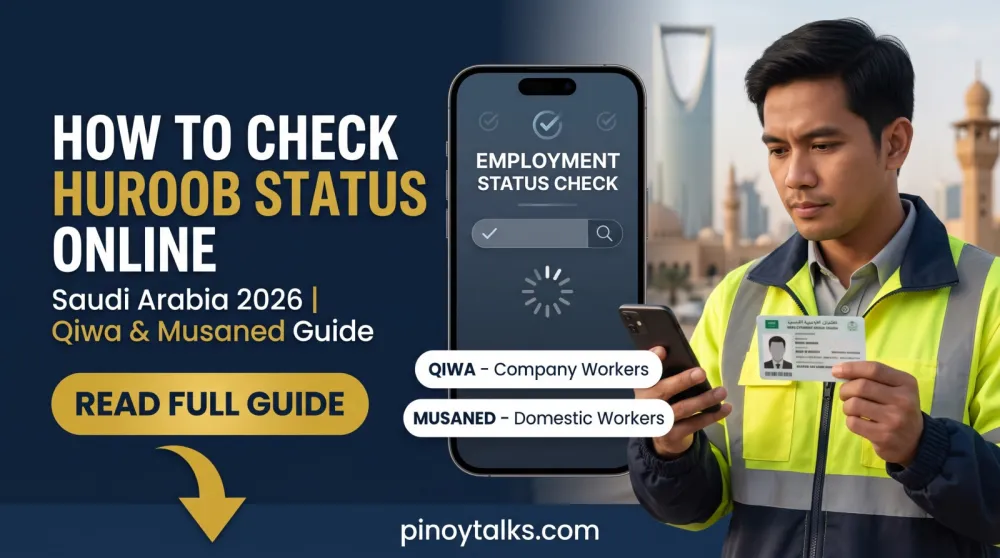
How to Check Huroob Status Online in Saudi Arabia (2026 Guide)
If you are an Overseas Filipino Worker (OFW) in Saudi Arabia and someone tells you that you have a Huroob or Absent from Work status, do not assume the information is correct without checking your official employment record.
Some workers discover this problem when they cannot accept a new Qiwa job offer, transfer to another employer, or complete their final-exit procedures.
Others are told by their employer that they have been reported as absent, even though they believe they have a legitimate reason for not reporting to work.
How to Check Huroob Status Online in Saudi Arabia (2026 Guide)
The first step is to verify your actual status using the appropriate Saudi government system.
This guide explains:
- How to check Huroob status online using your Iqama number
- How to verify your Qiwa employment record
- What Huroob and Absent from Work mean
- The difference between work discontinuation and an absent-from-work classification
- How the 60-day period works for qualifying private-sector cases
- What to do if an absence report is incorrect
- How domestic workers can verify their status through Musaned
- What legal options may remain after an absent-from-work status appears
Quick answer: Private-sector expatriate workers can start with the official
"HRSD Expatriate Employee Inquiry", using an Iqama, border, or passport number and the required verification details. They should also check their Qiwa employment records. Domestic workers under Musaned must follow a separate procedure and should not rely on the private-sector inquiry as a definitive check of their domestic-worker status.
What Does Huroob Mean in Saudi Arabia?
Huroob is a commonly used expatriate term associated with a worker who has allegedly absconded, stopped reporting to work, or been recorded as absent.
However, the term people use in conversation may not be the exact status recorded in Saudi Arabia's official employment systems.
Under the Ministry of Human Resources and Social Development (HRSD), there are important differences between the following classifications:
Status| General meaning
On the Job (على رأس العمل)| The worker is recorded as being employed or on duty
Discontinued from Work (منقطع عن العمل)| The worker is recorded as having stopped or discontinued work under an applicable procedure
Absent from Work (متغيب عن العمل)| The worker is recorded in the relevant system as absent from work
Contract Terminated| A contractual status that does not, by itself, establish whether an absent-from-work classification exists
These statuses must not be treated as interchangeable.
For example, under the applicable private-sector work-discontinuation procedure, a worker may initially be classified as Discontinued from Work and have a 60-day opportunity to complete an eligible transfer or final exit.
If the worker does not complete the required action within that period, the classification may change to Absent from Work in HRSD and connected government systems.
This process is explained in HRSD's official [Work Discontinuation Announcement] (https://www.hrsd.gov.sa/en/node/1170537).
For a broader explanation of how work absence and employment termination are regulated, read our existing guide: "Huroob in Saudi Arabia: Absent from Work Rules 2026".
How to Check Huroob Status Online Using Your Iqama Number
Saudi Arabia's Ministry of Human Resources and Social Development provides an official electronic inquiry for expatriate employee information.
The inquiry page allows a search using identification details and can return employment-status information recorded in the labor system.
Step 1: Open the Official HRSD Inquiry Website
Visit the following government service:
"HRSD – Inquire About an Expatriate Employee"
This is a Saudi Ministry of Human Resources and Social Development service.
You can also visit the official ["HRSD Service Information Page"] (https://www.hrsd.gov.sa/en/ministry-services/services/816411).
The service is known in Arabic as الاستعلام عن موظف وافد.
If the direct inquiry page is temporarily unavailable, use the official HRSD electronic services portal instead of an unofficial website requesting your personal information.
Step 2: Enter Your Identification Details
The inquiry form provides fields for:
- Border Number (رقم الحدود)
- Iqama Number (رقم الإقامة)
- Passport Number (رقم الجواز)
- Nationality (الجنسية)
- Verification Code (رمز التحقق)
You can search using an accepted identification number and the required additional information.
For most OFWs who already have an Iqama, the Iqama number is the most practical starting point.
Enter the information accurately.
Step 3: Complete the Verification Code
The website displays a verification image.
Enter the characters shown in that image into the verification field.
If the image is unclear, use the site's available refresh option.
Do not share your Iqama number or verification information with unknown people offering to perform Huroob checks for a fee.
Step 4: Submit the Inquiry
Submit the search using the button displayed on the page.
The website may return information about the expatriate worker and the employment status recorded in the HRSD system.
Review the complete record rather than relying on one translated word.
Step 5: Read the Employment Status Carefully
Depending on the record, the inquiry may indicate whether the worker is recorded as on the job or under another employment classification.
Pay attention to terms such as:
- على رأس العمل — On the Job
- منقطع عن العمل — Discontinued from Work
- متغيب عن العمل — Absent from Work
The exact information displayed may vary depending on the record and the current service interface.
Important limitation: HRSD's published service description identifies employers and businesses as intended beneficiaries of its expatriate employee inquiry service. Although an official electronic inquiry form is publicly accessible, it should not be described as a guaranteed, comprehensive self-service legal-status certificate for every worker.
If the lookup does not display your record, produces an unclear result, or conflicts with Qiwa or another government system, seek confirmation directly from HRSD.
An unsuccessful search does not prove that your status is clear.
How to Check Your Employment Status Through Qiwa
For workers employed by private-sector companies or establishments, Qiwa is another important source of employment and contract information.
Qiwa is the official Saudi platform used for services involving employment contracts, employee transfers, and other labor procedures.
Step 1: Log In to Qiwa
Open the official Qiwa Platform.
Sign in using the applicable individual account and authentication process.
If you are unfamiliar with the platform, read our [Qiwa Contract Explained: Complete Guide for OFWs] (https://pinoytalks.com/d/127-qiwa-contract-explained-complete-guide-for-ofws-in-saudi-arabia).
Step 2: Review Your Employment Contract
Open the available employment contract or employment relationship section.
Check:
- Your employer's name
- Contract status
- Contract start and end dates
- Any completed or pending termination action
- Any available work-discontinuation notification
- Any job-transfer request or related message
The exact menu names and information available may change as Qiwa updates its platform.
Step 3: Compare Your Records
If your Qiwa contract says Terminated, this does not automatically mean that you have Huroob status.
Likewise, an expired contract is not sufficient evidence, by itself, that an absent-from-work classification has been registered.
Your contract status, labor-record status, and residency status are related but distinct matters.
If an official employment-status inquiry conflicts with your Qiwa record, contact Qiwa or HRSD for clarification.
Step 4: Save Your Evidence
Keep screenshots showing the date of the inquiry and the information displayed.
If your record includes a notification, work-discontinuation date, termination date, or reference number, save those details.
These records may become important if you need to challenge an incorrect report or complete a lawful employer transfer.
What Is the Difference Between Huroob and Absent from Work?
The word Huroob is commonly used among foreign workers, but Absent from Work is a more precise classification found in Saudi employment procedures.
Another important status is Discontinued from Work.
Under HRSD's updated private-sector work-discontinuation framework:
- The employer submits an applicable request to end the employment relationship because of work discontinuation.
- The worker's employment link to that establishment is discontinued in the relevant system.
- The worker is classified as discontinued from work.
- The worker has 60 days to complete an eligible transfer or final exit.
- If neither permitted action is completed within the period, the worker's classification changes to absent from work in the relevant systems.
This is the process described in the official "HRSD Work Discontinuation Rules" (https://www.hrsd.gov.sa/en/node/1170537).
Do not confuse this 60-day regularization period with an ordinary contractual notice period.
A worker's 30-day or 60-day resignation notice is a separate matter from a statutory or administrative period for completing a transfer or final exit after work discontinuation.
The applicable pathway must be identified from the worker's actual Qiwa record.
Can an Employer Report a Worker as Huroob After Only One Day of Absence?
A single missed workday does not automatically establish that the worker has reached the absence threshold for termination under Saudi Labor Law Article 80(7).
Under Article 80(7), an employer may rely on unjustified absence as a ground for termination without an end-of-service award, notice, or compensation when the specified legal conditions are met.
The statutory thresholds include:
Type of absence without a legitimate reason| Article 80(7) threshold| Written warning
Intermittent absence in one contractual year| More than 30 days| After 20 days of absence
Consecutive absence| More than 15 consecutive days| After 10 consecutive days
The worker must also have an opportunity to state their reasons for objecting to termination under Article 80.
These are Article 80 termination conditions, not a universal statement that every electronic work-discontinuation or absence-related action follows exactly the same sequence.
An employer's administrative action and the legal validity of an Article 80 dismissal may require separate examination.
Official source: "HRSD – Saudi Labor Law Article 80" (https://www.hrsd.gov.sa/en/knowledge-centre/articles/307).
What Happens During the 60-Day Work-Discontinuation Period?
For a qualifying private-sector worker covered by the relevant HRSD procedure, the 60-day period provides an opportunity to resolve the employment situation through an authorized pathway.
Option 1: Transfer to a New Employer
A worker may be able to transfer to a new employer if the relevant Qiwa mobility requirements are satisfied.
The new employer must initiate the applicable official process.
The worker should confirm that all required approvals and system updates have been completed.
Accepting a job offer does not automatically mean the employer transfer is completed.
The employee should not begin working for a different employer merely because a transfer has been promised or an offer has been accepted.
For details about this risk, see "Before Accepting a New Qiwa Offer: 15 Things Every OFW Must Check" (https://pinoytalks.com/d/531-before-accepting-a-new-qiwa-offer-15-things-every-ofw-should-know-in-saudi-arabia).
Option 2: Complete Final Exit
The worker may pursue the appropriate final-exit procedure if eligible.
The immigration requirements, visa validity, and any outstanding restrictions must be addressed through the relevant government systems.
A verbal promise of final exit or a purchased airline ticket does not mean the immigration process is complete.
What If the 60 Days Expire?
Under the HRSD work-discontinuation framework, a worker who does not complete an eligible transfer or final exit within the prescribed period may be reclassified as Absent from Work.
That can complicate ordinary employment and immigration procedures.
Workers should confirm the actual starting date and status of the applicable process, rather than assuming they have 60 days from the date they first notice an SMS or log into Qiwa.
Can You Still Transfer After Becoming Absent from Work?
There is a lawful correction pathway for certain eligible private-sector workers, but it is not automatic.
HRSD introduced a Qiwa initiative for professional workers recorded as absent from work, effective September 18, 2025.
The initiative covers certain situations, including:
- Workers whose status became absent from work after the 60-day work-discontinuation period.
- Workers whose status became absent from work after the expiration or termination of a documented employment contract.
- Workers who had earlier absence reports before the work-discontinuation initiative.
Among the published conditions are:
- The worker must have completed at least 12 continuous months in Saudi Arabia before the relevant work discontinuation or contract expiration.
- The new employer must agree to pay outstanding work-permit-related financial dues where required.
Other transaction and employer eligibility requirements may apply.
A worker with a willing new employer should ask that employer to check the correct status-correction and transfer pathway through Qiwa.
Do not assume that an ordinary transfer request will necessarily work for an Absent from Work record.
Official reference: "HRSD – Initiative to Regularize Workers Absent from Work" (https://www.hrsd.gov.sa/en/media-center/news/%D9%85%D8%A8%D8%A7%D8%AF%D8%B1%D8%A9-%D9%84%D8%AA%D8%B5%D8%AD%D9%8A%D8%AD-%D8%A3%D9%88%D8%B6%D8%A7%D8%B9-%D8%A7%D9%84%D8%B9%D9%85%D8%A7%D9%84%D8%A9-%D8%A7%D9%84%D9%85%D8%AA%D8%BA%D9%8A%D8%A8%D8%A9-%D8%B9%D9%86-%D8%A7%D9%84%D8%B9%D9%85%D9%84%E2%80%8B).
What If Your Employer Reported You Absent Even Though You Were Working?
An incorrect or disputed absence report requires prompt attention.
For example, imagine an OFW whose employer records them as absent despite the worker having attendance logs, supervisor messages, and salary records showing that they continued to report for duty.
The existence of those documents does not automatically cancel the report, but they can help establish the facts.
Step 1: Secure the Evidence
Gather documents relevant to the disputed period, including:
- Qiwa contract and employment-status screenshots
- Attendance records and approved duty rosters
- Salary records and payslips
- Approved leave or sick-leave documentation
- Written instructions from the employer
- Relevant messages or emails
- Warning notices and your responses
- The date and reference of the disputed absence action
Keep the original documents and do not edit or fabricate evidence.
Step 2: Ask for Written Clarification
Contact the employer or HR department and request clarification regarding the absence report.
Ask for the report date, stated reason, and whether a correction or withdrawal option remains available.
Avoid relying solely on a verbal assurance that the matter has been fixed.
Step 3: Contact HRSD or Qiwa
If the report is disputed or the worker cannot resolve the issue through the employer, contact the responsible platform or authority.
For private-sector labor issues, HRSD provides assistance through 19911.
Explain the actual employment situation and request guidance on correcting or challenging the record.
Step 4: Use the Appropriate Labor-Dispute Procedure
Where a genuine employment dispute exists, the worker may use HRSD's official labor-dispute service.
The "Friendly Settlement for Labor Disputes" (https://www.hrsd.gov.sa/en/ministry-services/services/269970) service is an established channel for eligible private-sector employee disputes.
However, submitting a labor claim does not automatically cancel an Absent from Work classification, suspend an immigration requirement, or authorize employment with a different company.
The worker should ask HRSD which separate status-related action, if any, is needed while the employment dispute is being considered.
How to Check Huroob or Absence Status for Domestic Workers Under Musaned
Domestic workers do not follow the same employment-status and transfer procedure as ordinary Qiwa private-sector employees.
Workers employed by individual households—including household drivers, housemaids, domestic caregivers and similar occupations—are generally subject to the domestic-worker regulatory framework administered through Musaned.
For a more detailed explanation, read our "Musaned Domestic Workers: Complete Guide" (https://pinoytalks.com/d/126-musaned-domestic-workers-complete-guide-for-household-workers-in-saudi-arabia).
Step 1: Open the Official Musaned Platform
Visit "Musaned" (https://www.musaned.com.sa/).
Use the appropriate account access to review any available domestic-worker contract or employment information.
Step 2: Check Available Contract and Status Information
Review the information that is available under your account or employment arrangement.
If you have received an absence-related notification, preserve the message and the date.
Do not assume that a Qiwa-based private-sector employment inquiry or an ordinary company-worker contract-status screen represents the domestic worker's complete record.
Step 3: Contact Musaned for an Official Status Confirmation
If your status is unclear or an absence report has been filed, ask Musaned support to verify the relevant record and available procedures.
Official Musaned support:
Request clarification on:
- Whether an absence report exists
- The date the report was submitted
- Whether the employer can still withdraw it
- Whether an eligible transfer or final-exit route is available
- Whether a separate status-correction mechanism applies
Musaned is not simply another name for Qiwa. Its domestic-worker procedures must be examined independently.
The 60-Day Rule for Musaned Domestic Workers
HRSD confirmed the domestic-worker Work Stoppage Service through Musaned in March 2026.
The applicable route depends, among other conditions, on how long the domestic worker has been in Saudi Arabia when the relevant work stoppage occurs.
Case 1: Work Stoppage Within the First Two Years
When the employer terminates the domestic employment contract because of work stoppage during the worker's first two years after entering Saudi Arabia, the specific HRSD procedure requires the worker to complete final departure within 60 days.
Failure to leave within that permitted period can result in non-compliance with residency and labor requirements.
This is the rule for that particular work-stoppage pathway. It should not be interpreted as a blanket prohibition on every other lawful domestic-worker mobility remedy that may exist under separate rules.
Case 2: Work Stoppage After More Than Two Years
If the qualifying work stoppage occurs after two years from the worker's entry into Saudi Arabia, the HRSD framework provides for:
- Final exit, or
- Transfer to a new employer
The applicable action must be completed within the stated 60-day period, subject to the relevant eligibility and system requirements.
The HRSD announcement describes the period by reference to the work stoppage, so the worker should verify the officially recorded date.
Can a Domestic Employer Cancel an Absence Report?
HRSD's domestic-worker contractual relationship controls provide a 15-day period during which an employer may withdraw an absence report, subject to important conditions.
There are exceptions and restrictions, including circumstances connected with the worker's initial period after entry into Saudi Arabia.
Therefore, workers should not assume that every report can be withdrawn simply because fewer than 15 days have passed.
They should ask Musaned to confirm the actual withdrawal eligibility.
Official references:
HRSD – Domestic-Worker Contractual Relationship Initiative
HRSD – Musaned Work Stoppage Service, March 2026
What If a Musaned Domestic Worker Is Already Recorded as Absent from Work?
Some domestic workers with older absence or irregular-status records may have a lawful correction pathway through Musaned.
Musaned provides an official service for the Correction of Absent Domestic Worker Status, through which eligible absent domestic workers may be transferred to a new employer.
The service involves an employer submitting the transfer request, the worker's approval, required payments and completion of the connected official procedures.
However, eligibility depends on the specific record and currently applicable initiative conditions.
It is especially important not to assume that an earlier temporary grace period remains open for every newly reported case.
Workers and potential new employers should confirm eligibility using the official Musaned Absent Domestic Worker Correction Service.