How Does an Employee Become Huroob or Absent from Work in Saudi Arabia? 2026 Guide
Learn how a worker becomes Huroob or Absent from Work in Qiwa, including Article 80 absence limits, written warnings, the 60-day period, and transfer options.
Many Filipino and expatriate workers in Saudi Arabia are afraid of the word “Huroob.” It is commonly used when an employer allegedly reports a worker for running away, going AWOL, or no longer reporting for work. Under the current Saudi labor system, however, an employer simply saying “you are Huroob” does not explain the worker’s official status. Legal requirements, digital procedures, and different system classifications may apply.
How does a worker become huroob in Saudi Arabia
This guide explains how a non-Saudi private-sector employee may acquire an Absent from Work status, when Article 80 may apply, the written-warning requirements, how the 60-day period works, and whether a transfer may still be possible after the status appears.
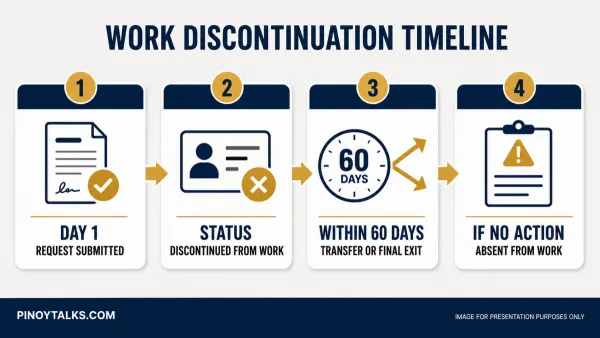
Quick answer: A worker does not automatically become Huroob after missing one or two days of work. Article 80 of the Saudi Labor Law sets absence thresholds and written-warning requirements before an employer may rely on unjustified absence as a ground for termination. After the applicable Qiwa procedure is completed, the worker may first be classified as “discontinued from work.” The worker then has 60 days to complete an eligible transfer or final exit. If no permitted action is completed during that period, the worker’s status may become “absent from work” in the relevant government systems.
This article applies to non-Saudi employees of private-sector establishments covered by Qiwa. Domestic workers—including household drivers, housemaids, and other categories managed through Musaned—are subject to a separate procedure.
What Does Huroob Mean in Saudi Arabia?
“Huroob” is a common expatriate term derived from Arabic. It is often used to describe a worker who has allegedly fled or has been recorded as absent from work. What matters most, however, is the exact status shown in the official Saudi system—not merely the term used by an employer, recruiter, or another worker.
The HRSD procedure contains an important distinction between two Arabic statuses:
** Munqati’ an al-amal: ** discontinued or interrupted from work; and
** Mutaghayyib an al-amal: ** absent from work.
English translations displayed on platforms may vary. Workers should therefore review the complete Qiwa record, any SMS notification, and their employment details. These two classifications should not be treated as identical because, in applicable cases, a 60-day process separates work discontinuation from the final absent-from-work status.
If you are unfamiliar with the platform, read Qiwa Contract Explained: Complete Guide for OFWs.
One Day of Absence Does Not Immediately Create Huroob Status
The Saudi Labor Law does not state that a worker becomes Huroob on the first day of absence. An employer may have attendance policies and disciplinary measures, but an ordinary attendance violation is different from termination based on prolonged unjustified absence.
Under Article 80 of the Saudi Labor Law, an employer may terminate a contract without an end-of-service award, notice, or compensation in specified serious cases. The worker must nevertheless be given an opportunity to state their objections to the termination.
For absence without a legitimate reason, Article 80 provides the following thresholds:
Type of unjustified absence | When is the legal threshold exceeded? | When must a written warning be issued? |
|---|
Intermittent absence within one contractual year | More than 30 days | After 20 days of absence |
Continuous absence | More than 15 consecutive days | After 10 consecutive days |
“More than 30 days” means the total must exceed 30 days, while “more than 15 consecutive days” means the continuous absence must exceed 15 days. The law also refers to a contractual year, not simply a calendar year.
What May Count as a Legitimate Reason for Absence?
Article 80(7) does not provide an exhaustive list of every possible legitimate reason. Depending on the facts, approved leave, documented illness, evidence of an emergency, official instructions, or other records may be relevant.
If you cannot report for work, take the following steps whenever possible:
- Notify your employer or supervisor promptly through an official communication channel.
- Follow the company’s leave and sick-leave procedures.
- Provide an authentic medical report or supporting document when applicable.
- Keep copies of messages, emails, attendance records, and employer acknowledgments.
- Never create, alter, or submit false documents.
Having evidence does not guarantee that a reason will be accepted, but it may be important during an internal investigation or labor dispute.
Is a Written Warning Required?
Yes. Before prolonged absence may be used under Article 80(7), the law requires a written warning:
- after 20 days of absence in the intermittent-absence case; or
- after 10 consecutive days in the continuous-absence case.
Article 80 also requires that the worker be allowed to state why they object to the termination. Separate Saudi Labor Law provisions governing disciplinary action also address written notice, investigation, and communication of a disciplinary decision.
A worker should not automatically assume that no warning exists merely because they do not remember receiving one. It may be necessary to determine whether a warning was sent to a registered address, email address, company system, or another documented channel, and to examine the evidence held by both parties.
How Does the Work-Discontinuation Process Begin in Qiwa?
The procedure depends on whether the worker has an active, documented employment contract in Qiwa.
If the Worker Has a Documented Qiwa Contract
The contract and termination reason should be handled through the applicable contract-management procedure. This should not be confused with the special absence-reporting route for a worker without a documented contract.
HRSD provides an official electronic service for termination of the contractual relationship. The process includes selecting the contract, the reason for termination, and the last working date. The legal validity of the selected reason still depends on the facts, available records, and applicable law.
If the Worker Has No Documented Employment Contract in Qiwa
According to the HRSD Procedural Guide for Work Discontinuation, the stated conditions for the special reporting service include:
- The establishment must be active, regardless of its Nitaqat range.
- The expatriate worker must not have a documented contract registered in Qiwa.
- The worker’s status must be “on the job.”
- The worker’s work permit and Iqama must remain valid for at least 60 days.
The employer or an authorized representative submits the request through Qiwa. The procedural guide states that both parties are notified by SMS, the worker is removed from the establishment’s records, and the worker is no longer counted in the establishment’s Nitaqat calculation.
What Happens After the Report Is Submitted?
Under the applicable work-discontinuation procedure, the basic sequence is:
Stage | Status or action | What may the worker do? |
|---|
Day 1 | Work-discontinuation request is submitted | The 60-day period begins |
Within 60 days | Discontinued from work | Complete an eligible transfer or final exit |
After 60 days with no permitted action | Absent from work | Status becomes irregular and is reflected in connected systems |
This is not an ordinary contractual notice period. It is a period during which the worker may regularize their status after work discontinuation.
What Can the Worker Do During the 60-Day Period?
Option 1: Transfer to a New Employer
Under the procedural guide, a new employer may submit a transfer request and the worker may approve it. For the transfer option within the basic 60-day procedure, the guide states that the worker must have been in Saudi Arabia for more than 12 months.
A verbal promise such as “we will transfer your sponsorship” is not enough. The official transfer request must be submitted, accepted, approved, and completed in Qiwa and the connected government systems.
Read the PinoyTalks guide on Transfer Employer After Contract Expiry in Saudi Arabia.
Option 2: Final Exit
The worker may pursue a final-exit route during the permitted period, subject to applicable visa and government-system requirements. Having an airline ticket is not sufficient. The worker needs a valid final-exit process and must depart within the authorized period.
For general requirements, read Final Exit Visa Rules in Saudi Arabia.
What Happens When the 60 Days Expire?
Under the HRSD rules, if the worker does not complete a transfer or final exit during the 60-day period, the status may become Mutaghayyib an al-amal, or absent from work, and may appear in systems connected with the Ministry.
At this stage, the worker may be treated as non-compliant with labor and residency requirements. Ordinary transfer and exit procedures can become more complicated. Workers should not wait until the final day because a job offer, worker acceptance, Ministry approval, and connected-system completion may require additional time.
Can a Worker Transfer After the Status Becomes “Absent from Work”?
The blanket statement that no transfer option can ever exist after an absent-from-work status appears is no longer accurate for every case.
In September 2025, HRSD announced an initiative to regularize absent professional workers through Qiwa. The announcement covers certain professional workers who:
- Became absent from work after the 60-day work-discontinuation period.
- Became absent from work following the expiration or termination of a documented contract.
- Had earlier absence reports issued before the work-discontinuation initiative was introduced.
The announced conditions include:
- The new employer must agree to pay any outstanding financial consideration connected with the worker’s work permit.
- The worker must have completed at least 12 continuous months in Saudi Arabia before the work discontinuation or contract expiration.
The initiative does not provide automatic approval. Actual eligibility and the available transaction must be confirmed and completed through Qiwa. No person should promise a guaranteed transfer because the outcome depends on the worker’s record, the new employer’s eligibility, outstanding fees, and approval by connected government systems.
Can Absent-from-Work Status Follow Contract Expiration or Termination?
Yes. The 2025 HRSD announcement expressly recognizes workers whose status became absent from work following the expiration or termination of a documented employment contract.
This does not mean every expired contract automatically becomes Huroob on the same day. The important lesson is that employment and residency status should not remain unresolved after a contract ends. The worker must complete the appropriate next step—transfer, final exit, or another procedure available through the official system.
If your contract is approaching its end date, review its expiration date, renewal clause, and notice period. See How Notice Period Works in Qiwa and How to End an Indefinite Qiwa Contract.
Does an Expired Iqama or Work Permit Automatically Cause Huroob?
Absent From Work timeline
Three separate issues should not be treated as identical:
- An expired Iqama
- An expired work permit
- An absent-from-work status
An expired Iqama or work permit is a serious compliance problem, but it is not by itself proof that the worker automatically has Huroob status. The worker should verify the actual HRSD/Qiwa status, contract record, and immigration record.
Read Expired Work Permit in Saudi Arabia: 2026 Guide for a separate explanation.
What Should a Worker Do If the Absence Report Is Incorrect or Unfair?
If a worker believes they continued reporting for work, had approved leave, possessed medical documentation, or was reported incorrectly, they should not rely only on a verbal promise that the employer will fix the record.
Secure Evidence Immediately
Keep copies of:
- The Qiwa contract and status screenshots
- SMS notifications
- Attendance logs, duty rosters, or biometric records that the worker may lawfully access
- Approved leave and medical reports
- Salary bank transfers or payslips
- Messages and emails exchanged with the employer
- Warning letters and the worker’s written response
- Any document showing the worker remained ready and available to perform the job
Request Written Clarification
Contact HR or the employer calmly and factually. Ask for the date, reason, and system action taken. Avoid threats, insults, or publicly posting confidential company records.
Use the Official Dispute Channel
If the issue is not resolved, the worker may need to contact Qiwa or HRSD and use the applicable labor-dispute procedure. Filing a complaint does not automatically prove that the employer acted incorrectly; the records and evidence of both parties still need to be reviewed.
See the step-by-step PinoyTalks guide: How to File a Labor Complaint in Saudi Arabia Online.
How May Salary, End-of-Service Award, and Other Claims Be Affected?
When Article 80 is validly applied, the law permits the employer to terminate the contract without an end-of-service award, notice, or compensation in the specified cases. Workers should not, however, automatically assume that every separate wage or financial claim also disappears.
Unpaid salary, disputed deductions, unused leave, damages, or other claims may require a separate legal assessment based on the contract, attendance records, termination reason, evidence, and the decision of the competent Saudi authority.
To understand the differences between termination provisions, read Article 77 vs Article 81 in Saudi Arabia.
Domestic Workers Follow Different Rules
The Qiwa private-sector procedure explained in this article should not be applied directly to domestic workers.
Household workers are generally covered by Musaned and the domestic-worker regulations. Under the HRSD domestic-worker contractual relationship initiative, separate rules apply depending on whether the work discontinuation occurs within or after two years from the worker’s entry into Saudi Arabia.
Separate 60-day exit or mobility rules apply, and the domestic employer has a 15-day period to cancel an absence report, subject to the stated conditions.
Before assessing a case, first determine whether the person is:
- A company or establishment employee covered by Qiwa
- A domestic worker covered by Musaned
Frequently Asked Questions
Does One Missed Workday Immediately Cause Huroob Status?
No. One missed day may create an attendance or disciplinary issue, but Article 80(7) contains specific prolonged-absence thresholds and warning requirements for termination based on unjustified absence.
How Many Days of Absence Are Required Before Article 80 May Apply?
More than 30 intermittent days in one contractual year or more than 15 consecutive days, subject to the required written warning.
When Must the Warning Be Issued?
After 20 days of intermittent absence or after 10 consecutive days, depending on the applicable case.
Can an Employer Submit an Absence Action When the Worker Has a Qiwa Contract?
A documented contract and the termination reason must be handled through the applicable contract-management procedure. The special HRSD work-discontinuation report has separate eligibility conditions, including the absence of a documented Qiwa contract.
What Is the 60-Day Period?
It is the period following the applicable work-discontinuation action during which the worker may regularize their status through an eligible transfer or final exit.
Can a Worker Transfer During the 60 Days?
It may be possible if the worker is eligible and the new employer and worker complete the official Qiwa transfer. The procedural guide refers to a more-than-12-month entry condition for transfer under this route.
Can a Worker Transfer After Becoming Absent from Work?
It may be possible for some eligible professional workers under the HRSD correction initiative, but the transfer is neither automatic nor guaranteed. Eligibility and the transaction must be checked in Qiwa.
Does an Expired Iqama Automatically Create Huroob Status?
It should not be described as automatic based only on Iqama expiration. Iqama validity, work-permit status, contract status, and absent-from-work status are separate records.
What If I Am Still Working but My Status Says Absent from Work?
Preserve attendance records, salary evidence, duty rosters, messages, and Qiwa screenshots. Request written clarification and promptly contact Qiwa or HRSD. If a dispute exists, use the applicable official complaint procedure.
Do Company Workers and Domestic Workers Follow the Same Process?
No. Company workers are generally covered by Qiwa, while domestic workers are covered by Musaned and separate absence-reporting and mobility rules.
Key Takeaways
- A worker does not automatically become Huroob after one day of absence.
- Article 80(7) sets a threshold of more than 30 intermittent days or more than 15 consecutive days of unjustified absence.
- A written warning is required after 20 intermittent days or 10 consecutive days.
- Under the applicable Qiwa work-discontinuation procedure, the worker has 60 days to complete an eligible transfer or final exit.
- If no action is completed, the worker’s status may become absent from work and appear in connected systems.
- A correction initiative exists for certain eligible professional workers, but transfer is not guaranteed.
- Qiwa employees and Musaned domestic workers do not follow the same procedure.
- Official status, documentation, and timely action matter more than hearsay or verbal promises.
Join the PinoyTalks Community
Do you have a question about Huroob, Qiwa status, employer transfer, contract termination, or final exit?
Post the relevant details of your case in PinoyTalks Ask the Community. Do not publish your Iqama number, passport number, bank details, employer login information, or other sensitive personal information.
To help the community understand your situation, include:
- Your Qiwa contract status
- Contract start and end dates
- Date of last attendance
- Date of any SMS notification or status change
- Iqama and work-permit validity
- Whether you are a Qiwa employee or a Musaned domestic worker
Disclaimer
This article is provided for general educational and informational purposes only. It is not legal advice and does not guarantee the outcome of any individual case. The actual result may depend on the employment contract, Qiwa record, Iqama and work-permit status, available evidence, employer action, and decisions of the Saudi authorities.
Digital procedures and eligibility requirements may change. Always verify your current status through official platforms such as HRSD, Qiwa, Absher, or Musaned.
Last fact-checked: August 3, 2026.