Is Saudi EOSB based on basic salary or total salary? Learn what “last wage” means and when allowances may be included under Articles 84 and 86.
Kabayan, kapag kino-compute ang End-of-Service Benefits, commonly called EOSB, isa sa pinakamadalas na tanong ng Saudi OFWs ay:
“Basic salary lang ba ang ginagamit sa EOSB, o kasama ang housing, transportation at ibang allowances?”
Maraming workers ang sinasabihan na basic salary lamang ang puwedeng gamitin. Others calculate their EOSB using the entire amount deposited into their bank account.
Neither approach is automatically correct in every case.
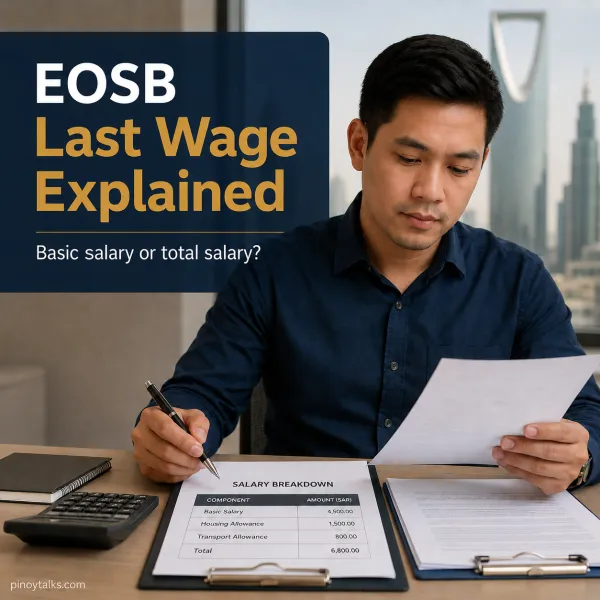
Saudi EOSB last wage
Article 84 of the Saudi Labor Law says that the worker’s last wage received is the basis for calculating the end-of-service award. The law also defines “wage” as the worker’s actual wage, which can be broader than the basic wage. However, Article 86 allows the parties to exclude certain commissions, sales percentages and similar variable wage elements under an applicable agreement.
Kabayan Question:
" Sir, kasama ba sa pag-compute ng End-Of-Service-Benefits ang allowances tulad ng food o housing or Basic salary lang talaga?"
The correct EOSB wage basis may therefore depend on:
- the worker’s basic wage;
- the allowances stated in the employment contract;
- company work regulations;
- payslips and bank records;
- whether a payment is fixed or variable;
- whether it is compensation or only expense reimbursement; and
- whether an Article 86 exclusion applies.
This guide explains what last wage, basic wage and actual wage mean, and how common salary components may affect Saudi EOSB calculations.
Quick Answer: Is EOSB Based on Basic Salary or Total Salary?
The safest general explanation is:
Saudi EOSB is calculated using the worker’s legally recognized last wage. Under the Saudi Labor Law, “wage” generally means actual wage, which may include the basic wage and other legally due wage components.
This means that EOSB is not automatically limited to basic salary in every case.
However, it is also inaccurate to assume that every amount shown in the last bank deposit must be included. A salary deposit may contain overtime, expense reimbursements, temporary incentives or other payments that do not necessarily form part of the EOSB wage basis.
Each component must be checked according to its legal and contractual nature.
The official HRSD End-of-Service Benefit Calculator also asks the user to enter the worker’s actual wage, rather than simply asking for basic salary. HRSD notes that the calculator operates automatically and that its result is an estimate rather than a binding determination.
You can also use the PinoyTalks EOSB Calculator for an initial estimate.
What Is End-of-Service Benefit?
End-of-Service Benefit is an employment entitlement that may become payable when the employment relationship ends.
Under Article 84, the full end-of-service award is generally calculated as follows:
- half a month’s wage for every year of the first five years;
- one month’s wage for every year after the first five years; and
- a proportional amount for any fraction of a year worked.
Article 84 states that the last wage received is used as the basis for the calculation.
General Article 84 formula
For the first five years:
Last wage × 0.5 × years of service
For the years after the first five:
Last wage × 1 × additional years of service
The two amounts are added together.
A reduction may then apply if the employment relationship ended through resignation under Article 85.
What Does “Last Wage” Mean?
Article 84 does not use the phrase last basic salary. It refers to the worker’s last wage received.
To understand this phrase, it is necessary to examine the definitions found in Article 2 of the Saudi Labor Law.
Basic wage
Basic wage is the amount given to the worker in return for work under a written or unwritten employment contract, including applicable periodic increments.
It is the core salary amount before considering other qualifying additions.
Actual wage
Actual wage is broader.
It consists of the basic wage plus other legally due increments granted to the worker because of:
- effort exerted at work;
- risks encountered while performing the job;
- provisions of the employment contract; or
- provisions of the employer’s work regulations.
The legal definition lists examples such as commissions, qualifying allowances, cost-of-living or family-related increments, contractual or customary rewards, and qualifying benefits in kind.
Most importantly, Article 2 states that the term “wage” means the actual wage.
This is why it is too broad to say that Saudi EOSB is always calculated using basic salary only.
Basic Wage Versus Actual Wage
Consider this simplified example:
- Basic wage: SAR 3,000
- Fixed housing allowance: SAR 800
- Fixed transportation allowance: SAR 200
- Regular monthly compensation: SAR 4,000
The basic wage is SAR 3,000.
The possible actual wage may be SAR 4,000 if the two allowances are legally recognized as fixed and due components of the worker’s compensation.
However, the inclusion of the allowances should not be assumed solely because they are called “housing allowance” or “transportation allowance.”
The worker should check:
- the Qiwa contract;
- signed employment contract;
- salary amendment letters;
- company work regulations;
- payslips;
- bank transfers; and
- how consistently the allowances were paid.
The competent authority may need to determine the correct wage basis when the employer and worker disagree.
What Article 84 Says About EOSB
Article 84 establishes three important rules:
- The first five years are calculated at half a month’s wage per year.
- The following years are calculated at one month’s wage per year.
- The worker’s last wage is the basis for calculating the award.
The worker is also entitled to a proportional award for fractions of a year worked.
For example, a worker who served for seven years and six months would generally have:
- five years under the half-month formula; and
- two years and six months under the one-month formula.
The worker does not normally have to complete another full year before the additional months can be considered.
What Article 86 Says About Variable Wage Components
Article 86 creates an important exception.
The employer and worker may agree that all or part of the following will not be included in the wage used to calculate EOSB:
- commission amounts;
- percentages from sales; and
- similar wage elements that naturally increase or decrease.
This means that variable payments are not treated in exactly the same way as a fixed monthly wage component.
For example, a salesperson may receive:
- SAR 4,000 basic wage; and
- a different sales commission every month.
The contract or another applicable agreement may contain a provision excluding all or part of that fluctuating commission from the EOSB calculation.
Article 86 does not create a blanket rule allowing an employer to exclude every allowance. It specifically addresses commissions, sales percentages and similar components that are inherently variable.
Are Housing Allowances Included in Saudi EOSB?
A fixed cash housing allowance may have a reasonable basis for inclusion when it is:
- clearly stated in the employment contract;
- legally due every month;
- regularly shown in payslips;
- consistently paid with the salary; and
- treated as part of the employee’s agreed compensation.
However, no single answer should be applied to every worker.
A monthly contractual housing allowance is different from:
- temporary hotel reimbursement;
- accommodation provided only during a business assignment;
- reimbursement of a housing receipt; or
- a discretionary payment that is not contractually due.
The substance of the payment is more important than the label used by the employer.
Are Transportation Allowances Included?
A fixed monthly transportation allowance may also support inclusion when it forms part of the worker’s contractual and regularly paid compensation.
It should be distinguished from reimbursement of actual expenses.
For example:
Possible wage component
SAR 300 transportation allowance stated in the contract and paid every month regardless of actual travel expenses.
Possible reimbursement
Repayment of SAR 185 after the worker submits fuel, taxi or travel receipts for a specific business trip.
The first payment may be part of compensation. The second is more likely to be repayment of an expense rather than payment for the worker’s services.
The actual records and contract wording remain important.
Common Salary Components and Possible EOSB Treatment
1. Basic salary
The basic salary forms part of the wage and is normally included.
2. Fixed contractual allowance
A fixed allowance that is legally due under the contract or work regulations and regularly paid may form part of actual wage.
Its inclusion should be assessed through the contract and payroll records.
3. Housing allowance
A fixed contractual cash housing allowance may potentially form part of actual wage.
Temporary housing reimbursements should not automatically be treated the same way.
4. Transportation allowance
A fixed contractual transportation allowance may potentially form part of actual wage.
Repayment of documented transportation expenses is different from a fixed allowance.
5. Hazard or risk allowance
The HRSD definition of actual wage expressly includes allowances that a worker is entitled to receive because of the effort exerted or risks encountered while performing the job.
Examples may include qualifying:
- hazard allowances;
- site-risk allowances;
- difficult-work allowances; or
- other documented risk-related compensation.
The allowance must still be legally due and supported by evidence.
6. Cost-of-living or family increment
The definition of actual wage includes increments granted according to the cost of living or to meet family-related expenses.
The worker should verify whether the payment is contractual, regulated or regularly due.
7. Commission and sales percentage
Commissions and sales percentages appear within the definition of actual wage.
However, Article 86 permits the parties to agree that all or part of these inherently variable components will be excluded from the EOSB calculation.
Workers receiving commissions should review:
- the Qiwa contract;
- commission agreement;
- sales policy;
- company work regulations;
- payslips; and
- any specific EOSB exclusion clause.
8. Bonus or reward
A bonus may form part of actual wage when it is:
- stipulated in the employment contract;
- provided under the company’s work regulations; or
- granted so regularly that workers regard it as part of their wage rather than a voluntary gift.
A purely discretionary, exceptional or one-time gift may be treated differently.
9. Benefits in kind
Benefits in kind may form part of actual wage when the employer is obligated to provide them in exchange for the worker’s services under the contract or work regulations.
The official definition states that qualifying benefits in kind are generally valued up to the equivalent of two months’ basic wage per year unless the contract or work regulations specify a higher value.
This area can be difficult to calculate. Workers should not assign their own value to employer-provided accommodation, meals or transportation without reviewing the relevant documents.
10. Expense reimbursement
Expense reimbursement is generally different from compensation for work.
Examples include repayment of:
- business travel expenses;
- hotel bills;
- fuel receipts;
- company purchases; or
- official transportation costs.
The payment records should show whether the amount was an agreed wage component or merely repayment of money spent for company business.
11. Overtime payments
Do not automatically add occasional overtime payments to the last-wage basis.
Overtime is compensation for additional hours actually worked and may change from month to month. Any unpaid overtime may remain a separate final-settlement entitlement.
For related information, read the PinoyTalks Overtime Pay Guide.
EOSB Calculation Example With Fixed Allowances
Assume the worker has the following documented compensation:
- Basic wage: SAR 3,000
- Fixed housing allowance: SAR 800
- Fixed transportation allowance: SAR 200
- Potential actual wage: SAR 4,000
- Continuous service: 8 years
- Employment ended under circumstances qualifying for the full Article 84 award
First five years
SAR 4,000 × 0.5 × 5
= SAR 10,000
Following three years
SAR 4,000 × 1 × 3
= SAR 12,000
Estimated full EOSB
SAR 10,000 + SAR 12,000
= SAR 22,000
If only the SAR 3,000 basic wage were used:
First five years
SAR 3,000 × 0.5 × 5
= SAR 7,500
Following three years
SAR 3,000 × 1 × 3
= SAR 9,000
Basic-wage-only result
SAR 7,500 + SAR 9,000
= SAR 16,500
The difference is:
SAR 22,000 − SAR 16,500
= SAR 5,500
This example shows why the correct wage classification matters.
It does not guarantee that every worker with housing and transportation allowances must use total monthly compensation. The allowances must first qualify as part of the legally recognized last wage.
How Resignation Affects the EOSB Amount
Article 84 establishes the full-award formula.
Article 85 then provides a reduced entitlement when the employment relationship ends because of the worker’s resignation.
The general Article 85 scale is:
- less than two years: ordinarily no resignation EOSB;
- at least two years but not more than five years: one-third of the award;
- more than five years but less than ten years: two-thirds of the award; and
- ten years or more: full award.
Article 87 contains exceptions under which the full award may be payable in specified circumstances, including qualifying force majeure situations.
Example using the SAR 22,000 full award
If the worker resigns after eight years and Article 85 applies:
SAR 22,000 × 2 ÷ 3
= approximately SAR 14,666.67
The reason the employment relationship ended is therefore just as important as the wage basis.
For more information about different termination situations, read:
What If the Salary in Qiwa Is Different From the Actual Salary?
A worker may find different amounts in:
- the Qiwa contract;
- signed employment contract;
- original job offer;
- salary amendment letter;
- payslips;
- bank transfers; or
- employer payroll records.
Do not ignore these discrepancies.
A documented Qiwa contract is important evidence of the employment terms. However, when the contract is absent or a worker’s entitlements are disputed, Article 51 allows the worker to establish the contract and resulting entitlements through available methods of proof.
Possible supporting evidence includes:
- bank salary transfers;
- payslips;
- signed salary increase letters;
- official HR emails;
- company payroll reports;
- Wage Protection System records available to the worker; and
- regular payment patterns.
Review your contract through the PinoyTalks Qiwa Guide.
For cases involving an unwritten or disputed contract, read Article 51: What If There Is No Written Contract?.
Documents to Check Before Accepting an EOSB Calculation
Before accepting or signing a final settlement, collect and compare:
- Latest Qiwa contract
- Signed employment contract
- Job offer
- Salary amendment letters
- Payslips
- Bank salary transfers
- Employer payroll records available to you
- Company work regulations
- Commission agreement
- Bonus policy
- Final settlement worksheet
- Employment start and end dates
- Resignation, termination or non-renewal documents
Check whether the employer used:
- basic wage only;
- basic wage plus fixed allowances;
- a previous salary instead of the final salary;
- the wrong service period;
- the wrong termination reason; or
- an Article 85 resignation percentage that does not match the facts.
Questions to Ask HR About Your EOSB
Request a detailed written computation instead of accepting only a total amount.
Ask the employer:
What last-wage amount was used?
Which wage components were included?
Which allowances were excluded?
What contractual or regulatory basis was used for each exclusion?
Was an Article 86 agreement applied?
What start date and end date were used?
Were partial years, months and days included?
What reason for ending the employment relationship was selected?
Was an Article 85 resignation reduction applied?
What deductions were made?
A written breakdown allows the worker to identify whether the disagreement concerns:
- wage classification;
- service duration;
- resignation percentage;
- contract compensation;
- unpaid salary;
- unused leave;
- overtime; or
- another deduction.
When Must the Employer Release EOSB?
Article 88 provides the general settlement deadlines after the employment relationship ends.
When the employer ends the contractual relationship, wages and entitlements must generally be settled within a maximum of one week.
When the worker ends the contract, the employer must generally settle the worker’s entitlements within a period not exceeding two weeks.
The employer may deduct a legitimate work-related debt owed by the worker from the amounts payable.
For a detailed explanation, read the PinoyTalks Article 88 Final Settlement Guide.
What to Do If You Disagree With the EOSB Calculation
1. Ask for the detailed calculation
Request a copy showing:
- wage basis;
- years, months and days of service;
- Article 84 calculation;
- Article 85 percentage, if applicable;
- allowances included or excluded;
- deductions; and
- final payable amount.
2. Compare it with your documents
Check the calculation against your:
- Qiwa contract;
- payslips;
- salary transfers;
- salary amendment letters; and
- company regulations.
3. Identify the exact disagreement
Avoid submitting only a general statement that the EOSB is “too low.”
State the exact issue.
Example:
The employer calculated my EOSB using SAR 3,000. My employment contract and payslips show SAR 3,000 basic wage, SAR 800 fixed housing allowance and SAR 200 fixed transportation allowance paid monthly. I respectfully request a written explanation of the basis for excluding the two fixed contractual allowances from the last wage used under Article 84.
This wording does not assume that the worker has already won the dispute. It requests clarification based on documented facts.
4. Do not sign without understanding the document
Before signing any final settlement or waiver, verify:
- the total amount;
- included entitlements;
- excluded components;
- payment date;
- deductions;
- release language; and
- whether the document confirms full and final settlement.
Do not sign a statement saying that all entitlements were received if the payment has not actually been received or the amount remains disputed.
5. Use the appropriate official process
When the issue cannot be resolved internally, the worker may contact HRSD or use the applicable labor-dispute process.
The procedure and result depend on the worker’s employment classification, evidence and case circumstances.
Workers may also post a privacy-safe question in the PinoyTalks Ask the Community.
Do not publicly post:
- full Iqama number;
- passport number;
- bank account details;
- contract QR codes;
- personal verification codes; or
- confidential company records containing third-party data.
Frequently Asked Questions
Is Saudi EOSB always based on basic salary?
No universal “basic salary only” wording appears in Article 84.
Article 84 uses the worker’s last wage, while Article 2 defines wage as actual wage. The correct wage basis depends on the legally recognized compensation components.
Does this mean all allowances are automatically included?
No.
The nature, contractual basis, regularity and purpose of each allowance must be reviewed.
Is a fixed housing allowance included?
A fixed and regularly paid contractual housing allowance may support an argument that it forms part of actual wage.
The final treatment depends on the contract, payroll evidence and any official determination.
Is a transportation allowance included?
A fixed contractual cash allowance may be treated differently from reimbursement of actual transportation expenses.
Are commissions included?
Commissions are included in the definition of actual wage. However, Article 86 allows an agreement excluding all or part of commission, sales percentages and similar inherently variable wage elements from the EOSB calculation.
Is a yearly bonus included?
It depends.
A contractual, regulated or customary bonus may potentially form part of actual wage. A purely discretionary one-time gift may be treated differently.
Is overtime included in the last wage?
Do not automatically include occasional overtime in the EOSB wage basis.
Overtime may fluctuate and relates to additional hours worked. Any unpaid overtime may instead be claimed as a separate employment entitlement.
What if the employer provides housing instead of paying an allowance?
A contractual benefit in kind may potentially form part of actual wage, but its valuation requires careful review of the contract and work regulations.
Is the last bank deposit always the EOSB wage basis?
No.
The deposit may include reimbursements, overtime, incentives or other temporary amounts. The components must be classified individually.
Is the HRSD calculator legally binding?
No.
The HRSD page states that the calculator operates automatically and that the Ministry is not responsible for the generated result. It should be treated as an estimation tool.
Can PinoyTalks determine whether my allowance must be included?
PinoyTalks can help explain the general rules and estimate different scenarios, but the final determination in a disputed case belongs to the competent Saudi authority or court.
Official Saudi Sources
HRSD Labor Relations: Articles 84–88
HRSD Definitions and General Provisions
HRSD Labor Education FAQ: Basic Wage and Actual Wage
HRSD End-of-Service Benefit Calculator
Official Saudi Labor Law PDF
Final Reminder for Saudi OFWs
Kabayan, huwag agad maniwala sa simpleng sagot na “basic salary lang palagi” o “lahat ng natanggap mo ay kasama.”
The Saudi Labor Law uses the worker’s last wage, and wage generally means actual wage. Actual wage may include more than basic salary, but every payment must still be classified correctly.
Before accepting your EOSB:
- check your Qiwa contract;
- review your payslips and salary transfers;
- identify fixed and variable components;
- check for an Article 86 agreement;
- confirm your exact service period;
- verify the reason the employment relationship ended; and
- request a written calculation from the employer.
A correct wage basis can make a significant difference in the worker’s final EOSB amount.
Disclaimer: PinoyTalks is an independent educational and community platform and is not affiliated with any Saudi government authority. This article provides general information based on publicly available official sources. It does not constitute legal representation, an official wage determination or a guarantee that a specific allowance will be included. Contract terms, payroll records, company regulations, termination circumstances and supporting evidence may affect each case. The competent Saudi authority or court makes the final determination when a dispute arises.
Last Reviewed: August 1, 2026