Naaksidente sa trabaho sa Saudi Arabia? Learn Articles 133–141, GOSI occupational injury rules, medical treatment, disability compensation, reporting deadlines, and OFW rights.
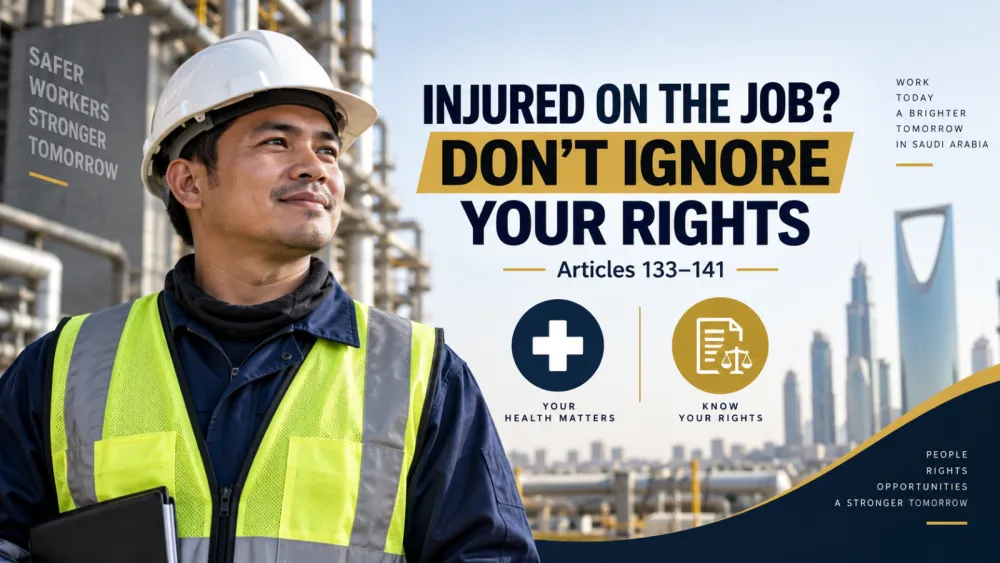
Saudi Arabia work injury compensation
Naaksidente ka habang nagtatrabaho sa Saudi Arabia?
Nasugatan habang gumagamit ng machine? Nahulog sa construction site? Naaksidente habang papunta sa isang work assignment? O nagkaroon ng sakit na posibleng dulot ng matagal na exposure sa chemicals, dust, noise, vibration, o ibang occupational hazard?
Hindi lahat ng ganitong kaso ay dapat ituring na ordinaryong sick leave lamang.
Saudi law has a specific framework for work injuries and occupational diseases, including medical treatment, temporary incapacity, disability assessment, compensation, and reporting procedures.
Articles 133–141 of the Saudi Labor Law discuss these issues.
But before using those articles, there is one extremely important rule that every OFW should understand:
Article 132 Comes First
Article 132 states that the Labor Law provisions in this work-injury chapter do not apply to establishments subject to the Occupational Hazards Branch of the Social Insurance Law.
This matters because GOSI states that the Occupational Hazards Branch applies compulsorily to covered workers without distinction based on nationality, sex, or age, and the 2% occupational-hazard contribution is paid entirely by the employer.
So for many private-sector OFWs in Saudi Arabia, a work-injury claim will primarily be handled through the GOSI Occupational Hazards system, rather than simply calculating compensation directly from Articles 133–141.
That distinction is very important.
Do not automatically assume that Article 138's three-year-wage compensation or SAR 54,000 minimum applies to every injured OFW.
The first question should often be:
Is this case covered by GOSI's Occupational Hazards system?
For a broader explanation of Saudi employment rights, see the PinoyTalks guide:
Saudi Labor Law for OFWs: Complete Guide to Your Rights in Saudi Arabia 2026
Quick Summary of Articles 133–141
Article | Main Rule |
|---|
Article 133 | Treatment and necessary medical expenses for a work injury or occupational disease |
Article 134 | Work injury follows the Social Insurance definition; occupational disease is treated as a work injury |
Article 135 | Relapse or complications are treated like the original injury |
Article 136 | Occupational diseases and disability percentages follow Social Insurance rules |
Article 137 | Temporary disability: full wage for 60 days, then 75% during treatment when this Labor Law chapter applies |
Article 138 | Compensation for permanent total disability, death, or permanent partial disability |
Article 139 | Circumstances where the employer may not be liable under Articles 133, 137 and 138 |
Article 140 | Possible liability of previous employers in occupational-disease cases |
Article 141 | Reporting procedures are determined by ministerial decision |
These provisions should always be read together with Article 132 and the applicable GOSI Occupational Hazards rules.
What Is Considered a Work Injury in Saudi Arabia?
A work injury is not limited to an accident that physically happens inside a factory, shop, office, or construction site.
Under the Social Insurance framework, an occupational injury can include an accident:
- occurring while performing work;
- caused by or related to the work;
- occurring while carrying out a task assigned by the employer;
- occurring during qualifying travel between the worker's residence and workplace;
- occurring during qualifying travel between work and the place where the worker normally eats or prays; or
- involving an occupational disease established as caused by the work.
For example, depending on the facts:
A worker injured while operating machinery during his normal shift may have an occupational-injury case.
A technician injured while traveling to carry out a task specifically assigned by the employer may also fall within the occupational-injury framework.
A worker who develops a recognized disease after prolonged occupational exposure may have an occupational-disease case.
However:
Becoming sick while employed does not automatically mean the illness is occupational.
There must be a sufficient medical and legal connection between the illness and the work.
Article 133 — Treatment and Medical Expenses
Article 133 states that where this Labor Law chapter applies, if a worker suffers a work injury or occupational disease, the employer must provide treatment and bear the necessary expenses.
These can include:
- hospital accommodation;
- medical examinations;
- laboratory tests;
- X-rays;
- prosthetic devices; and
- transportation to treatment facilities.
But again, Article 132 must be checked first.
For establishments subject to GOSI's Occupational Hazards Branch, the worker's medical care and occupational-injury benefits are handled under the applicable Social Insurance framework.
GOSI's rules provide medical care that can include:
- doctors and specialists;
- diagnostic examinations;
- hospitalization;
- necessary medicines and medical materials;
- prosthetic devices;
- rehabilitation-related care; and
- qualifying transportation connected with medical treatment.
Emergency Treatment: What If You Cannot Reach the GOSI-Designated Facility?
This is an important practical rule.
Under GOSI's Occupational Hazards regulations, in an emergency, an injured worker may go to a licensed private doctor, clinic, or hospital if the worker's condition cannot reasonably tolerate transportation to the treatment provider designated under the GOSI system.
The injured person or employer should notify the appropriate office within three days of using that emergency treatment option.
The competent medical authority then determines whether the situation qualified as an emergency. GOSI's rules also allow consideration of justified reasons for delayed notification.
So if the injury is genuinely serious or urgent:
Do not delay necessary emergency medical care just because you are unsure which hospital is designated.
But preserve all documents and make the required notification as soon as possible.
Keep:
- emergency-room reports;
- medical certificates;
- diagnostic results;
- receipts;
- accident records;
- employer notifications;
- pictures where appropriate;
- witness details; and
- any GOSI injury-report number.
Article 134 — Occupational Disease Is Treated as a Work Injury
Article 134 provides that whether an injury qualifies as a work injury is determined according to the Social Insurance framework.
It also states that an occupational disease is treated as a work injury, with the date of the first medical observation of the disease treated as the injury date.
What Is an Occupational Disease?
An occupational disease is not simply any illness suffered by someone who has a job.
GOSI defines occupational disease as a disease arising because of work in a profession or industry capable of causing that disease, subject to the applicable occupational-disease rules and medical determination.
Potential occupational exposure can involve:
- harmful chemicals;
- industrial dust;
- excessive noise;
- toxic substances;
- biological hazards;
- certain repeated physical exposures; and
- other recognized workplace hazards.
Whether a particular disease qualifies depends on the official medical and Social Insurance assessment.
Article 135 — What If the Injury Comes Back?
Sometimes a worker initially recovers from an injury but later experiences a relapse or complication.
Article 135 says that a relapse or complication resulting from the original work injury or occupational disease is treated similarly to the original injury for purposes of treatment and assistance.
GOSI also recognizes relapse or complications connected with an accepted occupational injury.
Example
A worker suffers a serious back injury after falling at work.
After treatment, he eventually returns to work.
Months later, doctors determine that a new medical problem is directly connected to the original accepted injury.
The new condition should not automatically be treated as a completely unrelated illness simply because time has passed.
Medical evidence connecting the complication to the original injury is important.
Article 136 — Who Determines the Disability Percentage?
Article 136 says occupational diseases are identified according to the occupational-disease framework under Social Insurance.
It also states that degrees of:
- permanent total disability; and
- permanent partial disability
are determined according to the applicable disability-assessment rules.
This means a worker cannot simply calculate their own disability percentage.
For example:
“Hindi ko na maigalaw nang maayos ang kamay ko, kaya siguro 50% disability ako.”
That is not enough for an official compensation calculation.
The disability percentage must be established through the competent medical process.
GOSI currently also provides a proactive occupational-disability benefit service once the competent medical committee confirms occupational disability.
Article 137 — Temporary Disability From a Work Injury
Article 137 applies where the Labor Law work-injury chapter itself applies.
The current HRSD text states:
First 60 days
The injured worker is entitled to financial assistance equivalent to the worker's full wage.
After 60 days
The worker is entitled to 75% of the wage for the remaining treatment period.
If the treatment reaches one year, or medical assessment establishes that recovery is not possible and the worker's health prevents continued work, the injury is treated as total disability.
The employment contract is then terminated and compensation for the injury becomes applicable.
The employer cannot recover amounts already paid to the worker during that year.
Important: Don't Confuse This With Article 117 Sick Leave
Article 137 deals with temporary incapacity caused by a qualifying work-related injury where this chapter applies.
Ordinary sickness is governed separately.
For ordinary sick leave, read:
Sick Leave in Saudi Arabia 2026: Article 117 Guide for OFWs
Under Article 117, ordinary qualifying sick leave follows a separate structure.
Therefore:
Article 117 sick leave ≠ occupational-injury compensation.
GOSI Temporary Disability Uses a Different Payment System
This is where many online explanations become inaccurate.
For an occupational injury covered under GOSI, do not simply apply Article 137's “60 days full pay, then 75%” formula.
The GOSI Occupational Hazards system has its own daily-allowance rules.
GOSI's regulations state that the daily allowance is generally calculated at 100% of the injured person's daily contributory wage.
It is reduced to 75% while the injured person is under treatment at GOSI's expense at a treatment facility or other qualifying place.
So the 75% reduction under GOSI is not simply triggered because 60 days have passed.
That is a different legal framework.
Article 138 — Permanent Disability or Death
Article 138 is one of the most misunderstood provisions in Saudi work-injury discussions.
Where the Labor Law Articles 132–141 framework applies, Article 138 provides the following:
Permanent Total Disability or Death
If the injury results in permanent total disability or death, the injured worker or eligible beneficiaries are entitled to compensation equivalent to the worker's wages for three years, subject to a statutory minimum of SAR 54,000.
Permanent Partial Disability
If the injury causes permanent partial disability, compensation is calculated according to the officially assessed disability percentage multiplied by the compensation applicable to permanent total disability.
But this does NOT mean:
“Lahat ng OFW na permanently disabled automatic may three years salary or minimum SAR 54,000 from the employer.”
That would ignore Article 132.
For establishments subject to GOSI's Occupational Hazards Branch, Article 132 excludes this Labor Law chapter from applying, and occupational-injury benefits are instead determined under the applicable Social Insurance/GOSI framework.
Before calculating compensation, determine:
- Was the worker covered or registered under the Occupational Hazards system?
- Was the accident accepted as an occupational injury?
- What wage was registered for contribution purposes?
- What disability percentage was officially established?
- Which Social Insurance provisions apply?
What If the Worker Was Not Yet Showing as Registered in GOSI?
This requires care.
Do not automatically conclude:
“Hindi ako registered sa GOSI noong naaksidente, so wala na akong occupational-injury rights.”
The Social Insurance framework recognizes circumstances where entitlement may exist even when an accident occurs during the applicable period allowed for registration.
For example, GOSI rules include exceptions involving injuries occurring during the month a worker entered employment or the following month, subject to the applicable conditions.
The Social Insurance Law also refers to injuries occurring during the prescribed period for employer or worker registration.
Therefore, the better question is:
Was the worker registered or covered, or did the injury occur within an applicable statutory registration period?
A worker should not abandon a claim solely because the employer failed or delayed in completing registration.
The actual employment start date, GOSI record, contribution history, and applicable registration rules should be checked.
Article 139 — When Can Liability Be Excluded?
Article 139 says the employer is not required to comply with Articles 133, 137 and 138 where one of the listed circumstances is proven.
These include:
- the worker intentionally caused their own injury;
- the injury resulted from deliberate misconduct by the worker; or
- without valid reason, the worker refused examination or treatment from the physician designated by the employer.
The important word here is:
Proven.
An employer cannot automatically end the discussion by saying:
“Kasalanan mo kasi ang accident.”
Ordinary negligence, human error, and deliberate misconduct are not automatically the same thing.
The actual facts and evidence matter.
What If the Worker Was Not Wearing PPE?
This question also needs a case-by-case assessment.
It is not legally safe to say:
“Walang PPE = walang compensation.”
Relevant questions may include:
- Was PPE required for that particular task?
- Did the employer actually provide the correct PPE?
- Was the equipment suitable and usable?
- Was the worker trained?
- Were safety rules communicated?
- Did the worker deliberately ignore a safety instruction?
- Did that conduct actually cause the accident?
- Did the employer comply with occupational safety obligations?
A PPE issue may be relevant evidence, but it does not automatically settle every occupational-injury claim.
Article 140 — What If an Occupational Disease Developed After Several Employers?
Occupational diseases may develop slowly.
A worker may spend years performing similar hazardous work under several employers before symptoms become serious enough to diagnose.
Article 140 addresses this issue where the Labor Law work-injury chapter applies.
The liability of previous employers is determined based on the treating physician's medical report.
Qualifying previous employers may be responsible for Article 138 compensation in proportion to the period the worker spent with them, provided the industries or occupations involved are among those capable of causing the disease.
Example
Imagine a worker who spent:
- four years working with silica dust under Employer A;
- three years doing similar work under Employer B; and
- two years under Employer C.
Later, the worker is medically diagnosed with a qualifying occupational disease.
Depending on the medical findings and applicable legal framework, the worker's earlier employment history may become relevant.
Article 141 — Reporting the Work Injury
Article 141 states that procedures for reporting work injuries are determined by ministerial decision.
For workers under the GOSI Occupational Hazards system, specific reporting deadlines are particularly important.
How Long Does an Injured Worker Have to Report the Accident?
GOSI states that the injured worker—or someone acting on the worker's behalf when appropriate—should notify the employer within seven days of:
- the injury;
- a relapse;
- a complication; or
- discovery of the occupational disease,
when the worker's condition allows.
If the notification is late, entitlement to the daily allowance for the period before notification can be affected.
However, GOSI's rules allow justified reasons for delay to be considered by the competent authority.
Practical advice
Do not wait seven days just because seven days are allowed.
If your condition permits:
Report the injury immediately.
Preferably send something in writing through:
- company email;
- HR communication;
- supervisor message; or
- another channel that creates a record.
How Long Does the Employer Have to Report the Injury?
For occupational injuries where first aid alone is insufficient, GOSI states that the employer—or someone acting on the employer's behalf—should notify the appropriate authority within three days after being informed of the injury or becoming aware of it.
The employer should therefore not simply ignore a reported work accident for weeks.
What If the Employer Refuses or Fails to Report the Work Injury?
This is especially important for OFWs.
GOSI currently provides an online Report an Occupational Injury service for individual contributors.
The worker can report the injury electronically.
The process currently allows the contributor to:
- log in;
- choose Occupational Hazard;
- select Report Occupational Hazard;
- choose Report Injury;
- enter the required information;
- upload supporting documents where available; and
- submit the report.
After submission, the report is sent to the establishment's supervisor for approval or rejection.
The employer has three working days to respond.
If the employer does not respond within that period, GOSI states that the request is automatically referred to the Social Insurance Authority for the necessary action.
Official service:
GOSI – Report an Occupational Injury
This is a particularly important option if the employer is delaying or ignoring an occupational-injury report.
Step-by-Step: What Should an OFW Do After a Work Accident?
If you suffer an accident at work, your first priority should be your safety and necessary medical treatment.
After that:
1. Inform Your Employer Immediately
Tell your supervisor, HR, or authorized representative.
Use written communication when possible.
Include:
- date;
- time;
- location;
- task being performed; and
- basic description of what happened.
2. Seek Appropriate Medical Treatment
If emergency treatment is required, get the necessary care.
Tell the medical provider truthfully how the accident happened.
Do not describe a work accident as a normal home accident merely because someone tells you to do so.
The medical record may later become important.
3. Preserve Medical Evidence
Keep copies of:
- medical reports;
- X-rays;
- laboratory results;
- prescriptions;
- discharge summaries;
- sick-leave certificates;
- surgical reports; and
- follow-up appointments.
4. Document the Accident
Where safe and appropriate, preserve evidence such as:
- photographs;
- videos;
- damaged equipment;
- site conditions;
- witness names;
- supervisor messages;
- incident reports; and
- work instructions.
Do not fabricate, alter, or exaggerate evidence.
5. Check Your GOSI Status
Determine whether the worker was:
- registered;
- covered;
- newly hired within an applicable registration period; or
- affected by an employer registration issue.
Do not rely only on a verbal statement from HR.
6. Ask Whether the Injury Was Reported
Ask for:
- the injury report;
- GOSI reference number;
- date of reporting; and
- treatment instructions.
7. Report the Injury Through GOSI If Necessary
If the employer fails to act, use the individual GOSI work-injury reporting service where applicable.
8. Follow Medical Instructions
Attend required medical examinations and treatment.
Failure to follow legitimate medical instructions without justification may affect benefits under the applicable framework.
9. Keep Your Own Copies
Do not give away the only copy of:
- your medical report;
- incident report;
- employment records; or
- correspondence.
Keep digital backups if possible.
Work Injury vs Ordinary Sick Leave
This distinction is very important.
Ordinary illness
Examples may include:
- flu;
- infection;
- an unrelated medical condition;
- non-work-related surgery;
- ordinary illness unrelated to occupational exposure.
These cases may fall under Article 117 sick-leave rules.
Occupational injury
Examples can include:
- an accident during work;
- injury caused by the work;
- injury during an employer-assigned task;
- certain qualifying commuting accidents;
- recognized occupational disease; or
- relapse or complications from an accepted work injury.
For ordinary sick leave, read:
Saudi Sick Leave Article 117 Guide for OFWs
Work Injury vs Normal Health Insurance
Your normal cooperative health-insurance policy and GOSI Occupational Hazards coverage are not the same system.
Normal health insurance handles medical coverage according to the applicable health-insurance framework and policy.
A qualifying occupational injury has its own reporting, treatment, disability, and compensation framework.
If your separate problem is that your employer has not provided active health insurance, read:
No Medical Insurance in Saudi Arabia: Complete OFW Guide 2026
Can an Accident While Going to Work Count as a Work Injury?
Potentially, yes.
The Social Insurance definition includes certain accidents occurring during the worker's usual journey:
- from residence to the workplace;
- from the workplace back home;
- from work to the place where the worker normally eats;
- from that place back to work;
- from work to the place where the worker normally performs prayers and back; and
- during travel connected with a task assigned by the employer.
However, this should not be interpreted as:
“Any road accident anywhere is automatically a work injury.”
The circumstances still need to satisfy the applicable requirements.
Who Pays the GOSI Occupational Hazard Contribution?
GOSI states that the Occupational Hazards Branch contribution is 2% of the contributory wage and that the employer bears the contribution in full for workers covered under the compulsory system.
This is separate from ordinary salary deductions or other Social Insurance branches applicable to particular categories of contributors.
What If the Employer Says: “Kasalanan Mo ang Accident”?
Do not immediately assume that means your claim is finished.
There is a difference between:
- an accident;
- ordinary worker error;
- negligence;
- deliberate misconduct;
- intentional self-injury; and
- a third party causing the accident.
Which rules apply depends on the evidence and the legal framework governing the claim.
Preserve the facts.
Do not sign a statement admitting intentional misconduct if that is not what happened.
Can the Employer Make You Sign a Waiver?
Be very careful with documents stating things such as:
“I have received all compensation.”
“I waive all claims.”
“The accident was entirely my fault.”
“This injury did not happen at work.”
Do not sign statements that are factually incorrect.
The Social Insurance Law also contains protections against agreements or settlements that improperly prejudice statutory insurance rights.
Does a Work Injury Automatically End Your Qiwa Contract?
No.
A work injury itself is not the same thing as:
- resignation;
- voluntary termination;
- non-renewal;
- ordinary sick leave; or
- abandonment of work.
Depending on the medical findings, the worker may have:
- temporary incapacity;
- ongoing treatment;
- permanent partial disability;
- permanent total disability; or
- recovery allowing a return to work.
The effect on employment therefore depends on the medical and legal circumstances.
Do not voluntarily submit a resignation simply because you suffered a work accident unless you fully understand the consequences and actually intend to resign.
Outdoor Workers and Heat-Related Risks
Outdoor workers in Saudi Arabia can face significant occupational risks from extreme heat.
Depending on the circumstances, heat-related illness may involve occupational-safety and work-injury questions.
Saudi Arabia also implements seasonal restrictions on work under direct sunlight during the hottest part of the summer.
For more information:
Midday Work Ban in Saudi Arabia: 2026 Guide for OFWs and Outdoor Workers
Frequently Asked Questions
Is every accident inside the workplace automatically an occupational injury?
No.
The circumstances must meet the applicable legal definition and the injury may need to be accepted through the relevant Social Insurance process.
Is the minimum compensation always SAR 54,000?
No.
The SAR 54,000 minimum appears in Article 138 for permanent total disability or death when the Labor Law work-injury chapter applies.
It should not be advertised as an automatic minimum payment for every GOSI-covered occupational injury.
Does Article 137 really say 60 days at full wage?
Yes.
The current HRSD work-injury text states 60 days at full wage, followed by 75% of the wage during the remaining treatment period, for cases governed by Article 137.
Is GOSI also 60 days full salary then 75%?
No.
GOSI uses a different occupational-injury daily-allowance framework.
The allowance is generally calculated at 100% of the daily contributory wage and reduced to 75% while the injured person is under treatment at GOSI's expense under the applicable rules.
What if my employer did not register me properly?
Do not automatically assume you have no rights.
GOSI rules recognize certain circumstances involving injuries occurring during applicable registration periods.
The actual employment date, registration record, contribution history, and Social Insurance rules should be checked.
How soon should I report the injury?
If your condition permits, the worker should notify the employer within seven days.
Reporting immediately is safer whenever possible.
How soon should the employer report it?
For an injury where first aid is insufficient, the employer generally has three days after being informed or becoming aware of it under the applicable GOSI rules.
Can I report the injury myself?
Yes.
GOSI currently provides an online contributor service for reporting occupational injuries.
After submission, the employer has three working days to respond. If the employer does not respond, GOSI says the report is automatically referred to the Social Insurance Authority for action.
What is the GOSI customer-service number?
GOSI currently lists 199044 for callers inside Saudi Arabia.
Final Reminder for OFWs
Kabayan, kapag naaksidente ka sa trabaho, huwag agad isipin na:
At huwag din agad maniwala na:
“Kapag kasalanan daw ng worker, wala nang kahit anong karapatan.”
Saudi Arabia has a specific occupational-injury framework.
But it is equally important to use the correct legal framework.
The safest sequence is:
Work accident → medical treatment → immediate documentation → employer notification → check GOSI coverage → occupational-injury report → official medical assessment → applicable benefits.
And remember:
Articles 133–141 should not be read without Article 132.
For establishments subject to GOSI's Occupational Hazards Branch, occupational-injury medical care and compensation are primarily determined under the applicable Social Insurance/GOSI rules.
Need Help Understanding Your Work-Injury Case?
May work accident ka sa Saudi at hindi mo alam kung na-report sa GOSI?
Sinabi ba ng company na ordinary sick leave lang kahit nangyari habang nagtatrabaho ka?
Or hindi mo makita kung may occupational-injury report na ginawa?
Post your question at PinoyTalks.com – Ask the Community.
When asking, include only the relevant facts:
- type of work;
- date of accident;
- where it happened;
- what task you were doing;
- whether your employer was informed;
- whether you received medical treatment;
- whether a GOSI injury report exists; and
- what your employer told you.
For your privacy, do not publicly post your full Iqama number, passport number, insurance number, OTP, home address, or complete confidential medical records.
Official Sources
This guide was fact-checked using current official Saudi sources, including:
Ministry of Human Resources and Social Development (HRSD)
Articles 132–141 — Prevention of Occupational Hazards and Work Injuries.
General Organization for Social Insurance (GOSI)
Social Insurance Law and Occupational Hazards provisions.
GOSI Occupational Hazards Regulations
Medical treatment, reporting, emergency treatment, daily allowance, and disability provisions.
GOSI — Report an Occupational Injury
Current electronic reporting service for contributors.
Disclaimer
PinoyTalks is an independent educational and community platform and is not affiliated with HRSD, GOSI, Qiwa, Absher, Musaned, or any Saudi government authority.
This article provides general educational information based on official Saudi sources reviewed on September 14, 2026.
It is not legal advice, medical advice, legal representation, or a guarantee that a particular work injury, occupational disease, disability assessment, or compensation claim will be approved.
Actual entitlement can depend on factors including:
- whether the worker is covered by the applicable Social Insurance system;
- GOSI registration and contribution records;
- applicable registration periods;
- the circumstances of the accident;
- whether the injury is officially recognized as occupational;
- medical reports;
- disability assessment;
- contributory wage;
- employment history;
- occupational exposure;
- reporting deadlines; and
- decisions of the competent Saudi authorities.
For an actual injury, serious medical condition, disputed disability assessment, or compensation claim, use the appropriate official Saudi channels and seek qualified professional assistance where necessary.
Last fact-checked: September 14, 2026